

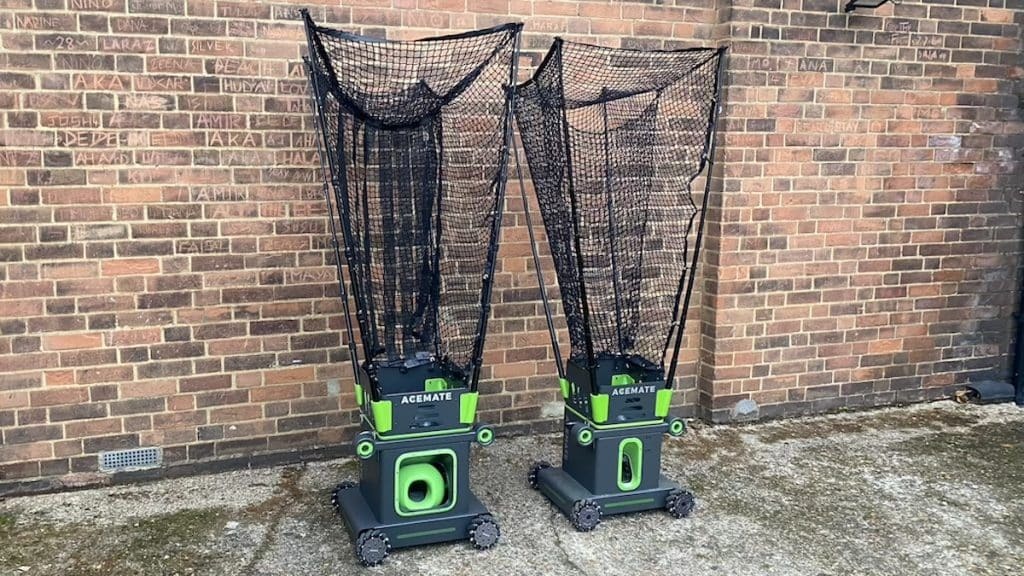
Automated tennsca_ref=11539908.espCPYTfX1FA3f&utm_source=uppromote&utm_medium=referral&utm_campaign=standard-affiliate-commission&utm_content=affiliate-Marko-Maslakovic” target=”_blank” rel=”noopener”>Acemate S10 Pro currently carries a reduced price of $2,499 USD directly from the manufacturer down from its standard $2,999 USD MSRP. This category of connected court hardware targets intermediate club players, competitive juniors, and solo athletes who want intense hitting repetition without paying hourly fees to a hitting partner or private coach.
🛒 Where to Buy: Early Black Friday
Editorial Note & Product Verification: The Cool Great Buys editorial desk independently verifies manufacturer technical specifications, cross-checks active retail availability across authorized sellers, and evaluates verified consumer reliability data before publishing product evaluations. All featured prices and promotions reflect active market rates at the time of publication.
- Early Black Friday: View on Amazon
Click the link above to check current pricing, availability, and customer reviews on Amazon.
A major pricing shakeup is hitting the tennis technology sector well ahead of the official holiday shopping rush. Fresh market dispatches on early Black Friday tennis robot deals confirm substantial cost cuts across four major connected machinery brands: Acemate, Lumistar, Pongbot, and Tenniix. Entry-level machines like the Lumistar Tero have dropped to $799 USD down from $1,099 USD, while high-end training rigs like the Pongbot Pace S Pro now sit at $1,219.99 USD after a massive $780 USD price cut. Tenniix has slashed its entry-level Basic model to $769 USD down from $899 USD, and its top-tier Tenniix S Pro down to $1,299 USD.
These temporary price drops change the value proposition for private court practice. Historically, buying a ball machine meant settling for a heavy box that tossed predictable feeds into a single spot. Modern robotic launchers use optical tracking, dynamic lateral movement, and variable top-spin motors to replicate real match play. However, high entry prices have kept them out of reach for casual players. With discounts slashing prices by up to 39%, evaluating actual hardware construction and real-world software performance becomes vital before spending your hard-earned money.
Real-World Context and Target Buyer Profile
Understanding who actually benefits from an automated hitting machine requires looking past marketing promises. Hitting against a standard static ball launcher builds static muscle memory, but it fails to prepare you for actual match conditions. Advanced tennis robots solve this by introducing active tracking, lateral court movement, and real-time feed variations. The target buyer for these machines ranges from 3.0 USTA recreational players fixing groundstroke mechanics to 4.5+ tournament competitors needing high-velocity drill conditioning.
Different price brackets target vastly different practice styles. Buyers looking for rapid court setup and basic stroke repetitions should focus on portable units like the Lumistar Tero at $799 USD. This footprint fits players who drive smaller vehicles, hit on public park courts, and want to start practice within 60 seconds of unzipping the carry bag. It offers pure convenience without forcing you to lug a 50-pound industrial appliance out of your trunk.
Conversely, intermediate and advanced players focused on tactical footwork need active horizontal movement and AI shot detection. The standard Acemate S10 at its discounted $1,799 USD point (down from $2,499 USD) targets hitters who want the machine to track their shot depth and adjust return feeds dynamically. Meanwhile, players chasing raw physical conditioning will prefer the heavy-duty drill programming found in the Pongbot Pace S Pro at $1,219.99 USD. Buying the wrong model means paying for complex sensors you will never configure or dragging a heavy machine you hate loading into your car.
Hardware Engineering, Materials, and Core Specs
Evaluating tennis robot construction reveals stark differences in chassis components, internal motor drive quality, and optical tracking hardware. Lower-tier machines rely on molded ABS plastic housings and simple counter-rotating polyurethane throwing wheels. Premium robotic systems use reinforced polycarbonate frames, brushless DC motors, dynamic motorized pan-tilt heads, and optical camera modules mounted on separate tripods or direct chassis mounts.
Chassis weight and ball capacity directly dictate structural stability during high-velocity feeds. The Lumistar Tero prioritizes lightweight portability, utilizing a compact polymer shell holding roughly 100 tennis balls. The trade-off is reduced top-end velocity and lower stability under maximum top-spin generation. In contrast, the Pongbot Pace S Pro utilizes a reinforced structural base carrying over 150 tennis balls. The heavier chassis anchors the launcher during violent directional changes, keeping feeds accurate even when pushing ball speeds past 75 mph.
In official product launch documentation, Tenniix claims its top-tier S Pro launcher delivers ball speeds up to 81 mph with real-time AI rally responses. Analyzing the hardware reality behind these claims reveals how air resistance and court physics work in practice. While internal throwing wheels can spin fast enough to launch a ball out of the chute at 81 mph, aerodynamic drag degrades that velocity significantly before the ball reaches the opponent’s baseline. Real-world landing speeds hover closer to 62 mph to 65 mph. That is still fast enough to push strong intermediate players back, but buyers expecting ATP-level 100 mph heavy groundstrokes from a portable battery-powered launcher need to adjust their expectations.
Acemate takes a distinct mechanical approach with the Acemate S10 Pro. Reduced to $2,499 USD for Black Friday, the machine sits on a physical motorized rail system that rolls horizontally along the baseline. Instead of merely pivoting its barrel, the entire launcher moves laterally across the court surface. This mechanical lateral drive requires high-torque stepper motors and a rigid base chassis. It adds physical weight, pushing the unit over 45 pounds, but delivers actual player-like court movement that static throwers cannot match.
Everyday Usability & Design Compromises
Living with a tennis robot exposes daily friction points that glossy sales pages ignore. Battery architecture, mobile software stability, ball jamming rates, and public court transport quickly separate solid engineering from overhyped tech projects. A machine that takes 15 minutes to align, calibrate, and connect to Wi-Fi ruins brief morning practice sessions before you even hit your first ball.
The Lumistar Tero excels in daily ergonomics. Setup requires setting the unit on the baseline, powering on the main switch, and pairing the included wristband controller. The simple hardware design minimizes ball jam incidents, even when using worn pressureless training balls. The wristband push-to-talk voice control allows you to pause feeds or alter drill tempos without walking over to your smartphone with a pocket full of balls. The limitation rests in its standard manual feed patterns unless you add the optional camera module for $599 USD (down from $699 USD).
Acemate’s dynamic tracking hardware environment requires more preparation. To enable reactive rally modes on the Acemate S10 or S10 Pro, you must mount an optical camera sensor behind your side of the net. The camera tracks your return depth, speed, and placement, sending data back to the machine’s processor to select the next feed. On paper, this creates a responsive hitting partner. In practice, setup on a windy public court can be frustrating. Bright sunlight reflections, shadow line shifts on hard courts, and misaligned camera tripods can cause feed delays or missed shots. When environmental conditions align, the rally simulation works impressively well, but it demands patience and calibration time before every session.
The Pongbot Pace S Pro trades visual camera tracking for pre-programmed tactical drills. Its primary daily headache is sheer bulk. Transporting its high-capacity frame requires folding down back seats in compact cars, and wheeling it across gravel or cracked asphalt paths taxes your wrists. However, once positioned on the court, its smartphone companion app offers exceptional drill customization. You can plot complex six-ball footwork patterns, adjust spin RPMs on individual feeds, and save customized routines. Jam rates remain low provided you clean court debris out of the internal ball hopper regularly.
Category Alternatives and Value Comparison
Comparing these smart tennis robots against established market alternatives reveals how rapidly connected features are redefining price expectations. Traditional non-robotic ball launchers have dominated courts for decades, but modern AI tracking hardware directly challenges their market dominance at similar price points.
The Slinger Bag Grand Slam Player Pack— $899 USD on Amazon serves as a classic hardware benchmark. The Slinger Bag built its popularity around a soft-sided wheeled luggage design that is easy to move and store. However, it relies on a single-wheel ejection system that cannot produce heavy top-spin and back-spin independently. It also lacks side-to-side motorized oscillation unless mounted on an optional turntable plate. Compared to the discounted Lumistar Tero at $799 USD, the Slinger offers integrated bag storage but falls short in shot variety, spin control, and weight efficiency. The Lumistar Tero provides dual-wheel spin generation and lighter transport weight for $100 USD less during early holiday sales.
At the higher end of the traditional market sits the Spinshot Player Tennis Ball Machine— $2,199 USD on Amazon. The Spinshot Player features a rugged aluminum body, high-velocity dual throwing wheels, and fully customizable electronic drill programming via a phone app. Its mechanical build quality is proven, but it remains a static launcher firing blind balls on predetermined timers. Comparing the Spinshot to the discounted Acemate S10 at $1,799 USD highlights the shift in consumer tech. The Acemate S10 costs $400 USD less during this sale while adding dynamic baseline movement and ball-tracking vision capabilities that the Spinshot’s traditional hardware architecture cannot offer.
Tenniix presents an interesting middle ground with its updated line. The Tenniix S Basic at $899 USD and Tenniix S Pro at $1,299 USD aggressively target the space between cheap static launchers and multi-thousand-dollar robotic systems. The Tenniix S Pro offers 81 mph max wheel speeds, scored target challenges, and real-time AI rally modes at a price that undercut older premium machines like the Spinshot by nearly $900 USD. For players wanting advanced metrics without crossing the $1,500 USD mark, Tenniix creates strong competitive pressure against legacy brands.
Final Buyer Verdict: Long-Term Ownership Value
Early Black Friday discounts make high-end tennis robots significantly more accessible, but buying decisions must match your personal court routine. If your goal is straightforward solo practice, painless court transport, and zero setup delays, the Lumistar Tero at $799 USD is the smartest overall purchase in this deal roundup. It delivers essential groundstroke repetition, clean dual-wheel spin controls, and reliable wristband operation without transforming your 45-minute morning practice into a complex software configuration task. Skip the optional vision add-on modules unless you actively plan to spend time analyzing video recordings.
For competitive intermediate hitters seeking an interactive training partner, the standard Acemate S10 at $1,799 USD stands out as the best hardware value over its high-end S10 Pro sibling. The $2,499 USD S10 Pro offers extra speed and spin headroom, but the baseline S10 provides the exact same core tracking mechanism and dynamic lateral movement for $700 USD less. Meanwhile, severe training junkies and high-level juniors should opt for the Pongbot Pace S Pro at $1,219.99 USD for its heavy-duty frame, precise multi-ball drill programming, and unyielding conditioning workouts. Pick the tool that matches how you actually practice, grab the early sale discount, and skip overpriced feature add-ons you will never roll out to the baseline.