

The Göbel Divin Monarque is an ultra-high-end floorstanding loudspeaker designed for absolute physical acoustic pressurization. The system costs $529,000 USD per pair directly through North American distributor Bending Wave USA. It targets multi-millionaire audiophiles with dedicated listening rooms backed by reinforced floor joists.
🛒 Where to Buy: Divin Monarque Loudspeakers
- Divin Monarque Loudspeakers: View on Amazon
Click the link above to check current pricing, availability, and customer reviews on Amazon.
Industry veteran Elliot Goldman presented the American debut of this German flagship in the Jackson Suite at Capital Audiofest 2026. Goldman brought decades of retail authority from Lafayette Radio, Audio Den, Lyric HiFi, and Front Row Center. He knows high-end audio inside and out. He skips marketing fluff and focuses purely on physical output capability. His demonstration paired the monolithic German speakers with a stack of Canadian electronics that rivaled the price of luxury real estate.
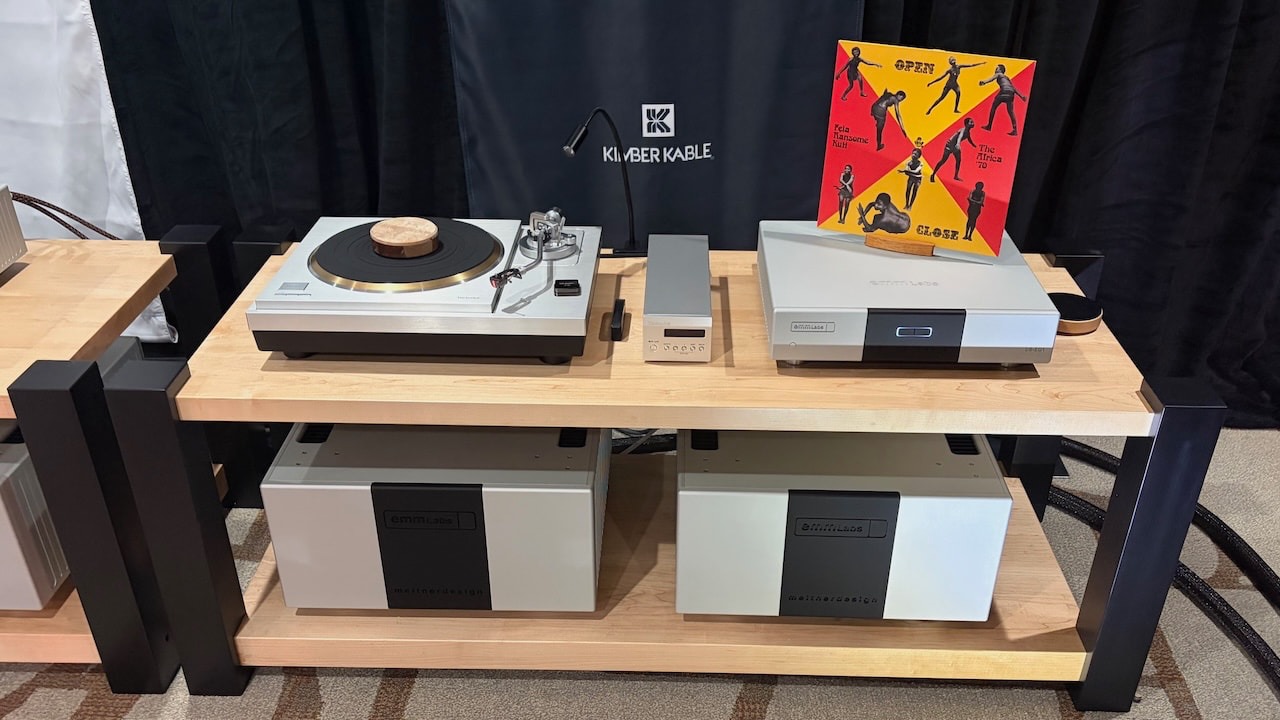
The demonstration system relied on four massive EMM Labs MTRX monoblock amplifiers running in a bi-amplified configuration. The front-end electronics included the EMM Labs PREi reference preamplifier priced at $28,900 USD and the EMM Labs DV2i DAC priced at $35,000 USD. Digital playback duty fell to the EMM Labs TXi CD/SACD transport at $13,500 USD. Kimber Kable supplied the flagship KS6068 speaker cables and PK10 power cords. The overall hardware cost in the room easily exceeded $700,000 USD. Detailed coverage of the exhibit was originally reported by eCoustics report from Capital Audiofest 2026.
Listening to low-frequency pipe organ passages on this rig changed the room atmosphere entirely. Most home speakers output notes. The Divin Monarque displaces actual air mass. It forces a physical reaction from your lungs and the floorboards. But paying half a million dollars for stereo speakers demands ruthless scrutiny. We must separate physical acoustic performance from luxury audio hype.
Core Disclosure & Hardware Announcement
The Göbel Divin Monarque represents the peak of German loudspeaker engineering. Manufacturer Göbel High End built this cabinet to eliminate acoustic limitations. Each speaker tower stands 76.4 inches tall. The cabinet spans 26.8 inches wide and reaches 33.1 inches deep. A single speaker weighs 838 pounds. A pair weighs nearly 1.7 tons combined.
You do not slide these speakers across carpet to adjust toe-in. Installing them requires structural planning and heavy machinery. The cabinets use constrained-layer damping alongside solid aluminum front baffles. Thick internal bracing controls structural resonance across all enclosure chambers. The symmetrical bass-reflex design houses dual 15-inch long-throw woofers, dual 8-inch bending-wave midrange drivers, and a single Air Motion Transformer (AMT) tweeter mounted in a custom waveguide.
Bending Wave USA sets the retail pricing for the Divin Monarque at $529,000 USD for the pair. Deliveries operate on a built-to-order basis through authorized luxury audio integrators. The target buyer is clear. This speaker belongs in custom-built listening rooms with dedicated electrical sub-panels and heavy structural floor support.
This launch also introduces an updated crossover network architecture. Göbel engineered this updated crossover to improve phase coherence between the bending-wave midranges and the AMT tweeter. Existing owners of previous Divin series speakers can contact Göbel to purchase factory crossover upgrades. Complete product specs are cataloged directly on goebel-highend.de.
Manufacturer Claims vs. Engineering Reality
In Göbel High End’s official launch documentation, the engineering team claims a sensitivity rating of 96 dB at 2.83V/1m. They list the frequency response from 21 Hz to 24 kHz with a nominal impedance of 4 ohms. Examining the fine print of the hardware documentation reveals a minimum impedance dip down to 3.2 ohms in the lower bass registers. On paper, a 96 dB rating implies an easy electrical load. In the real world, driving four 15-inch woofers down to 21 Hz demands massive current reserves.
High sensitivity ratings can mislead buyers. A speaker can produce 96 dB at 1 kHz with minimal milliwatts. But generating sustained 21 Hz organ pedal notes requires raw amplifier current. The 3.2-ohm minimum dip happens precisely where low-frequency power demands spike. That physical reality explains why Elliot Goldman used four EMM Labs MTRX monoblocks. Attempting to run these 838-pound towers with low-power tube gear will result in clipped transients and muddy bass control.
Göbel heavily promotes its proprietary bending-wave midrange technology. The manufacturer claims these 8-inch drivers eliminate typical cone break-up patterns. On paper, bending-wave drivers flex intentionally to maintain linear dispersion across midband frequencies. In practice, bending-wave units require meticulous crossover damping. If the crossover slopes fail, phase alignment between the 8-inch drivers and the fast AMT tweeter falls apart.
During the Capital Audiofest demonstration, the transition between drivers proved reliable to human ears. The AMT tweeter matched the speed of the bending-wave drivers perfectly. High-frequency transients had biting speed without harsh metallic ringing. However, claiming 21 Hz extension without subwoofers requires giant cabinet volume. The Divin Monarque delivers that volume. But it demands an enormous room to let those long bass waves develop cleanly.
Under the Hood: Technical Architecture and Build Quality
The cabinet architecture of the Divin Monarque avoids standard MDF construction. Göbel utilizes high-density composite materials bonded under extreme pressure. Metal plates sandwich the composite panels to create constrained-layer damping. This structure converts cabinet vibrations into harmless heat energy. The front baffle features thick aluminum plates machined via CNC. These plates anchor the dual 15-inch woofers securely, preventing micro-movements during violent driver excursions.
The driver arrangement follows a D’Appolito-inspired symmetrical layout. The waveguide-loaded AMT tweeter sits in the vertical center. The two 8-inch bending-wave midrange drivers sandwich the tweeter above and below. The two massive 15-inch bass drivers anchor the top and bottom sections of the enclosure. This configuration creates a virtual point-source projection. It controls vertical dispersion and reduces ceiling and floor reflections in large spaces.
The front-end electronics driving the Capital Audiofest system matched the speaker build quality. The Canadian-built EMM Labs PREi preamplifier operates in pure Class A mode. It uses dual-balanced analog signal paths from input to output. Volume control uses EMM Labs’ proprietary MVControl3 technology. This system avoids mechanical potentiometers entirely, eliminating wiper noise and channel imbalance at low listening volumes. Technical details on the signal path are hosted on emmlabs-meitner.com.
Digital conversion relies on the EMM Labs DV2i DAC. The $35,000 USD processor upsamples digital signals to 16xDSD using custom discrete converters. It accepts high-resolution streams from Qobuz, TIDAL, and Roon over network connections. The physical chassis of each EMM Labs component features thick brushed aluminum plates. Steel fasteners secure internal circuit boards against mechanical vibration. The hardware feels built like industrial laboratory equipment. Weight, thickness, and isolation define every piece of gear in this signal chain.
Verified Market Alternatives
Buyers looking at half-million-dollar Loudspeakers operate in a rare financial space. However, direct competitors offer alternative engineering approaches at lower price points. Two prominent rivals dominate this ultra-flagship category.
The Focal Grande Utopia EM EVOsells for approximately $279,999 USD per pair through authorized high-end audio dealers. The French flagship utilizes an Electro-Magnetic (EM) 16-inch woofer powered by an external power supply. It features an adjustable articulated spine. Users rotate manual cranks to align the driver cabinets precisely toward the listening position. The Grande Utopia delivers incredible dynamic snap and upper-midrange sparkle. It costs roughly half the price of the Göbel Divin Monarque. However, its aesthetic design is far more polarizing. Its cabinet dynamic damping also relies on fiberglass composites rather than Göbel’s metal-layered damping structures.
Another primary rival is the Wilson Audio Chronosonic XVX, priced at $349,000 USD per pair direct from factory-authorized dealers. The Chronosonic XVX uses an open gantry structure housing individual driver modules. It allows micro-adjustments of driver delay down to microseconds. Wilson uses proprietary X-Material and V-Material composites to eliminate cabinet resonance. The Wilson system offers superior time-domain tuning for precise seating positions. But the the model delivers a larger physical bass impact. The Göbel’s dual 15-inch woofers displace more physical air volume than the mixed woofer array in the Wilson tower.
Choosing between these ultra-flagships comes down to room architecture and sonic priorities. The Focal delivers bright, ultra-detailed sound with tunable electromagnetic bass. The Wilson provides absolute time-alignment precision for seated critical listening. The the unit offers raw physical scale, unrestricted dynamic headroom, and massive bass energy. Further event coverage and competitor listings can be explored on eCoustics Home.
Final Editorial Verdict: Long-Term Reliability Outlook
The the hardware is an extraordinary exercise in uncompromised acoustic engineering. It does not exist to solve a mass-market consumer need. It exists to push physical room pressurization to its absolute limit. During the pipe organ demonstrations, the system moved low frequencies effortlessly. There was zero audible port noise, zero driver strain, and zero cabinet vibration. The soundstage remained wide and rock-solid during massive dynamic spikes. The system preserves low-frequency definition without turning bass notes into muddy booms. The EMM Labs electronics provided endless current headroom, keeping the 838-pound towers under total control.
Is the the device worth $529,000 USD? For 99 percent of music lovers, the short answer is no. You can purchase exceptional high-end sound for a fraction of this cost. But for ultra-wealthy buyers who want total physical realism and effortless dynamic scale, this speaker delivers hardware performance that smaller boxes cannot match. The build quality suggests a multi-decade operational lifespan. The passive drivers and aluminum-reinforced enclosures will outlast most electronics. Skip this speaker if you live in an apartment or lack dedicated power lines. Buy it if you have the space, the cash, and a floor structure strong enough to hold a two-ton stereo system.