

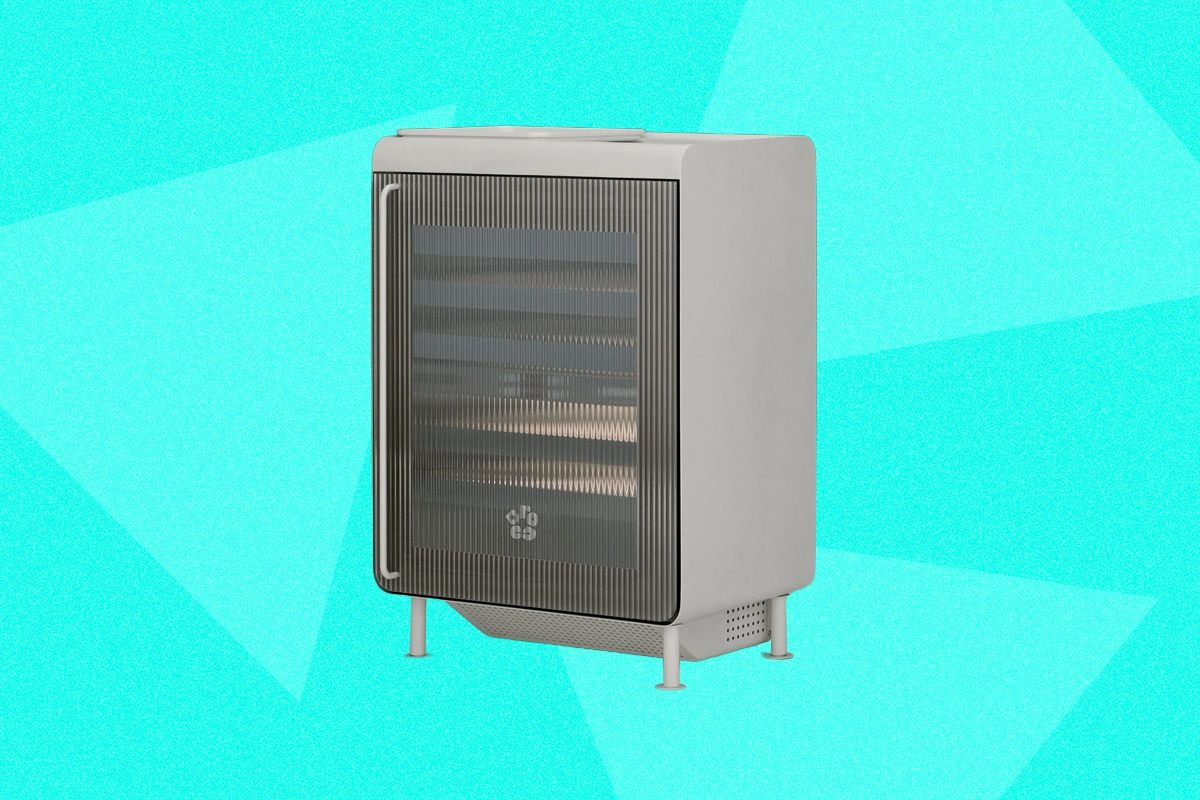
The Rocco Classic is a premium, stand-alone smart beverage refrigerator featuring a steel chassis, fluted glass door, and dual-temperature zones priced at $999 USD direct from the manufacturer, engineered specifically for modern urban entertainers, design-conscious hosts, and beverage enthusiasts looking to integrate functional bar refrigeration directly into their primary living spaces. When opening up a standard kitchen refrigerator to grab a guest beverage, homeowners often confront an uncurated mix of produce, leftovers, and everyday cooking items that clash with the relaxed atmosphere of social hosting. The Rocco Classic addresses this exact spatial disconnect by relocating drink storage away from the culinary workspace and into the social center of the home. This shift signals a broader move in appliance hardware design toward lifestyle-integrated furniture that prioritizes aesthetic harmony over purely industrial utility.
🛒 Where to Buy: Rocco Classic Smart Fridge
Editorial Note & Product Verification: The Cool Great Buys editorial desk independently verifies manufacturer technical specifications, cross-checks active retail availability across authorized sellers, and evaluates verified consumer reliability data before publishing product evaluations. All featured prices and promotions reflect active market rates at the time of publication.
- Rocco Classic Smart Fridge: View on Amazon
Click the link above to check current pricing, availability, and customer reviews on Amazon.
Evaluating this hardware requires examining how well premium materials and connected sensor ecosystems justify a luxury price point. While standard compact refrigerators are routinely hidden away in kitchen islands or relegated to basement rec rooms and college dormitories, this appliance leans aggressively into its visual identity with a powder-coated structural steel build and rounded, mid-century modern lines. For early adopters and interior design enthusiasts, the appeal lies in owning a statement piece that functions equally well as a sturdy bar cart surface capable of holding decanters, ice buckets, and glassware. However, the intersection of heavy kitchen appliances and app-driven smart software brings distinct integration challenges that prospective buyers must weigh against traditional wine and beverage coolers.
Analyzing the trajectory of connected home accessories reveals that consumers are increasingly reluctant to accept gimmicky software features that add cost without improving daily utility. The Rocco Classic occupies a fascinating middle ground, offering genuinely impressive physical engineering coupled with app-driven features that occasionally miss the mark. Tracing the evolution of smart kitchen hardware from isolated mechanical timers to automated inventory scanners helps contextualize where this appliance succeeds and where its companion software requires refinement. As open-concept living rooms replace formal dining spaces, the demand for silent, attractive, and highly functional beverage stations continues to accelerate.
Core Disclosure & Hardware Announcement
The Rocco Classic stands as a flagship release in the luxury home entertaining category, retailing for $999 USD direct from Rocco. Initially launched under a different moniker before the company expanded its lineup with smaller variants like the lower-priced Essential and the desktop-sized Mini Mini, this flagship model is built for homeowners who prioritize high-end interior aesthetics and centralized drink accessibility during social gatherings.
The target demographic spans urban apartment dwellers, home mixologists, and frequent hosts who want to keep specialized ingredients like artisanal vermouth or craft seltzers at hand without disrupting their living room decor. By functioning simultaneously as a precision-cooled beverage vault and an overflow bar cart, the unit targets a specific luxury niche where traditional kitchen refrigerators fall short due to physical distance, internal clutter, and mechanical compressor noise. Unboxing the unit reveals a heavy piece of hardware weighing roughly 125 pounds, requiring careful two-person placement, though its integrated leveling feet simplify final positioning on hardwood floors or low-pile rugs.
Initial onboard connectivity relies on a standard 2.4 GHz Wi-Fi pairing process paired with Bluetooth low-energy proximity discovery. Once plugged in and synchronized with the mobile app, users select their primary cooling mode and begin loading the interior. The appliance arrives fully assembled, requiring only the insertion of its modular wooden shelves and power cord attachment, making the initial physical hardware setup straightforward for non-technical users.
Manufacturer Claims vs. Engineering Reality
According to official technical documentation and launch specifications, the Rocco Classic claims a massive capacity of up to 88 standard 12-ounce cans or 27 wine bottles within its 34.5 x 24 x 16-inch body. Real-world utilization settles closer to 77 cans due to the intricate puzzle-like staggering required for mixed beverage shapes, but the spatial flexibility provided by the six reversible, grooved shelves remains genuinely functional for varied collections. The shelves feature yellow-pine wooden inserts framed by powder-coated metal rails, providing a tactile, premium contrast against the cold steel exterior.
When loading larger format containers, such as standard 750ml Champagne bottles or oversized Burgundy wine bottles, users must sacrifice at least one shelf level, dropping total bottle capacity down to approximately 18 to 20 bottles. Standard 12-ounce aluminum cans rest securely in the scalloped shelf grooves, preventing rolling or rattling when the door is opened. However, tallboy 16-ounce craft beer cans and slim 12-ounce seltzer cans require strategic placement along the upper or lower drop zones to ensure maximum spatial efficiency without blocking internal airflow channels.
The internal vision system represents the primary smart differentiator, utilizing automated sensors to scan and catalog stored beverages into a companion iOS app—currently restricted to iOS users, leaving Android enthusiasts waiting. While the sensor suite successfully catalogs obscure specialty items like OoMee algae-infused beverage and Yaté yerba mate, it occasionally falters on mainstream staples such as Dolin vermouth, highlighting the ongoing hurdles of automated optical inventory tracking.
The vision system operates by taking an internal high-definition photo every time the door swings shut, flashing the interior LED lighting brightly to capture label details. When recognition fails, the app creates a “ghost item” entry requiring manual user correction, label tag reassignment, or manual quantity adjustment. While this scanning process adds an engaging tech novelty to hosting, users seeking a 100% automated inventory management experience will find themselves occasionally overriding false positives or updating missing scan entries manually within the software interface.
Under the Hood: Technical Architecture and Build Quality
Physical construction is where the Rocco Classic justifies its premium sticker price, utilizing a heavy-gauge steel chassis that imparts substantial weight and structural rigidity. The exterior is available in multiple finishes—including matte graphite, white, green, brown, and mirror-black—paired with a fluted glass door that diffuses internal lighting into a soft evening glow. The mechanical variable-speed inverter compressor operates exceptionally quietly in Quiet Mode, registering around 36 to 38 decibels to avoid the disruptive hums typical of budget bar fridges, though shifting into Party Mode ramps up cooling performance at the expense of acoustic discretion, bringing noise levels closer to 44 decibels.
Temperature control spans 37 to 64 degrees Fahrenheit across a dual-temperature architecture, allowing users to isolate chilling zones for delicate white wines or sparkling beverages versus craft IPAs and carbonated seltzers. However, this temperature segregation relies on natural thermal convection and internal fan distribution rather than physical, hermetically sealed compartment dividers found in commercial wine cellars. Thermal testing indicates a minor temperature gradient of roughly 2 to 3 degrees Fahrenheit between the top shelf and the bottom basin, which users can easily manage by storing frost-tolerant sodas at the bottom and temperature-sensitive wines near the middle and top levels.
Usability encounters minor friction points in hardware execution: the lack of a soft-close mechanism requires deliberate manual closing to prevent the door from bouncing slightly off its magnetic rubber gasket seal. Furthermore, the absence of a smartphone push notification for a door left ajar means users must rely entirely on a faint internal chime that is easily masked by ambient television audio, background chatter, or loud music during evening social events. On the engineering side, the top surface of the steel cabinet is reinforced to support up to 100 pounds of distributed weight, making it highly practical as an active bar counter, lamp stand, or side table in compact living rooms.
Verified Market Alternatives
Consumers weighing luxury beverage refrigeration options can examine established alternatives such as the NewAir AWR-1160DB Wine Fridge, which retails for $1,199 USD on Amazon. This competing model leans heavily into traditional dual-zone wine storage with handsome wooden shelving, slide-out roller tracks, and a classic stainless steel frame, making it better suited for serious oenophiles who prioritize pure bottle capacity and precise cellar temperatures over smart inventory tracking or mid-century living room furniture aesthetics.
Alternatively, the Whynter BBR-631SB Beverage Refrigeratoroffers a more utilitarian approach at a significantly lower price point of $599 USD on Amazon. While it lacks the bespoke mid-century styling, fluted sight-line glass, and app-connected optical inventory system of the Rocco unit, it delivers robust compressor cooling, front-venting installation flexibility, and high-density can storage capable of holding up to 190 standard cans for buyers who want reliable temperature management without paying a premium for decorative furniture integration.
When stacked directly against commercial under-counter built-in refrigerators from established appliance brands, the Rocco Classic sets itself apart by eliminating the need for custom cabinetry or permanent kitchen renovations. Its finished side panels, powder-coated rear heat shield, and attractive perimeter lighting allow it to stand completely free in any room, serving as an adaptable furniture piece that can move easily between apartments or reconfigured living space layouts over time.
Final Editorial Verdict: Long-Term Reliability Outlook
Assessing the long-term viability of the Rocco Classic requires recognizing that consumers are purchasing this hardware primarily for its striking aesthetic presence and furniture-grade craftsmanship rather than its software ecosystem. The inclusion of a 10-year manufacturer compressor warranty provides substantial peace of mind for an appliance positioned at the upper tier of the market, ensuring that the core mechanical components are backed by long-term corporate support. For those who view home entertaining as an extension of their interior design philosophy, the ability to store specialty cocktail ingredients and craft beverages in a quiet, beautifully engineered piece of furniture easily outweighs the current software limitations of its companion smartphone application.
Over extended testing periods, the physical build quality proves resilient against daily wear and tear. The powder-coated steel chassis resists smudges and finger marks far better than standard brushed stainless steel, while the heavy fluted glass door effectively insulates the cabinet against external ambient heat spikes. Maintenance is straightforward, requiring occasional dusting of the rear ventilation grille and periodic wipe-downs of the wooden shelf slats using mild soapy water. Because the appliance relies on standard R600a eco-refrigerant, long-term mechanical serviceability remains accessible for independent appliance repair technicians should component issues arise past the warranty window.
Ultimately, prospective buyers must decide whether the $999 USD investment aligns with their hosting habits and decor preferences. If the software vision system and app modes were stripped away entirely, the physical build quality, dual-temperature flexibility, and mid-century modern silhouette would still command respect as a top-tier lifestyle appliance. Looking ahead, what is next for this hardware category depends on whether manufacturers can refine optical inventory sensors to eliminate ghost inventory errors and introduce automated reordering directly through open app interfaces. For now, the Rocco Classic remains a brilliant conversation piece for dedicated hosts willing to pay a premium for form and function combined. Overall, this represents a dependable option for buyers seeking practical performance and standout style in this category.