

🛒 Where to Buy: Featured Audio Gear & Headphones
- SVS SB-1000 Pro Subwoofer: View on Amazon
- SVS PB-2000 Pro Subwoofer: View on Amazon
- Klipsch Reference R-12SW Subwoofer: View on Amazon
Click any link above to check current pricing, availability, and customer reviews on Amazon.
Delivering reference-quality low-frequency extension requires an uncompromising physical architecture that combines massive power delivery, highly controlled driver excursion, and inert structural mass to isolate acoustic energy from the listening space. The REL Acoustics Reference No.35 and No.36 flagship subwoofers retail for $10,000 USD and $12,000 USD respectively through authorized dealers, positioning them directly within the ultra-high-end tier of dedicated home audio and multichannel theater installations. These statement pieces are engineered specifically for discerning audiophiles and home theater integrators whose primary stereo loudspeakers or front soundstages demand absolute transparency, scale, and seamless phase integration down to the infrasonic threshold. When spending upwards of five figures on a low-frequency transducer, buyers expect more than mere room-shaking vibration; they demand an organic, seamless blending with high-resolution monitors or massive floorstanding towers, ensuring that the lowest octaves possess the exact same timbral accuracy, speed, and texture as the midrange and treble.
Historically speaking, the ultra-high-end low-frequency category has oscillated between brute-force driver displacement and sophisticated acoustic suspension designs. When REL Acoustics last refreshed the apex of its catalog with the No.31 12-inch and No.32 15-inch subwoofers, the manufacturer established a rigid benchmark for high-level connectivity and musicality in complex multi-driver arrays. However, as loudspeaker designs advance in transient speed and dynamic range, low-frequency reproduction must evolve synchronously to prevent acoustic smearing. This technological push brings us to the introduction of the No.35 and No.36 models, which look to surpass their predecessors through radical architectural changes rather than superficial cosmetic alterations. In elite listening rooms where source components extract micro-dynamics from vinyl grooves and high-resolution digital files alike, any lag or overhang in the bass response instantly betrays the presence of the subwoofer, pulling the listener out of the musical illusion and shattering the soundstage cohesion.
State of the Category & What Changed
The high-end audio landscape has long debated the merits of closed-box acoustic suspension designs versus ported multi-driver monoliths. While competitors like SVS frequently focus on maximizing sheer room-shaking output and infrasonic pressure via ported enclosures, REL Acoustics maintains an unwavering commitment to musical integration, speed, and transient fidelity. The transition from the 2022 flagship generation to the current No.35 and No.36 platforms represents a fundamental redesign of both amplification and driver mechanics. Rather than simply scaling up older topologies, the engineering team rebuilt the foundation of their flagship line to address the rigorous demands of modern ultra-resolution source components. Sealed cabinet alignments have traditionally favored transient attack and group delay performance over maximum efficiency, requiring monumental amplifier power and exceptionally robust driver motors to push significant volumes of air without compressing or distorting at high listening levels.
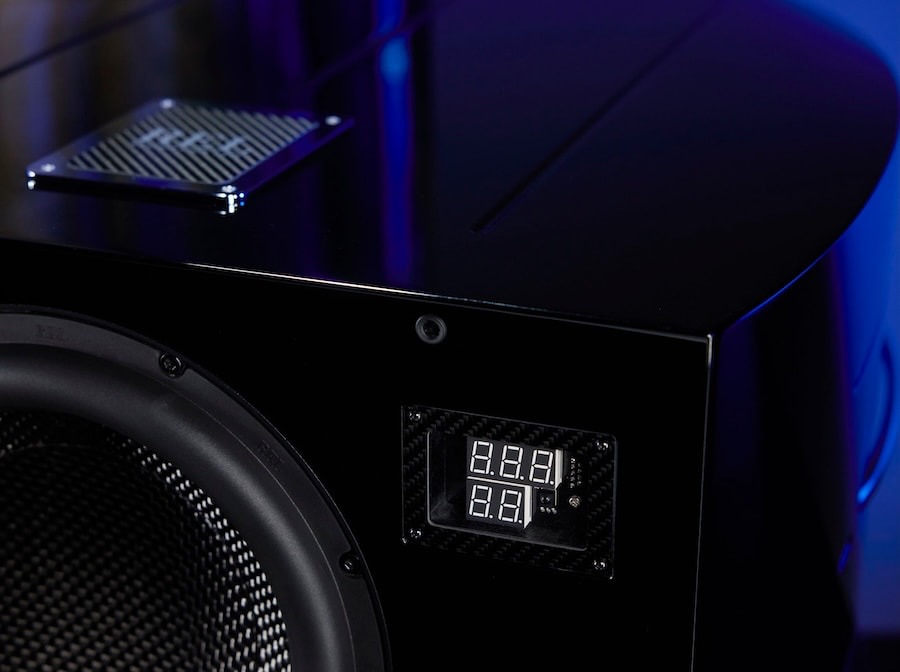
According to technical documentation published with this release, the core architectural shift centers on a proprietary Class AB/D amplifier topology designed to marry the high current delivery of traditional Class A/B circuitry with the thermal efficiency of Class D output stages. The smaller No.35 unit generates 900 watts RMS, while the larger No.36 pushes output to 1,000 watts RMS. Powering these stages is a formidable 17-pound toroidal transformer, an inclusion that signals a departure from lightweight switching power supplies in favor of uncompromised transient current reserves. John Hunter, REL President and Lead Designer, noted in launch briefs that the amplifiers served as the catalyst for the entire project, forcing a complete re-engineering of the matching carbon fibre transducer assemblies to keep pace with the enhanced electronic control. When complex orchestral crescendos or thunderous cinematic explosions demand instant current, this heavy linear power supply provides the necessary torque to snap the heavy carbon cones back into position with zero lingering resonance or thermal sag.
Generational Delta: The Engineering Upgrades That Matter
Examining the physical differences between the outgoing models and the new flagships reveals substantial mechanical improvements. The No.36 utilizes a 15-inch (380mm) reference driver upgraded with 12K Pure Carbon Fibre technology and a revised suspension geometry designed to permit significantly greater linear cone excursion. Meanwhile, the No.35 features a redesigned 12-inch (300mm) driver housed in a rigid cast-aluminium frame with an overhauled suspension system that yields an additional 12mm of travel in each direction compared to the previous No.31 generation. By adopting a finer 12K carbon fibre weave, the engineering team achieved a quieter, stiffer cone that maintains pistonic motion under extreme thermal and mechanical stress. This reduction in cone flexing minimizes harmonic distortion products that would otherwise cloud the lower midrange, allowing vocals and acoustic instruments to float freely above an exceptionally clean, articulate foundational bass layer.
Beyond raw driver mechanics, the physical enclosures reflect a meticulous approach to structural resonance control. Inspired by classical wooden runabout watercraft and informed by the design philosophy of Franco Serblin, each cabinet receives 12 coats of hand-rubbed piano black lacquer interspersed with extensive internal bracing. This inert housing ensures that mechanical energy is translated entirely into acoustic output rather than cabinet vibration. Furthermore, the physical dimensions of the No.35 (25.12 x 17 x 28.5 inches) and the No.36 (29 1/4 x 21.3 x 32 1/8 inches) match their immediate predecessors down to the millimeter. This deliberate retention of form factor allows existing owners to integrate the new flagships into established multi-unit configurations without disrupting spatial clearances, ensuring that custom-built cabinetry, acoustic wall panels, and precise speaker positioning parameters remain entirely undisturbed during an upgrade cycle.
Everyday Usability Trade-Offs & Adoption Barriers
Integrating ultra-high-end subwoofers into a domestic listening environment involves distinct physical and operational compromises. Weighing in at 130 lbs (59 kg) for the No.35 and a staggering 202.5 lbs (91.8 kg) for the No.36, these units demand careful placement and strong structural flooring. Maneuvering equipment of this mass requires professional assistance, particularly if an owner intends to utilize REL’s signature Line Array configuration. For more than two decades, these vertically stacked arrays have represented the brand’s ultimate expression of deep bass, utilizing up to three subwoofers secured via milled-aluminum REL Couplers (Line Array Connectors) to form an extremely rigid bass tower that distributes low-frequency nodes evenly throughout the listening space. Building a three-unit line array per channel transforms the listening room into a acoustically optimized environment where vertical wavefront distribution minimizes floor-to-ceiling boundary cancellations, though it also quadruples the financial and physical footprint of the playback system.
Operational complexity also scales with the hardware. While the units provide comprehensive connectivity—including high-level Neutrik Speakon inputs, low-level stereo RCA and XLR, and dedicated LFE channels—proper calibration demands patience and acoustic literacy. The included Reference remote control and dual parametric filters allow for precise tuning, but the sheer performance ceiling of these subwoofers means they will ruthlessly expose inadequacies in upstream source components, room acoustics, or primary loudspeakers. Listeners residing in multi-family housing or spaces with lightweight drywall should also consider structural vibration management, as the sheer energy output can easily excite building framing and trigger neighbor disputes before the drivers reach their physical limits. Additionally, the inclusion of REL’s signature high-level connection method—which mirrors the exact amplifier signal feeding the main speakers—requires careful wiring alongside speaker cables, rewarding those willing to experiment with phase settings and gain matching with a degree of musical coherence that traditional line-level RCA connections simply cannot replicate.
Category Alternatives and Rival Solutions
While the investment required for REL’s flagship offerings is substantial, the ultra-high-end low-frequency market hosts several formidable competitors catering to different acoustic priorities. For buyers seeking massive output and extended driver diameters without crossing into five-figure territory, the SVS 17-Ultra Evolutionseries presents an aggressive alternative. Priced below $3,000 USD on Amazon, these units deploy massive 17-inch drivers driven by high-powered Class D amplifiers capable of pressurizing expansive home theater rooms with earth-shattering infrasonic output, though they lack the specific high-level Neutrik Speakon connection philosophy championed by REL for seamless 2-channel musical integration. Where the SVS design prioritizes raw kinetic displacement and smartphone-app-driven digital room correction for high-impact movie soundtracks, the REL flagships focus on organic transient speed, delicate harmonic decay, and the tactile realism of acoustic double basses and pipe organs.
Another notable alternative in the high-performance space is the PS Audio Foundry F12, which retails for $2,749 USD direct. The F12 equips a 12-inch driver with a 1,000-watt amplifier, onboard DSP, wireless capabilities, and physical stackability, offering a balance of modern digital flexibility and traditional power delivery. However, neither SVS nor PS Audio replicates REL’s specific approach to vertical Line Array integration or the artisanal cabinet finishing characterized by 12 coats of hand-rubbed lacquer. Buyers must weigh whether they prioritize raw decibel output per dollar or the refined transient speed, high-level connectivity, and aesthetic furniture-grade execution that justify REL’s premium pricing structure. For the uncompromising audiophile whose listening sessions encompass complex classical masterworks, delicate jazz trios, and reference-grade multichannel film scores alike, the meticulous engineering choices embedded within the No.35 and No.36 platforms provide an unmatched level of refinement.
Final Trajectory Verdict: Future Outlook & Buying Advice
The release of the Reference No.35 and No.36 subwoofers confirms that REL Acoustics remains committed to iterative, engineering-led refinement rather than marketing-driven gimmickry. By pairing a high-current Class AB/D amplifier architecture with advanced 12K carbon fibre cones and heavier transformer designs, the manufacturer has successfully elevated transient precision and low-frequency authority without abandoning its core design principles. The backward compatibility engineered into these cabinets ensures that legacy owners can upgrade their systems incrementally rather than discarding prior investments, a pragmatic touch that softens the blow of flagship pricing. As high-end audio systems continue to push the boundaries of resolution, having a low-frequency foundation capable of keeping absolute pace with lightning-fast planar magnetic panels or diamond-dome tweeters becomes an absolute necessity rather than a luxury.
Ultimately, recommending products priced at $10,000 USD and $12,000 USD requires a specific target audience. These subwoofers are not intended for casual media consumption or modest budget builds where simpler alternatives will suffice. They are precision instruments built explicitly for reference-grade stereo and multichannel systems capable of revealing the subtle nuances of scale, texture, and phase alignment that define elite audio reproduction. For listeners equipped with world-class primary loudspeakers and the acoustic environment to support them, the No.35 and No.36 represent a formidable investment in absolute musical and cinematic realism, delivering an authoritative low-end presentation that honors the original recording session with breathtaking fidelity and mechanical mastery.