

🛒 Where to Buy: Featured Smartwatches & Fitness Trackers
- Google Pixel Watch 3: View on Amazon
- Samsung Galaxy Watch 6: View on Amazon
- Omron HeartGuide Blood Pressure Watch: View on Amazon
Click any link above to check current pricing, availability, and customer reviews on Amazon.
Google smartwatch hardware engineering incorporates miniature impedance plethysmography sensor technology designed to measure vascular blood pressure signals directly through fingertip contact. The component hardware architecture carries an estimated projected retail baseline of $399.00 USD on Amazon when integrated into future flagship wearable form factors. This advanced diagnostic tracking capability targets fitness enthusiasts and cardiac health monitors requiring clinical-grade cardiovascular data without traditional inflatable arm cuffs. By shifting toward electrical impedance measurements rather than relying exclusively on conventional optical light emitters, Google aims to overcome the notoriously difficult hurdles that have long plagued wrist-worn health monitoring devices.
Tracking vascular health from the wrist remains one of the hardest engineering challenges in modern consumer technology. Traditional oscillometric blood pressure monitors rely on physical inflation to restrict arterial blood flow completely, using a mechanical bladder that squeezes the arm to detect the exact moment blood begins to surge through the brachial artery again. Smartwatch manufacturers cannot fit motorized pumps and heavy rubber bladders into a slim wrist casing without sacrificing battery life, structural integrity, and daily wearing comfort. Google is tackling this hurdle by shifting the sensing paradigm away from continuous passive optical tracking and toward active electrical impedance measurements that require deliberate user interaction, thereby bypassing the physical spatial constraints imposed by micro-pneumatic pumps.
Core Disclosure & Hardware Announcement
The September patent filing details a miniaturized impedance plethysmography system built into portable computing devices. Examining the patent documentation reveals a layout utilizing four distinct electrodes placed underneath a fingertip contact area. Two electrodes introduce a minute electrical excitation signal through human tissue, while the remaining pair measures the resulting electrical response. This design marks a major pivot from traditional photoplethysmography sensors that rely solely on green or infrared light emission to detect blood volume changes, offering a fundamentally different physical mechanism for cardiovascular assessment.
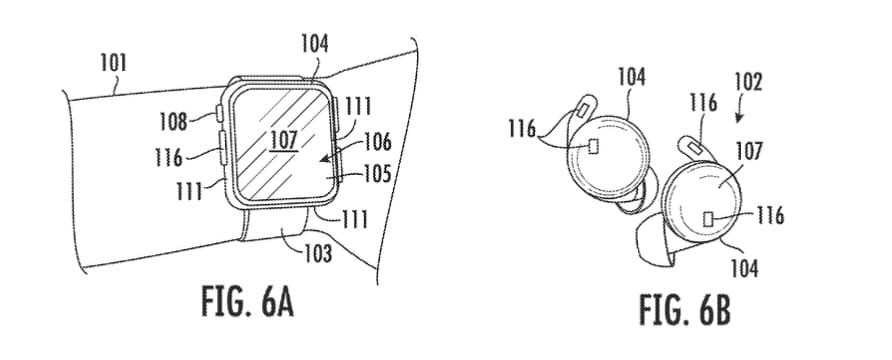
Hardware integration extends well beyond a single form factor according to the filing diagrams. Engineers mapped out placements for standard wrist-worn smartwatches, dedicated finger rings, true wireless earbuds, and mobile handsets. The watch implementation features a specialized contact zone on the chassis bezel or case body where users can deliberately rest a finger. This active sampling method ensures reliable signal acquisition by reducing motion artifacts that plague continuous passive optical wrist sensors during physical exercise. When a user initiates a reading, placing an index finger on the designated bezel zone completes the circuit, allowing the device to capture clean, uncorrupted vascular waveforms free from the severe noise introduced by arm swing and tendon movement.
Looking closer at the physical layout described in the engineering blueprints, the hardware leverages advanced micro-fabrication techniques to embed conductive contact points directly into the exterior housing without disrupting the sleek aesthetic of the device. The integration requires a dedicated analog front-end chip capable of processing micro-currents with extreme precision. While standard health wearables focus heavily on continuous background data collection, this patent embraces an intentional, point-in-time testing methodology. By requiring the user to sit still and apply gentle, consistent pressure to the sensor pad, the system minimizes the behavioral variables that usually invalidate casual blood pressure estimates captured passively during hectic daily routines.
Furthermore, the multi-device versatility outlined in the documentation suggests that Google is designing a unified health telemetry hardware environment. A user might capture a baseline reading using a smart ring in the morning, cross-verify it with a smartwatch mid-day, and analyze the aggregated trends through a companion smartphone application. This modular hardware philosophy ensures that the underlying impedance plethysmography technology is not shackled to a single chassis design, granting hardware teams the flexibility to iterate on electrode placement across diverse product categories while maintaining consistent algorithmic processing standards.
Manufacturer Claims vs. Engineering Reality
According to technical documentation published with this release, the impedance plethysmography architecture calculates blood pressure by tracking the changing electrical impedance of blood flow. When blood pulses through digital arteries, the electrical resistance of the tissue shifts measurably. The internal processor translates this pulsatile waveform into an estimated blood pressure reading. On paper, this eliminates the bulky cuff mechanism entirely while delivering actionable cardiovascular insights. Manufacturers claim that this direct electrical interrogation provides a faithful representation of arterial elasticity and pulse wave velocity, translating complex bio-impedance data into familiar systolic and diastolic numbers.
Hardware reality introduces significant hurdles that patent diagrams conveniently ignore. Human skin impedance varies wildly based on hydration levels, ambient temperature, and surface oils. A dry fingertip will yield entirely different electrical resistance values compared to a sweaty or cold digit. Furthermore, the signal-to-noise ratio in peripheral extremities makes consistent calibration notoriously difficult. Achieving clinical accuracy requires continuous algorithmic compensation for skin moisture and electrode contact pressure, variables that a standard consumer smartwatch struggles to isolate consistently in real-world environments without frequent manual reference calibrations against a validated arm cuff.
Another major engineering hurdle involves the physiological differences among individual users. Factors such as peripheral neuropathy, calloused skin on fingertips from manual labor, and varying subcutaneous fat distributions can profoundly alter the electrical path traveled by the excitation current. If the current bypasses the targeted digital arteries or encounters excessive resistance from the stratum corneum, the resulting waveform becomes distorted, leading to erroneous blood pressure calculations. Real-world testing of similar bio-impedance prototypes often reveals high sensitivity to user technique; pressing too hard or too softly on the sensor pad changes the contact area and alters the measured impedance, introducing user-induced variance that sophisticated software algorithms must actively filter out.
Moreover, environmental changes pose a persistent challenge to uncalibrated electrical sensors. Rapid transitions from a cold outdoor environment to a warm indoor room cause peripheral vasoconstriction and vasodilation, radically shifting skin resistance profiles within minutes. Unless the device incorporates auxiliary environmental sensors to dynamically adjust its internal calculation matrices, these rapid physiological shifts will trigger false readings. Overcoming these real-world discrepancies requires extensive machine learning models trained on diverse demographic datasets, ensuring that the software can reliably distinguish between genuine cardiovascular anomalies and temporary electrical noise caused by surface skin conditions.
Under the Hood: Technical Architecture and Build Quality
The physical makeup of the proposed sensor array relies on micro-electro-mechanical systems manufacturing to keep component footprints minimal. The four-electrode configuration requires conductive metal pads integrated flush into the ceramic or titanium casing of the wearable device. These pads must resist galvanic corrosion from sweat and skin oils over years of continuous daily wear. Material science constraints mean Google must select biocompatible alloys that maintain stable electrical conductivity without triggering skin irritation during prolonged contact, ensuring that the structural integrity of the contact zones remains uncompromised by chemical exposure.
Power consumption represents another critical hardware trade-off for this implementation. Injecting an electrical excitation signal through human tissue requires dedicated analog front-end circuitry and stable power delivery from the main battery cell. While the excitation current is micro-amperes and entirely safe for human subjects, driving active impedance measurements frequently drains auxiliary power rails. This hardware overhead directly impacts overall battery runtime, forcing engineers to balance measurement frequency against daily power efficiency targets to ensure that utilizing the health feature does not severely compromise the device’s ability to last through a standard multi-day usage cycle.
Inside the chassis, the spatial arrangement of the sensor circuitry demands meticulous electromagnetic shielding. Because smartwatches house numerous high-frequency radios including Wi-Fi, Bluetooth, cellular modems, and near-field communication chips, stray electromagnetic interference can easily corrupt the delicate micro-currents measured by the impedance plethysmography hardware. Engineers must implement robust Faraday cages and differential signaling pathways to isolate the analog frontend from digital noise. This internal complexity adds weight and manufacturing cost, reinforcing why high-end materials and precise assembly tolerances are mandatory for achieving reliable signal fidelity in a commercial wearable.
Durability testing for such an exposed hardware feature also pushes modern manufacturing limits. The metal contact pads on the watch bezel or casing will inevitably face abrasion from abrasive particles, pocket lint, and accidental drops. If a scratch bridges the gap between the excitation and measurement electrodes, it can short-circuit the sensor array or introduce permanent resistance offsets that render the calibration invalid. Consequently, research and development teams must explore ultra-hard conductive coatings, such as specialized titanium nitride or diamond-like carbon composites, that protect the underlying circuitry while preserving optimal electrical conductivity across the interface boundary.
Verified Market Alternatives
Consumers seeking reliable cardiovascular tracking today must look toward established commercial alternatives currently available on the market. The Fitbit Pixel Watch 3— $349.99 USD on Amazon — relies on optical heart rate tracking and upcoming software updates like Blood Pressure Trends heading to its wearables rather than raw electrical impedance sensors. While it lacks active fingertip impedance measurement, it provides robust long-term cardiovascular pattern monitoring backed by the Fitbit Hypertension Lab study with Pixel Watch 3 owners, offering users valuable statistical insights without requiring manual physical contact sessions.
For users prioritizing medical-grade accuracy over sleek smartwatch aesthetics, the Omron HeartGuide Blood Pressure Monitor— $499.00 USD on Amazon — utilizes a traditional inflatable wrist cuff built directly into the watch band. It delivers verified oscillometric blood pressure readings compliant with clinical standards, giving cardiac patients absolute confidence in their daily tracking data. The trade-off is a notably bulkier chassis and heavier physical footprint, proving that accurate blood pressure tracking still demands mechanical air compression rather than purely electrical sensor workarounds.
Another notable alternative in the health-focused wearables category is the Samsung Galaxy Watch 6, which approaches blood pressure monitoring through optical pulse wave analysis combined with mandatory monthly calibration against a traditional upper-arm cuff. This hybrid software-hardware method allows the unit to estimate blood pressure changes over time, though it requires regular maintenance calibrations to prevent significant drift. Users evaluating these options must weigh the convenience of passive or semi-passive optical and electrical estimation methods against the absolute precision and cumbersome mechanical footprint offered by certified cuff-based wrist instruments.
When comparing these alternatives, pricing and ergonomics emerge as the primary decision points for buyers. Devices relying on software trends and optical sensors maintain slim, comfortable profiles suitable for 24/7 sleep tracking and intense athletic training, but they sacrifice standalone diagnostic certainty. Conversely, units incorporating mechanical air bladders or specialized electrical sensor arrays demand compromises in either physical bulk or measurement consistency. Understanding these distinct trade-offs helps consumers align their hardware purchases with their specific medical requirements and daily lifestyle habits.
Final Editorial Verdict: Long-Term Reliability Outlook
Google’s exploration of impedance plethysmography highlights the intense industry race to solve non-invasive blood pressure monitoring on wearable devices. While the engineering concept is sound in controlled lab environments, translating a multi-electrode fingertip sensor into a durable consumer product remains an uphill battle. Environmental factors like skin moisture and daily wear-and-tear will severely test the long-term reliability of exposed metal contact pads on a wrist-worn gadget, making material degradation and calibration stability the ultimate determinants of commercial success.
Prospective buyers should view these patent filings as a glimpse into future research and development rather than an imminent hardware release. Skipping current generation placeholders and waiting to see how Google solves the calibration drift problem in future iterations is the wisest purchasing strategy for anyone seeking definitive cardiovascular diagnostics from a wrist-worn form factor. Until physical prototypes demonstrate clinical-grade repeatability outside of controlled testing environments, traditional cuff-based monitors and established optical trend trackers remain the only dependable choices for home cardiovascular tracking and daily wellness management.
Ultimately, the integration of electrical impedance sensors into consumer electronics represents a bold step forward in portable health monitoring. If engineering teams successfully conquer the complex variables of skin resistance, motion noise, and algorithmic drift, upcoming generations of smart wearables could fundamentally transform how everyday users manage vascular health. Until those breakthroughs materialize in retail hardware shelves, consumers should approach emerging patent disclosures with measured optimism, keeping a close eye on real-world validation studies before committing hard-earned money to unproven diagnostic architectures.