

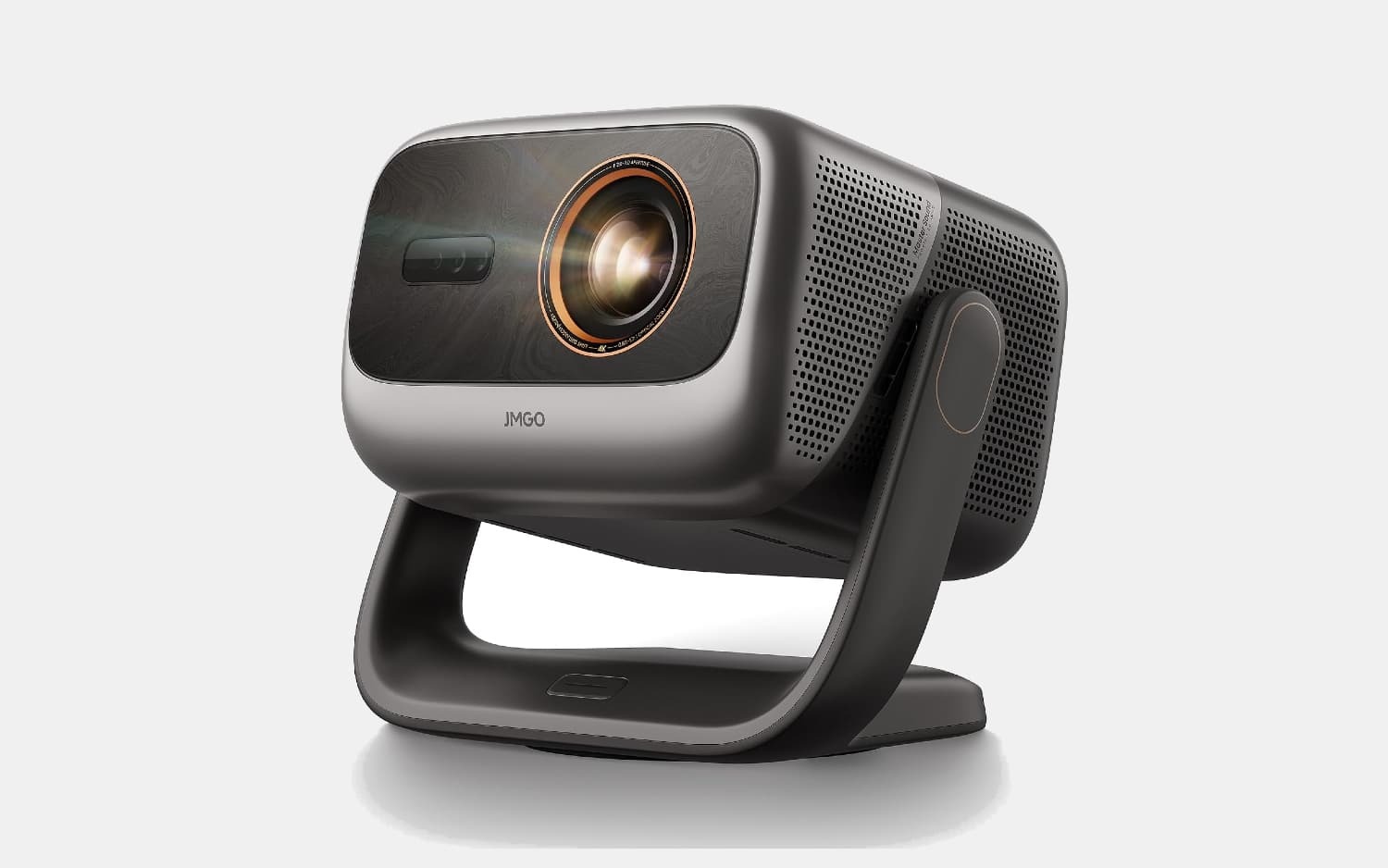
The JMGO IRIS Ultra Max 4K Projector is a high-output triple-laser home theater projector featuring a motorized dual-axis gimbal chassis, native 4K resolution processing at 120Hz, and an optical zoom system capable of throwing images up to 300 inches. It retails for $3,499 USD direct from JMGO and through authorized specialty AV retailers. Designed specifically for media room integrators and home cinema enthusiasts who want to avoid permanent ceiling bracket installation, the unit combines extreme luminous output with automated alignment hardware to solve the physical positioning friction long associated with high-end projection systems.
🛒 Where to Buy: JMGO IRIS Ultra Max
- JMGO IRIS Ultra Max: View on Amazon
Click the link above to check current pricing, availability, and customer reviews on Amazon.
Historically speaking, high-output home projection required a strict compromise between permanent architectural alteration and compromise-heavy portable setups. Evaluating the product details highlighted in initial Gear Moose coverage reveals that JMGO aims to eliminate that friction entirely. By housing a high-power optical engine inside an articulated, motorized base, the IRIS Ultra Max addresses the physical friction of manual geometry correction, shifting the engineering focus from room renovation to multi-environment deployment.
Upfront Investment & 2-Year Total Cost of Ownership
Acquiring the JMGO IRIS Ultra Max requires an initial capital outlay of $3,499 USD for the base unit, positioning it squarely in the premium tier of consumer lifestyle projectors. Unlike traditional lamp-based projectors that incur mandatory maintenance expenses every 2,000 to 4,000 hours in the form of replacement bulb assemblies, the solid-state MALC 6.0 triple-laser light engine inside the IRIS Ultra Max is rated for a 30,000-hour operational lifespan. Under typical residential usage of five hours daily, the core light source requires zero consumable replacement over a two-year standard accounting window.
However, calculating the realistic two-year Total Cost of Ownership (TCO) requires accounting for environmental accessories and power draw. Operating at a peak power consumption of approximately 350W under high-luminance laser drive modes, electricity costs total roughly $45 USD annually based on average utility rates of $0.16 USD per kWh. The primary indirect expenditure lies in surface pairing: to fully realize the claimed 10,000:1 native contrast ratio in spaces with uncontrolled ambient lighting, pairing the unit with a 120-inch ambient light rejecting (ALR) screen adds between $800 USD and $1,500 USD to the initial setup cost. Consequently, the true two-year expenditure ranges from $3,590 USD for a bare-wall setup to roughly $5,080 USD for an optically optimized multi-room installation.
The financial distinction matters here when comparing this projector against fixed-panel displays. While a premium 98-inch direct-lit LED television demands a similar initial outlay and carries significant wall-mounting labor costs, it remains hard-locked to a single dimension and location. The IRIS Ultra Max trades ultimate panel black levels for scalable image geometry up to 300 inches, shifting the value proposition toward raw spatial flexibility and screen-size-per-dollar efficiency.
What You Actually Get: Core Features & Build Specs
The technical foundation of the IRIS Ultra Max is built around JMGO’s proprietary MALC 6.0 (Micro-Laser Array Control) triple-laser optical engine. This hardware configuration utilizes separate red, green, and blue laser diodes to project a maximum rated brightness of 6,500 ISO lumens. By bypassing traditional phosphor wheels, the engine achieves broad color gamut coverage, exceeding 110% of the BT.2020 color space standard. The optical path integrates a native 4K Digital Micromirror Device (DMD) paired with a mechanical optical zoom system, allowing native image scaling without sacrificing pixel density through digital cropping.
The defining physical element of the chassis is its integrated dual-axis motorized gimbal base. The motorized arm provides 360 degrees of continuous horizontal panning and up to 150 degrees of vertical tilt articulation. In practice, this mechanism works alongside an array of time-of-flight (ToF) sensors and CMOS optical modules to execute real-time automatic focus, four-way optical lens shift, geometric keystone correction, and AI-assisted screen-fitting. The engineering trade-off here involves mechanical complexity: incorporating micro-stepper motors inside the primary pivot joint adds structural weight, resulting in a total system weight of roughly 11.5 kg.
From an input and processing perspective, the unit supports HDMI 2.1 architecture, processing native 4K video feeds at 120Hz refresh rates alongside Variable Refresh Rate (VRR) and Auto Low Latency Mode (ALLM) for gaming consoles. High Dynamic Range decoding extends across HDR10, HLG, and Dolby Vision protocols. Smart functionality is driven by native Google TV integration, powered by a quad-core ARM processor supported by 4GB of system RAM and 64GB of internal storage. Audio is handled by built-in stereo speakers tuned in collaboration with external audio engineers, though serious home cinema setups will rely on the unit’s HDMI eARC port to pass lossless Dolby Atmos soundtracks to a dedicated receiver.
- Light Engine Technology: MALC 6.0 Triple-Laser RGB Optical Module
- Peak Luminous Flux: 6,500 ISO lumens
- Native Contrast Ratio: 10,000:1
- Maximum Refresh Rate: 4K at 120Hz with VRR support
- Chassis Articulation: Motorized 360-degree horizontal rotation / 150-degree vertical tilt
- Smart OS Platform: Google TV with native Widevine L1 streaming certification
Worth observing is how this hardware iteration addresses past architectural limitations. Historically speaking, early attempts at high-lumen laser gimbal projectors (notably first-generation units launched between 2021 and 2023) suffered from center-to-edge optical defocusing caused by thermal drift during extended viewing sessions. Furthermore, early triple-laser systems were frequently marred by visible laser speckle—a grainy optical interference pattern inherent to coherent laser light. In the IRIS Ultra Max, JMGO mitigates speckle artifacting through a high-frequency dynamic light diffuser plate embedded in the optical assembly, while active liquid cooling loops maintain thermal equilibrium across the laser diode array to prevent focus shift over time.
Hidden Costs, Ecosystem Dependencies & Fine Print
While marketing materials emphasize high-brightness performance in fully lit rooms, examining the fine print of the hardware documentation reveals critical operational caveats. The headline figure of 6,500 ISO lumens is produced strictly under the projector’s “High Dynamic” light drive preset. In this mode, color balance leans noticeably cool, introducing a slight blue bias to whites. When switched to color-accurate picture modes—such as Movie Mode calibrated for DCI-P3 cinematic mastering—luminous output drops by approximately 28% to roughly 4,680 ISO lumens. While 4,680 lumens remains substantial for home projection, buyers calculating daylight performance must factor in this brightness reduction when operating in color-calibrated modes.
Another operational consideration involves spatial clearance and acoustic footprint. The physical movement of the motorized gimbal requires a clear operational radius around the base to avoid physical obstructions during automatic screen alignment sequences. Additionally, maintaining the laser engine at operating temperature under maximum output requires active fan cooling. According to technical documentation published with this release, system noise registers at 28 dB under standard thermal loads, but can rise to 33 dB when the laser engine operates at maximum brightness in warm ambient environments. If placed directly adjacent to seating positions, this fan noise is audible during quiet film passages.
Software and platform dependencies also dictate the user experience. Although Google TV provides native access to major streaming platforms, licensing requirements for high-bitrate playback mean users are subject to third-party software update cycles. Furthermore, while the device includes integrated stereo speakers suitable for temporary setups, utilizing the high-frame-rate 4K at 120Hz capability for current-generation gaming consoles requires high-bandwidth HDMI 2.1 cabling that is not included in the standard retail box. Buyers must purchase certified 48Gbps HDMI cables to prevent signal dropouts or chroma subsampling limitations.
Prospective owners should also review purchasing policy details. As noted in the standard transparency disclosures published alongside primary product dispatches., third-party retail fulfillment links may track referral interactions, though warranty claims and firmware support remain bound directly to JMGO’s regional service infrastructure.
Smarter Alternatives at This Price
At the $3,499 USD price tier, the IRIS Ultra Max faces competition from established short-throw and ultra-short-throw projection platforms. The choice between these models depends heavily on room geometry, physical mounting preferences, and ambient light management.
The first direct rival to consider is the Formovie Theater 4K UST Projector, available for $2,999 USD on Amazon. The Formovie Theater utilizes an ultra-short-throw (UST) optical design, sitting inches from the projection wall rather than requiring midfield or room-center placement. Powered by ALPD 4.0 triple-laser technology, it delivers a lower peak output of 2,800 ANSI lumens but compensates with a higher optical native contrast ratio of 3,000:1 and integrated Bowers & Wilkins soundfield hardware. The Formovie is superior for dedicated media cabinets where zero room obstruction is required, though it lacks the high-refresh-rate 120Hz gaming support and motorized point-anywhere versatility of the JMGO unit.
For purists seeking dedicated home theater performance in light-controlled spaces, the Epson Pro Cinema LS12000offers a traditional alternative at $4,999 USD on Amazon. The LS12000 relies on a 3-chip 3LCD optical engine rated at 2,700 ISO lumens, completely eliminating single-chip laser speckle and rainbow artifacts. It offers motorized lens shift, frame interpolation, and professional ISF calibration controls. However, it requires a permanent ceiling or rear-shelf installation, weighs a heavy 12.7 kg, lacks built-in smart TV streaming interfaces, and carries a $1,500 USD price premium over the IRIS Ultra Max. The distinction here is clear: the Epson is an install-and-forget fixture for dedicated dark rooms, whereas the JMGO is a high-output, adaptable solution built for multi-use living environments.
Final Buyer Verdict: Is the Investment Worth It?
The JMGO IRIS Ultra Max 4K Projector delivers a well-engineered balance of raw optical output, mechanical innovation, and modern processing capabilities. Its primary triumph lies in the implementation of the motorized gimbal base coupled with the MALC 6.0 triple-laser system; this combination successfully solves the alignment frustration that has plagued non-permanent projector setups for decades. With a authentic peak output capability that holds up against room ambient light, robust 4K 120Hz gaming performance, and native Google TV processing, it stands out as one of the most versatile long-throw display solutions in its class.
However, this level of hardware complexity is not necessary for every consumer setup. Buyers with dedicated, light-controlled cinema rooms featuring fixed ceiling mounts can achieve superior black levels and static optical performance for similar money through traditional home theater projectors, while users seeking a clean living room aesthetic without a central floor unit may find ultra-short-throw alternatives more practical. Nevertheless, for buyers seeking a flexible display device capable of projecting an immersive 300-inch image across multiple locations without installation headaches, the $3,499 USD investment in the IRIS Ultra Max is fully justified by its feature set and engineering execution.