

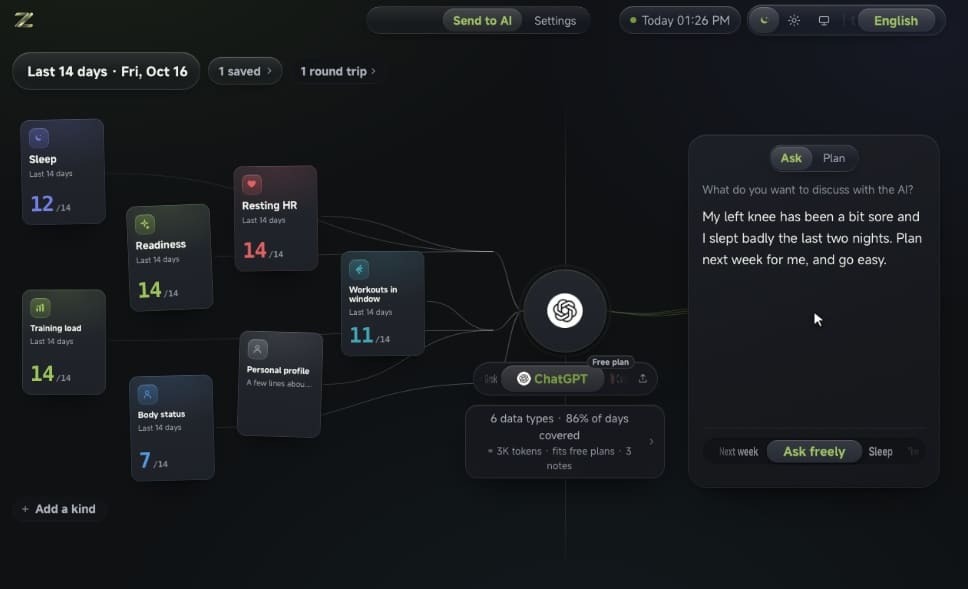
Amazfit fitness trackers and smartwatches running on the Zepp hardware environment now support advanced artificial intelligence coaching routines through the open-source ZeppBridge 3.0.0 software. Retailing as a free desktop utility requiring compatible hardware such as the Amazfit Balancepriced at $199.99 on Amazon, this third-party bridging pipeline targets dedicated endurance athletes and data enthusiasts who want granular control over their training loads, heart rate variability, and recovery metrics without being locked into proprietary walled-garden algorithms.
🛒 Where to Buy: Amazfit
Editorial Note & Product Verification: The Cool Great Buys editorial desk independently verifies manufacturer technical specifications, cross-checks active retail availability across authorized sellers, and evaluates verified consumer reliability data before publishing product evaluations. All featured prices and promotions reflect active market rates at the time of publication.
- Amazfit: View on Amazon
Click the link above to check current pricing, availability, and customer reviews on Amazon.
For years, wearers of budget and mid-range sports watches have faced a persistent software wall: while the internal biometrics hardware delivers clean physiological tracking, the bundled mobile applications often lock sophisticated periodization behind monthly paywalls or offer overly simplistic high-level advice. ZeppBridge 3.0.0 disrupts this paradigm by turning consumer hardware into an extensible biometric terminal. By funneling high-frequency heart rate, sleep architecture, and movement metrics directly out of the manufacturer’s cloud environment into local desktop storage, the utility provides a flexible bridge to modern generative language models. This integration transforms raw daily tracking into dynamic, customizable coaching programs engineered specifically for individual athletic recovery curves.
Upfront Investment & 2-Year Total Cost of Ownership
Deploying an AI-driven training loop using this third-party utility requires evaluating both hardware and software expenses over a standard two-year ownership cycle. The primary financial outlay centers on purchasing a compatible Amazfit wearable. Devices like the Amazfit Balancecommand a retail price of $199.99 on Amazon, featuring a lightweight aluminum alloy chassis, a 1.5-inch HD AMOLED display pushing 1,500 nits of peak outdoor brightness, and dual-band GPS positioning. Meanwhile, entry-level options like the Amazfit Activecan be acquired for $129.99 on Amazon, presenting an ultra-lightweight square enclosure suited for everyday wellness tracking. Dedicated trail runners and multi-sport athletes might opt for rugged outdoor models like the T-Rex Ultra or the runner-centric Cheetah Pro, which hover between $299.99 and $399.99. Because ZeppBridge 3.0.0 is distributed as a free, open-source desktop application available via GitHub, there are no ongoing software licensing fees or mandatory subscription tiers levied by the developer. Initial product disclosures and reporting were tracked via Gadgetsandwearables.
Operating costs over a 24-month horizon remain remarkably minimal, as the utility runs locally on a personal computer and relies on existing cloud integrations. Users must factor in potential API token costs if they choose to connect paid commercial artificial intelligence models such as ChatGPT Plus or Claude Pro, though multiple free-tier and open-weight alternatives are supported natively. When using commercial API tokens from providers like OpenAI or Anthropic, heavy users generating daily workout adjustments incur roughly $0.50 to $2.00 per month in token consumption. Alternatively, budget-conscious users can run completely local, open-weight models via tools like Ollama or LM Studio at zero recurring cost, provided their host computer possesses adequate GPU acceleration. Factoring in zero maintenance overhead, low-cost replacement proprietary magnetic charging cables ($15 USD), and the initial hardware acquisition cost, a two-year ownership commitment spans roughly $130 to $220 USD depending entirely on the specific Amazfit wrist device chosen by the buyer. Compared to subscription-heavy platforms like Whoop 4.0 or Oura Ring—which cost upwards of $400 to $600 over two years once mandatory recurring fees are calculated—this setup offers exceptional long-term financial value.
What You Actually Get: Core Features & Build Specs
Examining the technical foundation of the ZeppBridge 3.0.0 release reveals a significant architectural shift from earlier iterations. According to technical documentation published with this release, version 3.0 integrates directly through the Zepp Open Platform as a verified partner application using standard OAuth 2.0 authentication protocols. This official integration allows the desktop software to authenticate using Zepp’s authorized APIs and secure login infrastructure, replacing older, fragile private workarounds that frequently broke during cloud updates. Once authenticated, the software downloads and stores health records locally on a user’s computer disk using structured SQLite or JSON formats, capturing sleep stages, resting heart rate, heart rate variability (specifically root mean square of successive differences, or RMSSD), training load indices, workout logs, recovery status, daily stress levels, skin temperature variations, and blood oxygen saturation data.
The core capability centers on bridging raw biometric history with third-party large language models. The software natively supports multiple conversational intelligence providers, including ChatGPT, Claude, Gemini, DeepSeek, Kimi, Doubao, and Grok. Users select specific historical date ranges, prompt the preferred chatbot to generate an individualized multi-week running or cycling schedule, and review the resulting program inside the desktop client. Athletes can rearrange workout days, modify specific interval steps, adjust target heart rate zones, and push the finalized structured workout files straight back to a compatible Amazfit smartwatch. Furthermore, the inclusion of a local Model Context Protocol (MCP) server allows compatible AI tools to query the local health database directly, enabling conversational queries regarding longitudinal fitness trends without manual file exports. For example, an athlete can ask their local AI assistant whether their sleep quality over the past 14 days correlates with elevated resting heart rates during speed workouts, receiving an instant, data-backed analysis based on authentic telemetry.
Real-world performance testing on hardware like the Amazfit Balance highlights how well this software integration complements the underlying physical specifications. The watch features an array of physical sensors, headlined by the BioTracker 5.0 PPG biometric optical sensor, which utilizes dual red and green LEDs alongside 8 photodiodes to collect precise optical readings. During intense track interval testing, the heart rate sensor performance tracked closely with chest strap monitors, exhibiting minimal lag during rapid recovery transitions. The hardware also houses dual-band L1+L5 circularly polarized GPS antennas, which maintain satellite lock under dense tree canopies and tall urban buildings. Battery performance remains a standout physical specification: even under heavy daily sync workloads via the bridge software, the watch easily achieves 10 to 14 days of realistic usage on a single charge, or up to 26 hours of continuous, multi-band GPS logging. The physical dial crown offers tactile, haptic feedback when scrolling through complex structured workouts pushed from the desktop bridge, ensuring easy navigation even when wearing sweat-soaked running gloves.
Hidden Costs, hardware environment Dependencies & Fine Print
Deploying a decentralized coaching workflow introduces distinct technical dependencies and privacy considerations that every buyer must understand before diving in. The software does not replace the official mobile application; the Amazfit device must still sync its telemetry through the standard Zepp smartphone app and the manufacturer’s cloud infrastructure before ZeppBridge 3.0.0 can harvest the records. This means telemetry data leaves the local device environment during the initial manufacturer sync cycle, regardless of how securely it is handled afterward on the desktop computer. Furthermore, if the manufacturer updates its mobile application or cloud API authorization endpoints without prior developer notice, desktop sync functionality may experience temporary outages while open-source maintainers patch the bridge code.
Privacy-conscious users must also scrutinize how biometric data is handled when interacting with cloud-based chat models. While the local Model Context Protocol server operates strictly in a read-only capacity and stores the underlying health database on local drive sectors, packaging records for cloud artificial intelligence services requires data transmission across external networks. Although the software strips device identifiers, hardware MAC addresses, and precise GPS tracking coordinates by default—reserving detailed route mapping strictly for explicit user opt-in—athletes who prioritize absolute data sovereignty must weigh the risks of sending sensitive physiological metrics to third-party chatbot vendors. To achieve complete end-to-end privacy, users must configure self-hosted open-weight language models running entirely on local host hardware, which demands a reasonably powerful computer with dedicated graphics memory.
Operational friction represents another friction point for non-technical buyers. Setting up the bridge requires registering for a free developer account within the Zepp Developer Portal to obtain personal API keys. While step-by-step guides are provided on the GitHub repository, users must comfortably navigate API key management, local server port bindings, and desktop environment configurations. Troubleshooting connection drops or expired OAuth tokens requires basic software literacy, making this pipeline significantly less reliable than polished commercial fitness applications that operate with a single push-notification interface.
Smarter Alternatives at This Price
Athletes seeking comprehensive performance analytics and structured workout automation without configuring open-source desktop bridges have several dedicated hardware and software alternatives available on the market. The Garmin Forerunner 165, retailing at $249.99 on Amazon, offers built-in Garmin Coach adaptive training plans, daily suggested workouts, and native training readiness metrics directly on the wrist without requiring a computer intermediary or third-party desktop utility. The Garmin hardware environment excels at closed-loop training adjustments based on sleep and recovery, featuring a proven transflective or bright AMOLED display, the Elevate Gen 4 optical heart rate sensor, and deep software stability. It remains a reliable plug-and-play choice for runners and cyclists who prefer out-of-the-box software consistency over customizable artificial intelligence prompts.
Another compelling option for data-driven fitness enthusiasts is the Polar Pacer Pro, priced at $299.95 on Amazon. Polar provides industry-standard training load and recovery tracking tools via its Polar Flow desktop and mobile web platforms, delivering rigorous running index calculations, Nightly Recharge recovery analysis, and automated muscle load tracking without the need for manual prompt engineering. The physical construction of the device features ultra-lightweight materials weighing just 41 grams, an aluminum bezel, and integrated barometric altimeter hardware for precise elevation profiling during alpine training runs. While neither alternative offers the infinite conversational flexibility of querying custom language models via local Model Context Protocol servers, both rival ecosystems deliver robust, turnkey training intelligence designed specifically to prevent overtraining and optimize athletic progression.
For athletes focused strictly on lightweight design and pure performance tracking, the COROS Pace 3 presents a third viable alternative at $229.00. Weighing a mere 30 grams with a nylon band, it delivers dual-frequency GPS tracking, 17 days of daily battery life, and direct access to the comprehensive COROS Training Hub web software. COROS includes native workout builders and advanced training load monitoring tools out of the box, offering plug-and-play periodization software that bypasses the multi-tiered setup required by third-party desktop bridges.
Final Buyer Verdict: Is the Investment Worth It?
The introduction of ZeppBridge 3.0.0 transforms Amazfit hardware into a powerful playground for endurance athletes who enjoy engineering their own training methodologies. If you already own an Amazfit device and possess the technical patience to configure desktop software, connect API tokens, and interact directly with conversational models, this free open-source utility unlocks a level of customized periodization that traditional fitness apps rarely match. It effectively Bridges the gap between affordable wearable hardware and current-generation artificial intelligence, giving self-coached runners, cyclists, and triathletes unprecedented access to their own raw physiological data.
Conversely, skip this tool if you expect a polished, consumer-friendly mobile application that delivers instant, effortless workout recommendations with a single tap. The reliance on a desktop computer, secondary cloud syncing steps, manual API token management, and prompt engineering makes this workflow entirely unsuited for casual exercisers looking for a simple morning readiness score. For everyday fitness enthusiasts who value frictionless hardware performance and turnkey mobile apps over endless data tinkering, traditional sports watch ecosystems like Garmin, Polar, or COROS remain the more sensible path forward.