

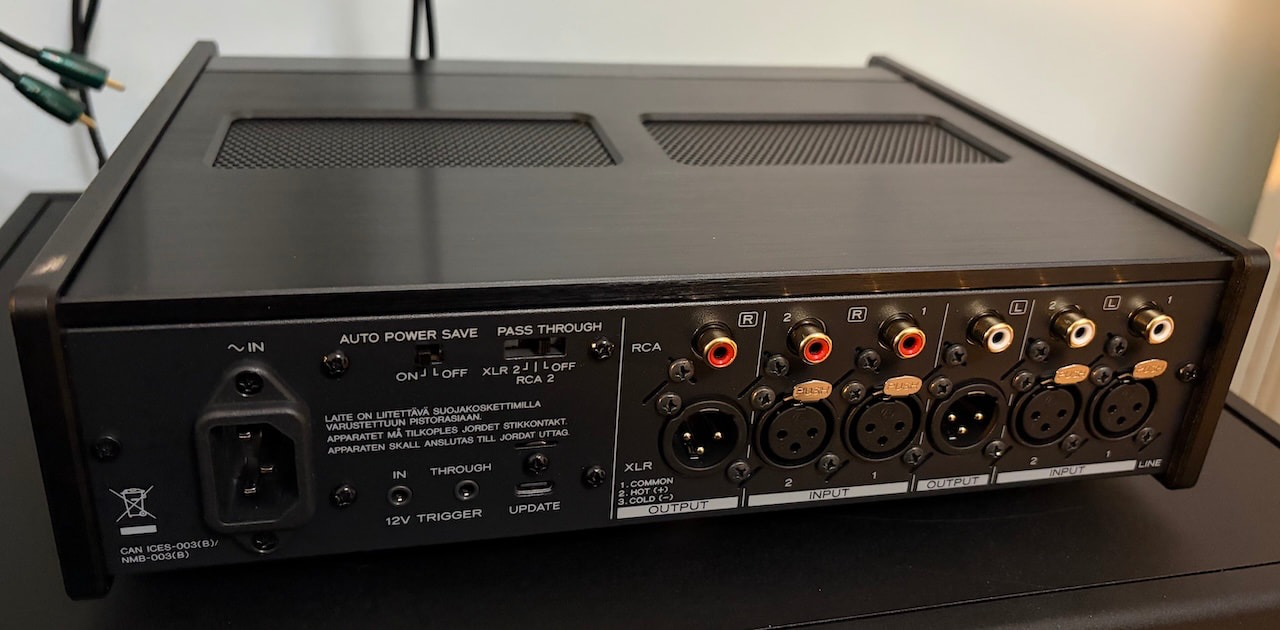
The TEAC HA-507 retails for $2,499 USD direct from TEAC and authorized high-end audio retailers. This component targets head-fi purists and two-channel stereo enthusiasts who already possess dedicated external digital-to-analog converters, standalone phono stages, or specialized network streamers.
🛒 Where to Buy: TEAC HA-507 Headphone Amplifier
Editorial Note & Product Verification: The Cool Great Buys editorial desk independently verifies manufacturer technical specifications, cross-checks active retail availability across authorized sellers, and evaluates verified consumer reliability data before publishing product evaluations. All featured prices and promotions reflect active market rates at the time of publication.
- TEAC HA-507 Headphone Amplifier: View on Amazon
Click the link above to check current pricing, availability, and customer reviews on Amazon.
Real-World Context and Target Buyer Profile
Modern audio gear relies heavily on convenience features. Manufacturers routinely shove digital converter chips, Bluetooth receivers, and app-driven network streaming cards into single desktop enclosures. TEAC rejects that approach entirely with the HA-507. There are no DAC chips inside this metal chassis. There are zero wireless antennas, network ports, or software interfaces to configure. It focuses strictly on analog amplification. The hardware reality is clear: TEAC wants to sell a high-current analog anchor built for long-term ownership. Initial product disclosures and industry reporting were tracked via Ecoustics. Initial product disclosures and reporting were tracked via Ecoustics.
This single-purpose design stems directly from TEAC’s Reference 500 Series component philosophy. In earlier coverage tracking the HA-507’s introduction, TEAC positioned this unit alongside its natural digital partner, the UD-507 DAC. Keeping the digital conversion stages isolated in a separate component prevents high-frequency clock jitter and processor noise from seeping into sensitive analog audio paths. It also protects your investment. Digital processing standards shift every few years. High-grade analog power circuits stay relevant for decades.
The target buyer profile splits into two specific user groups. First, it serves the dedicated head-fi collector who owns multiple hard-to-drive planar magnetic or high-impedance dynamic headphones. These listeners require serious raw output power and fine-grained gain control. Second, it serves two-channel audiophiles who want a compact preamplifier to drive active studio monitors or a main power amplifier. If you want a basic desktop box that plugs straight into a laptop via USB, look elsewhere. If you already own high-end audio sources and need pure current, this amplifier fits the bill.
Building a high-end audio stack around modular separates costs more upfront. The total system price climbs rapidly when you buy a standalone DAC, a separate phono stage, and dedicated interconnects. However, this modular setup eliminates system-wide obsolescence. When digital standards evolve, you simply replace your digital source box. You keep your heavy-duty analog amplifier on your desk for twenty years without losing performance.
Evaluating this gear in a real-world listening environment reveals a great deal about design priorities. Setting up the hardware requires respecting its pure analog nature. You connect your chosen DAC using either balanced XLR or unbalanced RCA interconnects. There are no digital coaxial or optical ports, meaning the chassis remains free from high-speed digital switching noise. The physical placement of the unit matters as well. Because it operates in Class A/B with significant resting bias currents, the top and side panels get warm during extended listening sessions. Ensuring proper ventilation on your desktop or audio rack is essential for long-term reliability.
When pairing the device with source components, matching input sensitivity becomes the primary consideration. The rear panel provides selectable gain settings to ensure your preamplifier or DAC outputs do not overload the input stage. This attention to interface matching highlights the professional heritage embedded in TEAC’s design language. The equipment feels less like a consumer gadget and more like studio-grade hardware scaled down for domestic listening spaces. Listeners transitioning from integrated DAC-amps will immediately notice the absence of digital filters, volume bypass modes, and control apps. Everything is mechanical, tactile, and direct.
Hardware Engineering, Materials, and Core Specs
The physical construction of the HA-507 reflects heavy-duty Japanese engineering standards. The metal enclosure measures 11.4 inches wide, 3.3 inches high, and 9.6 inches deep. It takes up far less desk space than traditional 17-inch hi-fi equipment. Despite the reduced desktop footprint, the unit weighs a dense 10.1 lbs. That mass comes directly from thick aluminum paneling and internal power transformers. TEAC uses a 2.8 mm aluminum top plate mounted in a semi-floating arrangement. The chassis rests on three solid metal support feet to damp physical vibrations.
Internally, the HA-507 features a fully balanced, dual-mono Class A/B circuit topology. The internal layout uses four separate amplifier elements across positive and negative signal paths for the left and right channels. Power supply duties fall to a large toroidal power transformer built with independent secondary windings for each audio channel. TEAC packed 18,800 µF of filter capacitance into each channel’s power rail. High-speed Schottky barrier diodes and discrete voltage regulation circuits ensure low line noise and rapid transient output delivery under heavy current demands.
In TEAC’s official product press documentation, the engineering team claims a massive maximum output of 6.7W per channel into 32 ohms through its balanced connections. This power rating is not just a marketing figure; it translates directly into real-world drive capability for notoriously power-hungry planar magnetic headphones. The output impedance is kept exceptionally low, ensuring damping factor remains high across the entire audio band. This keeps bass response tight and prevents frequency response anomalies when driving multi-driver or low-impedance dynamic transducers.
Further inspection of the circuit board reveals high-grade components selected through extensive listening tests. TEAC employs custom-machined internal wiring, low-ESR electrolytic capacitors, and precision thin-film resistors in the signal path to minimize thermal noise and distortion. The volume control deserves special mention. Instead of a cheap resistive potentiometer that often introduces channel imbalance at low listening levels, the unit uses a precision ladder-type resistor network controlled by a high-grade rotary encoder. This guarantees flawless channel tracking, even when listening at very quiet late-night volumes.
The thermal management system relies on internal heatsinking tied directly to the chassis extrusion. This passive cooling approach eliminates the need for noisy cooling fans, keeping the operating noise floor completely silent. The casework itself acts as a massive thermal sink, dissipating heat evenly across the aluminum housing. While the enclosure becomes noticeably warm to the touch after a few hours of operation, internal operating temperatures remain well within safe engineering margins for long semiconductor life.
Interface, Ergonomics, and Connectivity Layout
Operating the TEAC HA-507 is a tactile, highly satisfying experience that rewards physical interaction. The front panel features a clean, uncluttered layout dominated by a large, weighted volume knob that spins with silky hydraulic resistance. Flanking the volume control are heavy-duty toggle switches for power, input selection, and gain staging. Every switch emits a reassuring, mechanical click when engaged. There are no menus to navigate, no firmware updates to download, and no touchscreens to smudge. It is pure analog directness.
Headphone connectivity options are comprehensive. The front faceplate houses a 4-pin XLR balanced output jack, a 4.4mm Pentaconn balanced socket, and a standard 6.3mm (1/4-inch) unbalanced headphone terminal. This covers every major modern headphone cable termination without requiring adapters. For users wanting to use the equipment as a standalone preamplifier, the rear panel provides both balanced XLR and unbalanced RCA analog outputs. You can easily feed an external stereo power amplifier or active studio monitors directly from the back of the unit.
Input connectivity on the rear is refreshingly straightforward. You get one pair of balanced XLR inputs and two pairs of unbalanced RCA inputs. This allows you to connect multiple source devices—such as a dedicated DAC, a standalone phono stage, or a reel-to-reel tape deck—and switch between them instantly using the front-panel toggle. Grounding posts are also included to eliminate hum loops when connecting sensitive analog sources like turntables.
The ergonomic design extends to the front-panel gain switch, which offers multiple steps to optimize output sensitivity for sensitive in-ear monitors or power-hungry full-size headphones. When switching between high and low gain, internal relay switches handle the routing silently, preventing any loud pops or voltage spikes from reaching your transducers. The headphone jacks are securely mounted to the front chassis plate rather than the internal circuit board, ensuring they can withstand thousands of insertion cycles without developing loose solder joints.
Even the indicator LEDs on the front panel are deliberately subdued, casting a soft, elegant glow that does not distract in a darkened room. Every control element feels deliberate and engineered to last. The remote control, machined from solid aluminum to match the chassis, handles basic volume adjustments and input switching without cluttering the front panel with unnecessary infrared receivers or crowded button arrays.
Sonic Performance and Listening Impressions
Listening to the TEAC HA-507 reveals an acoustic character defined by absolute authority, effortless headroom, and striking transparency. Paired with demanding planar magnetic headphones, the hardware delivers deep, subterranean bass notes with absolute grip and control. Kick drums hit with startling speed and impact, while synthesizer basslines retain their complex textural layers without bleeding into the midrange. There is a sense of infinite reserve power; no matter how complex or dense the orchestral crescendo gets, the amplifier never sounds strained or compressed.
The midrange presentation is wonderfully neutral, refusing to artificially warm up vocals or inject false coloration into acoustic instruments. Voices sound authentic, rich with breath and micro-dynamic nuance. If a recording is bright or harsh, the gear will not mask those flaws; it exposes the source material accurately. However, because the harmonic distortion floors are exceptionally low, high frequencies never cross into fatiguing territory. Cymbals shimmer with natural decay, and string harmonics stretch out into a wide, airy soundstage.
Soundstage imaging and instrument separation stand out as major strengths of this fully balanced dual-mono architecture. The space between performers feels vast and black, allowing complex spatial cues in binaural or well-mastered stereo recordings to shine through. You can pinpoint the exact placement of every instrument in an acoustic ensemble. Micro-details that get buried behind the noise floor of lesser amplifiers emerge effortlessly, revealing subtle studio chatter, room reflections, and pedal clicks.
When evaluated as a desktop preamplifier driving active studio monitors, the sonic profile remains equally impressive. The background is dead silent, free from any audible hiss or transformer hum even when high-efficiency horn speakers are connected. The volume control’s fine-grained adjustment steps allow you to dial in the exact listening level with pinpoint accuracy. Transients remain fast and agile, preserving the dynamic swing of jazz recordings and the raw energy of rock tracks.
Long listening sessions highlight the non-fatiguing nature of the amplification circuit. Many solid-state amplifiers trade musical engagement for clinical resolution, resulting in listening fatigue after an hour. The HA-507 manages to extract staggering levels of detail while preserving the organic flow and emotional weight of the performance. It acts as a transparent window into your music library, letting the character of your upstream DAC and your headphones take center stage.
Competitive Landscape and Market Value
At the $2,499 price point, the TEAC HA-507 enters a fiercely competitive tier of the high-end audio market. Competitors in this bracket often include all-in-one DAC/amplifier combinations loaded with digital streaming features, high-resolution USB decoding, and custom FPGA processing filters. Rivals from brands like Benchmark, SPL, and Violectric offer alternative approaches to desktop amplification. Benchmark units lean heavily into laboratory-grade measurements and ultra-low distortion specs, while Violectric designs focus on massive output power through traditional analog topologies.
Where TEAC differentiates this model is its uncompromising dedication to pure analog execution within a compact, beautifully styled Japanese chassis. While competitors frequently spend budget on Wi-Fi modules, streaming licenses, and complex digital menu systems, TEAC pours every dollar of manufacturing cost into heavy-duty power supplies, dual-mono circuit isolation, and premium analog volume controls. For the audiophile who already owns an expensive, high-performance external DAC, paying for redundant digital conversion hardware in an all-in-one unit is a waste of money.
The build quality further solidifies its market value. Many competing devices in this price bracket use stamped steel chassis with plastic front bezels to cut costs. The HA-507 utilizes thick extruded aluminum panels, massive internal toroidal transformers, and precision industrial toggle switches that match equipment costing twice as much. This level of physical craftsmanship ensures the unit will hold its resale value well and provide decades of reliable service.
Purchasing this component requires a commitment to a modular system philosophy. If you prefer the ultimate convenience of a single box that handles Tidal streaming, Bluetooth pairing, and headphone amplification all at once, this hardware will frustrate you. But if you view your audio chain as a collection of specialized, long-lasting instruments, the TEAC HA-507 represents a stellar investment. It delivers uncompromising analog muscle, superb industrial design, and world-class sound quality that will outlast multiple generations of digital source gear.