

AliveCor’s dedicated consumer electrocardiogram (ECG) ecosystem—comprising the single-lead standard KardiaMobile at $79 USD on Amazon.com/s?k=AliveCor+KardiaMobile” target=”_blank” rel=”noopener”>Amazon, the ultra-slim KardiaMobile Card at $89 USD on Amazon, and the multi-lead KardiaMobile 6L at $149 USD direct from AliveCor’s website—delivers medical-grade cardiac trace capture directly to iOS and Android smartphones. Designed specifically for users monitoring cardiac arrhythmias such as atrial fibrillation, bradycardia, and tachycardia, these pocket-sized sensors eliminate the need to rely exclusively on smartwatch optical sensors. This hardware lineup matters because it signals the broader shift toward decentralized personal health diagnostics, where purpose-built biometrics outshine general-purpose wearables in data depth.
🛒 Where to Buy: KardiaMobile 6L
- KardiaMobile 6L: View on Amazon
Click the link above to check current pricing, availability, and customer reviews on Amazon.
While all three devices run on the unified Kardia software platform and complete a standard trace recording in 30 seconds, their internal transmission architectures, battery implementations, and clinical lead outputs diverge significantly. Choosing the correct monitor requires analyzing whether your routine demands continuous passive portability, maximum long-term battery serviceability, or full six-lead electrical data suitable for formal clinical diagnosis. According to market analysis published in the original product news dispatch, these hardware variations look similar on paper, but operational differences become immediate once integrated into a daily health regimen.
Upfront Investment & 2-Year Total Cost of Ownership
Calculating the true cost of ownership across the AliveCor lineup requires looking beyond the initial retail price tag. The entry-level standard KardiaMobile presents the lowest barrier to entry at $79 USD, followed closely by the credit-card-formatted KardiaMobile Card at $89 USD. The top-tier KardiaMobile 6L demands an upfront outlay of $149 USD. However, internal hardware design creates divergent financial trajectories over a standard 24-month deployment window, specifically regarding power cell maintenance and device longevity.
Both the standard KardiaMobile and the KardiaMobile 6L utilize a user-replaceable CR2016 3V lithium coin cell battery. A standard multi-pack of CR2016 batteries costs roughly $5 USD and powers either unit for approximately 12 to 24 months depending on measurement frequency. Consequently, the two-year operational hardware cost for the standard KardiaMobile sits at $84 USD, while the KardiaMobile 6L totals $154 USD. Conversely, the KardiaMobile Card features an ultra-thin, completely sealed internal battery rated for approximately two years of typical use. Because the internal cell cannot be replaced or recharged, the entire unit must be retired and repurchased at the end of its battery lifecycle, bringing its two-year hardware investment to $89 USD and requiring a full hardware refresh for year three.
Software functionality introduces an optional recurring expense across all three models. AliveCor operates a basic tier that requires zero ongoing subscription fees, granting users baseline rhythm determinations (Atrial Fibrillation, Normal, Bradycardia, Tachycardia) and unlimited PDF exports for medical professionals. For users seeking advanced features—such as automatic heart data back-ups, clinician review credits, and expanded rhythm detections—AliveCor offers its KardiaCare membership at $9.99 USD per month or $99 USD annually. Factoring in two years of optional KardiaCare brings the total 24-month ownership cost to $282 USD for the standard KardiaMobile, $287 USD for the Card, and $347 USD for the KardiaMobile 6L.
What You Actually Get: Core Features & Build Specs
The core distinction within this lineup rests on physical dimensions, communication protocols, and electrical signal acquisition. The standard KardiaMobile weighs a minimal 18 grams and measures 3.5mm thick, utilizing a rigid plastic chassis housing two stainless steel electrodes on the top surface. Rather than employing standard Bluetooth connectivity, the original KardiaMobile transmits high-frequency ultrasonic audio signals containing the encoded ECG waveform. Your smartphone’s microphone picks up this acoustic signal at close range and decodes it within the Kardia mobile application, completely bypassing the Bluetooth pairing menu.
The KardiaMobile Card represents an engineering triumph in miniaturization. Weighing just 7.4 grams with dimensions matching a standard credit card, it slips directly into a standard wallet billfold or card slot without adding noticeable bulk. Its front face features two integrated conductive contacts. Unlike the base model, the Card transfers data over low-energy Bluetooth, pairing automatically when touch pressure is detected on both pads. Its IPX4-equivalent spill resistance protects the internal components from moisture, making it the most resilient physical package of the trio.
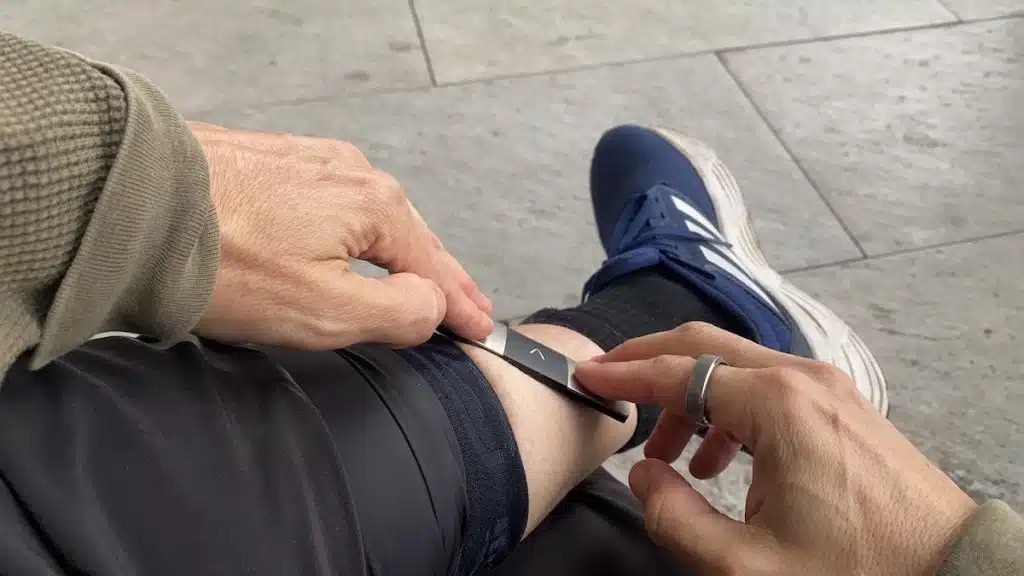
The flagship KardiaMobile 6L increases total weight to 24 grams but introduces advanced cardiac telemetry. While its top face resembles the standard model with two metallic pads for thumbs or index fingers, its underside incorporates a crucial third electrode. Placing this bottom contact against the bare skin of the left knee or left ankle while maintaining finger contact on top creates a full electrical circuit across the torso. In official launch documentation published with this release, AliveCor notes that this configuration captures six distinct clinical leads:
- Lead I: Measures electrical activity between the right arm and left arm.
- Lead II: Measures electrical activity between the right arm and left leg.
- Lead III: Measures electrical activity between the left arm and left leg.
- Lead aVR: Augmented lead viewing heart electrical activity from the right shoulder.
- Lead aVL: Augmented lead viewing heart electrical activity from the left shoulder.
- Lead aVF: Augmented lead viewing heart electrical activity pointing downward toward the feet.
Hidden Costs, Ecosystem Dependencies & Fine Print
Examining the fine print of the hardware documentation reveals several operational constraints that buyers must evaluate before choosing a model. The acoustic ultrasonic pairing method on the base $79 USD KardiaMobile requires an environment free from severe ambient acoustic noise. If you attempt to record a trace in a crowded venue or noisy vehicle, environmental audio interference can distort the microphone reception on your smartphone, resulting in an unreadable trace. Furthermore, users must explicitly grant microphone access permissions to the Kardia mobile app within their smartphone operating system, a requirement that occasionally trips up privacy-conscious users.
The physical recording procedure for the $149 USD KardiaMobile 6L introduces slight mechanical friction compared to single-lead alternatives. Capturing six leads requires sitting quietly, removing footwear or socks to access the bare left ankle or lower leg, and holding the small rectangular housing without inverting its orientation. Because the device is a symmetrical dark rectangle, users often inadvertently hold the unit upside down during initial tests, which reverses the signal orientation in the trace. While taking a single-lead measurement on the 6L is identical to the standard model, unlocking its primary feature demands dedicated physical positioning that is less discreet in public settings.
Software upsells represent another ecosystem friction point. While basic PDF generation and primary rhythm classifications remain entirely free without a monthly fee, the Kardia mobile application frequently surfaces prompts urging users to sign up for KardiaCare subscriptions. Features like sinus rhythm with PVCs (premature ventricular contractions) or wide QRS detection sit behind this paywall. Potential buyers should understand that while the core hardware delivers medical-grade signal resolution out of the box, automated software diagnostics beyond basic AFib detection require continuous digital investment.
Smarter Alternatives at This Price
Consumers evaluating the dedicated ECG market should also consider integrated smart wearables that incorporate single-lead heart telemetry directly into daily wristwear. The Apple Watch Series 10, retailing for $399 USD on Amazon, serves as the primary multi-function alternative. The Apple Watch incorporates electrical heart sensors within its digital crown and back crystal, allowing users to take a single-lead ECG anytime by resting a finger on the crown for 30 seconds. The primary advantage of the Apple Watch Series 10 is passive continuous background monitoring for irregular heart rhythms and fall detection, eliminating the need to carry a secondary physical card or dongle. However, its major limitation remains data depth: it is strictly a single-lead monitor, meaning it cannot replicate the vectors captured by the KardiaMobile 6L. Additionally, its high purchase price and daily charging requirements contrast sharply with the long battery life of dedicated devices.
For those preferring classic horology combined with passive cardiac monitoring, the Withings ScanWatch 2retails for $349.95 USD on Amazon. Featuring a traditional physical dial overlaying a small grayscale OLED display, the ScanWatch 2 delivers medical-grade single-lead ECG recordings on demand via built-in bezel electrodes. Its stand-out advantage over both Apple and AliveCor devices is its exceptional 30-day battery life on a single charge, alongside continuous body temperature tracking and sleep metrics. The trade-off lies in software complexity and physical execution: launching an ECG from the watch bezel requires navigating physical menus on a tiny watch screen, and like the Apple Watch, it remains restricted to single-lead electrical data. For individuals whose physicians specifically request multi-vector ECG traces, neither hybrid nor standard smartwatches can replace a dedicated six-lead sensor.
Final Buyer Verdict: Is the Investment Worth It?
The choice across AliveCor’s 2026 cardiac lineup comes down to explicit clinical needs versus lifestyle portability. If your primary goal is carrying an emergency single-lead monitor at all times without taking up extra space, the KardiaMobile Card at $89 USD on Amazon is the most elegant physical execution available today. The card form factor ensures you never leave home without diagnostic capability, provided you accept replacing the unit every two years due to its sealed battery design. For budget-conscious users who simply want occasional spot-checks at home, the standard KardiaMobile at $79 USD delivers identical single-lead clinical accuracy with a standard user-replaceable battery, making it the practical value choice.
However, for patients managing complex cardiac conditions or users explicitly collecting telemetry for cardiologist evaluation, the KardiaMobile 6L at $149 USD direct from AliveCor is easily worth its premium. The jump from one electrical view to six views (Leads I, II, III, aVR, aVL, and aVF) provides actual clinical diagnostic depth that no current smartwatch or wallet card can match. Looking at the broader arc of hardware design, if this generation gets multi-lead electrode contacts into pocketable form factors right, the next iteration could integrate flexible conductive polymers or kinetic micro-charging directly into wallet-style units. Until then, the KardiaMobile 6L stands as the benchmark dedicated portable diagnostic device for high-fidelity cardiac tracking.