

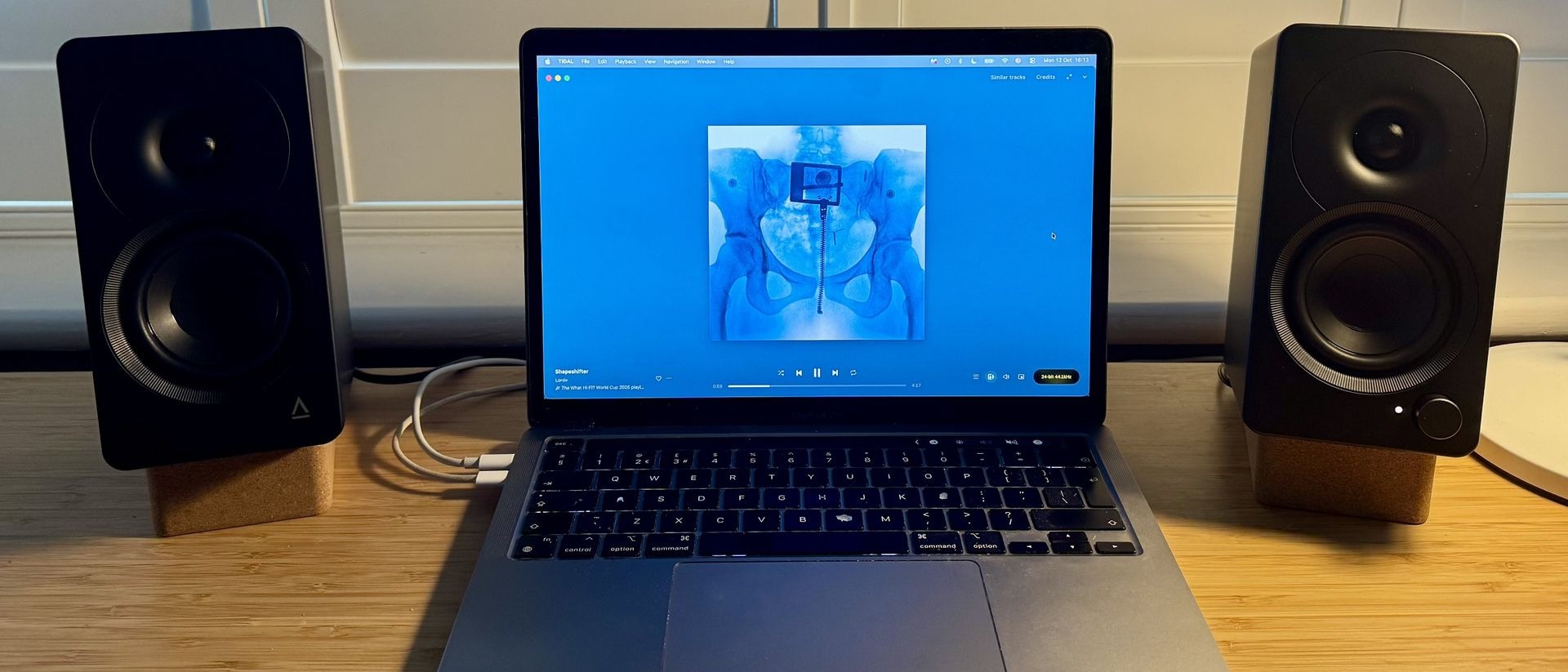
The Creative XF1desktop stereo speaker system provides a bi-amplified active nearfield audio solution that combines wired high-resolution digital playback with high-bitrate wireless streaming. Retailing at $179 on Amazon (and £139 in the UK), this two-channel active setup targets desktop professionals, remote workers, and computer audiophiles seeking an acoustically focused nearfield playback system without committing to cumbersome studio monitors or external power amplifier stacks. Upon unboxing, the package includes the left and right speaker enclosures, an external 24V DC power supply, a 1.5-meter USB-C to USB-C cable, a 3.5mm auxiliary audio cable, and a pair of custom density-matched cork wedge isolation stands. Available in both a matte black and an architectural white finish, the hardware delivers a compact physical footprint tailored specifically for overcrowded workspaces dominated by large monitors or multi-display configurations. For readers curious about evaluation methodologies, you can find out more about how we test audio hardware across varied acoustic environments.
🛒 Where to Buy: Creative XF1 Desktop Speakers
- Creative XF1 Desktop Speakers: View on Amazon
Click the link above to check current pricing, availability, and customer reviews on Amazon.
State of the Category & What Changed
Historically speaking, compact desktop audio has suffered from a persistent structural compromise. For years, computer speakers fell into one of two disappointing camps: low-cost USB-powered companion units plagued by thin, sibilant treble and boxy cabinet resonance, or oversized active studio monitors that consumed excessive desk real estate and required balanced audio interfaces alongside bulky cables. When manufacturers attempted to bridge this gap with compact Bluetooth speakers, listeners were typically forced to pair two independent wireless units in a software-driven stereo mode—a configuration that routinely introduced latency drift, channel phase inconsistencies, and heavy digital signal processing (DSP) compression. Initial product disclosures and reporting were tracked via Techradar.
Early iterations of desktop active monitors frequently attempted to cut manufacturing costs by using a single passive crossover network fed by a shared stereo amplifier block. In practice, this design choice limited dynamic headroom and caused noticeable intermodulation distortion when complex musical passages demanded simultaneous deep bass excursion and delicate high-frequency detail. Furthermore, running analog signals directly from an unshielded motherboard audio jack often introduced audible electrical noise ground loops, processing hum, and unwanted electromagnetic interference from internal PC graphics cards. The Creative XF1 represents a direct response to these historical limitations by bringing true bi-amplified active crossovers, internal high-resolution digital-to-analog conversion, and precision digital equalisation down to an accessible consumer price point.
Positioned alongside top contenders in our best stereo speakers hardware index, the XF1 demonstrates how far nearfield desktop engineering has progressed over recent product generations. Rather than relying on analog auxiliary line inputs alone, the system integrates a modern USB-C digital input stage and high-bitrate wireless connectivity into a pair of compact bookshelf cabinets designed specifically to sit beside a laptop or desktop monitor setup without cluttering the user’s workspace.
Generational Delta: The Engineering Upgrades That Matter
Examining the fine print of the hardware spec sheet reveals that Creative has outfitted the XF1 with an active bi-amped architecture capable of generating a combined 72W of peak power (36W continuous RMS). Each speaker cabinet houses a custom 19mm silk soft-dome tweeter powered by its own dedicated 10W Class D amplifier module, paired with a 76mm woven glass-fiber mid/bass driver driven by an independent 26W amplifier block. According to technical documentation published with this release, the mid/bass drivers were engineered using Finite Element Analysis (FEA) modeling to minimize physical cone flexing and distortion under heavy driver excursion. This discrete bi-amping approach eliminates the dynamic insertion losses common to passive crossover circuits, maintaining tight driver control across a stated frequency response of 55Hz to 40kHz, with the crossover slope fixed digitally at 2.8kHz using active 24dB/octave filtering.
On the digital front end, the right master speaker houses a native 24-bit/96kHz digital-to-analog converter (DAC) accessed directly via a rear-panel USB-C port. This allows PC and Mac users to bypass noisy onboard soundcards completely and feed bit-perfect digital audio streams straight to the internal active crossover. For wireless operation, the unit upgrades to a modern Bluetooth 6.0 receiver stack and incorporates Sony’s high-bitrate LDAC codec alongside standard SBC and AAC protocols. The inclusion of LDAC is worth observing, as high-bitrate wireless codecs operating up to 990kbps were historically reserved for premium wireless headphones or high-end active wireless monitors costing twice as much, providing near-cd quality transmission when streaming from compatible Android mobile devices or dedicated hi-res audio players.
The physical geometry of the XF1 also reflects thoughtful acoustic engineering tailored specifically for desk-bound listeners. Because standard computer desks position compact speakers well below human ear level—causing high frequencies to fire toward the user’s torso and creating acoustic reflections off the desk surface—Creative includes custom detachable cork wedge stands in the box. These isolation wedges elevate the front baffles at a 15° upward angle, directing the tweeter’s dispersion cone directly toward the listener’s ear canal to improve time alignment, reduce surface boundary reflections, and restore high-frequency phase coherence.
System control and sound customization are managed through the Creative Nexus companion software application, available for Windows, macOS, iOS, and Android. Beyond basic input switching and balance settings, the app gives users access to a fully functional 10-band parametric equalizer (PEQ). This degree of end-user tuning capability allows listeners to manually adjust specific parametric Q-factors, attenuate unwanted room boundary modes caused by nearby back walls, or load dozens of pre-configured acoustic profiles tailored for music playback, competitive gaming, or film viewing without altering the source hardware output settings.
Everyday Usability Trade-Offs & Adoption Barriers
Despite its technical accomplishments, the Creative XF1 entails real-world physical and mechanical compromises inherent to its modest dimensions (measuring 191 x 100 x 155mm per enclosure) and competitive price tag. The primary operational friction point stems from its fixed master-slave architecture. The right cabinet houses all central electronics, input sockets, status LEDs, and physical controls. There is no software toggle within the Nexus app to invert left and right channels, meaning users whose cable routing, desktop layout, or wall power outlet placement would benefit from a left-sided master speaker must adapt to a rigid right-hand configuration. Furthermore, the master unit connects to the left passive enclosure via a proprietary 4-pin multi-core cable that carries both power and audio signals to the bi-amped drivers; extending or replacing this multi-core connection with off-the-shelf copper speaker wire is impossible without custom soldering.
Top-panel physical controls on the primary enclosure feature a multi-function push-rotary dial paired with an multi-color LED indicator ring. While functional, navigating inputs requires cycling through colors—Green for USB digital input, Blue for standard Bluetooth pairing, Cyan for 3.5mm analog auxiliary mode, and Magenta when an active LDAC bitstream is established. The absence of a dedicated hardware remote control means listeners who adjust volume from across a room must rely entirely on their smartphone application or physical reach to the right speaker cabinet.
Sonically, while the XF1 excels in scale, soundstage stereo imaging, and midrange presence, its low-frequency behavior reveals physical limitations dictated by cabinet volume. The enclosures utilize back-firing flared bass reflex ports to extend lower boundary response. Consequently, placing these speakers directly against a wall or inside an enclosed desk cubby creates noticeable low-end acoustic boundary gain, leading to a lumpy, upper-bass boominess around the 80Hz to 120Hz region. Even when properly positioned away from rear surfaces, the lower register exhibits a somewhat single-note character with limited sub-bass extension below 55Hz, which can cause fast-paced electronic bass lines or orchestral timpani rolls to sound slightly muted in absolute texture.
The physical construction materials reflect practical manufacturing trade-offs as well. While the smooth curves and matte-finished medium-density fiberboard (MDF) cabinets look surprisingly refined in either black or white finish options, the included cork wedge stands require manual alignment and do not mechanically lock onto the cabinet bases. Additionally, while high-frequency resolution is impressive for a speaker in this class, the soft-dome tweeters can display an aggressive treble tilt on brightly mastered acoustic recordings, necessitating a slight reduction in high-end energy via the app’s PEQ controls to prevent listener fatigue during extended desk sessions.
Category Alternatives and Rival Solutions
To evaluate the XF1’s market standing, it is necessary to examine competing desktop playback solutions across nearby price brackets. Consumers prioritizing raw low-frequency impact on a restricted budget frequently turn to the Logitech, with its Z407 2.1 speaker package. Retailing for approximately $80 on Amazon, the Logitech system provides satellite speakers paired with a dedicated down-firing subwoofer and a wireless control dial. While the Z407 delivers superior absolute bass extension and lower upfront cost for movies and gaming explosions, it falls noticeably short of the XF1 in midrange transparency, high-frequency focus, and overall vocal clarity. The Logitech system lacks high-resolution USB DAC decoding, bi-amplified driver topology, and parametric software EQ controls, rendering it a compromise for critical music listening.
Conversely, listeners seeking audiophile-grade desktop performance without strict budget constraints often look to Ruark’s Mk1 line (now in its third generation as the MR1 Mk2 active Bluetooth system). Priced at approximately $399 (or £349 in the UK), the Ruark system offers real-wood veneer cabinets, optical digital connectivity, auto-switching inputs, and exceptionally refined dynamic control across the frequency spectrum. However, at more than double the cost of the Creative XF1, the Ruark system requires a far higher financial commitment while omitting built-in USB-C DAC decoding and user-configurable parametric equalisation. For PC-centric workstations, the XF1 provides a far higher ratio of digital features and bi-amped power per dollar spent.
Another common alternative in the desktop nearfield sector is the Audioengine A2+ Wireless system, which retails for roughly $269. While the A2+ offers premium painted cabinets and hand-built silk tweeters, it relies on a traditional class AB internal amplifier with passive crossovers, lacks high-bitrate LDAC wireless codec support, and omits software-based parametric equalization tools. Compared directly to the Audioengine design, the Creative XF1 delivers tighter crossover integration via its bi-amped Class D architecture and far superior signal customization at a significantly lower price point.
Final Trajectory Verdict: Future Outlook & Buying Advice
The Creative XF1 represents a well-calculated addition to the active desktop audio segment, setting a high standard for what budget nearfield speakers can deliver when modern DSP, active bi-amplified driver topographies, and versatile digital inputs are prioritized. By delivering genuine 24-bit/96kHz USB decoding, high-bitrate LDAC Bluetooth reception, 72W peak bi-amped power, and a comprehensive 10-band PEQ within a $179 footprint, Creative has successfully lowered the cost of entry for clean desktop audio monitoring.
The included 15° cork isolation wedges further underscore an engineering design intent focused directly on desktop boundary acoustics, mitigating desk surface reflections right out of the box. While users who demand deep sub-bass articulation below 50Hz or full multi-room wireless integration will need to budget for larger passive bookshelf speakers, an external subwoofer, or a dedicated amplification stack, the Creative XF1 offers an exceptional value proposition for desktop workers, remote professionals, and PC gamers alike. Provided users account for proper rear wall clearance (ideally maintaining 10 to 15 centimeters of distance) and take advantage of the Nexus app’s parametric EQ capabilities to tune out room modes, the Creative XF1 earns a solid recommendation as a sensible, highly functional nearfield audio upgrade.