

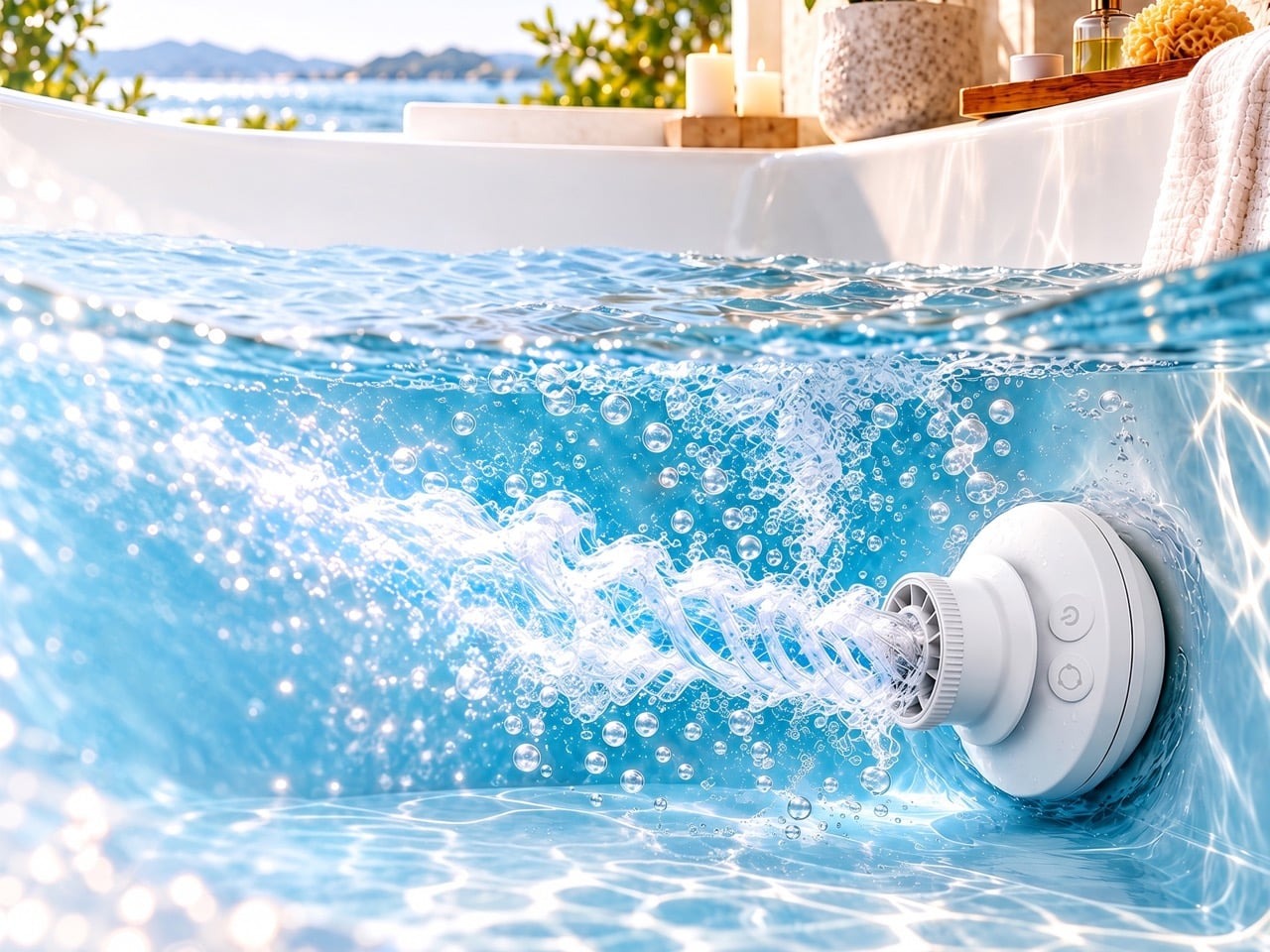
The WAVORA Z1 is a cordless, submersible hydrotherapy jet that mounts inside standard bathtubs via a double-sided suction plate to convert standard bathwater into a circulating whirlpool. Priced at an introductory $129 USD direct via its launching backer campaign ahead of a $235 USD standard MSRP, this compact puck is built for urban renters, post-workout athletes, and homeowners seeking targeted hydromassage without paying thousands of dollars for permanent plumbing installations. By shrinking a high-volume water pump down to a battery-powered device no larger than a grapefruit, the Z1 attempts to solve the fundamental friction points of home tub retrofits: invasive tile cutting, dedicated electrical wiring, and the bio-film grime that plagues internal whirlpool pipes.
🛒 Where to Buy: WAVORA Z1 Portable Jacuzzi
- WAVORA Z1 Portable Jacuzzi: View on Amazon
Click the link above to check current pricing, availability, and customer reviews on Amazon.
This hardware matters because it signals the shift toward self-contained, non-destructive home wellness devices. Historically, adding moving water to a bathroom required calling a contractor, cutting through subfloors to install a dedicated circuit, and committing to dynamic mechanical seals that eventually degrade and leak behind your drywall. The WAVORA Z1 bypasses that structural footprint entirely. Developed by Louisville, Kentucky-based WAVORA, the Z1 presents a compelling case for modular appliances that live directly inside the user’s existing environment rather than demanding permanent architectural changes. Initial product disclosures and reporting were tracked via Yankodesign.
Examining the hardware landscape reveals a clear trend: consumers are increasingly rejecting single-purpose fixtures that complicate home maintenance. The traditional jetted tub has fallen out of favor largely because the internal plumbing loops accumulate skin oils, hair, and stagnant water that spew unsightly flaking debris when activated after months of disuse. By housing the motor, impeller, and fluid channels in a single hand-held unit that drains completely at the sink, the Z1 fundamentally reframes how personal hydrotherapy equipment operates in domestic spaces.
The Problem and Hardware Purpose
Installing a traditional whirlpool tub is one of the most frustrating home renovation projects a homeowner can undertake. Beyond the baseline cost of the basin itself, standard installations require hiring a licensed plumber to rework drain lines, an electrician to run a dedicated 120V or 240V high-amp circuit, and a tile setter to rebuild surrounding walls. Total expenses routinely range between $3,000 USD and $10,000 USD for a feature that remains permanently anchored to a single room. For renters, the option does not exist at all, leaving standard shallow acrylic or cast-iron tubs as the only bathing option.
The WAVORA Z1 solves this exact structural bottleneck by decoupling hydrotherapy performance from fixed plumbing. Operating as an autonomous kinetic pump, the Z1 takes the water already in your tub and forces it through targeted directional grilles. Retailing at an accessible introductory price of $129 USD direct for the full launch kit, it provides a functional remedy for muscle fatigue and stress recovery at a fraction of the cost of a bathroom remodel. The device addresses the daily friction of static soaking, giving users controllable water movement without asking for a permanent commitment to a single floor plan.
Furthermore, the workflow solved by the Z1 extends to post-use maintenance. Traditional built-in jets utilize tens of feet of hidden flexible PVC piping tucked beneath the tub surround. Water collects in low points, breeding bacteria and mold that cannot be mechanically scrubbed without dismantling the tub apron. The Z1 condenses the entire fluid pathway into an open, accessible housing measuring just 4.3 by 3.5 inches (109 x 89mm). Cleaning the system does not require specialized chemical flushes; the user simply detaches the front grille and rinses the impeller housing directly under a tap.
Engineering Architecture & How It Works
From an architectural standpoint, the most critical engineering decision inside the WAVORA Z1 is its complete separation of the motor drive from the fluid transmission. In conventional compact water pumps, an electric motor spins a shaft that extends directly through a rubber dynamic seal into the water chamber. Under continuous operation, the friction of the spinning metal shaft against the rubber seal wears down the material, creating micro-gaps that inevitably allow water to seep into the dry motor housing and short out the electronics. WAVORA eliminated this failure point by utilizing static seals coupled with a isolated drive design.
Because there are no rotating surfaces penetrating the Z1’s outer shell, the risk of dynamic seal breakdown is engineered out of the chassis. The internal motor stays completely dry behind a sealed wall, transmitting rotational force across the barrier to drive the external fluid impeller. As an added benefit of this submerged layout, the bathwater surrounding the 19-ounce (545g) housing acts as a continuous thermal heat sink. Thermal energy generated by the electric motor dissipates directly through the shell into the bathwater, using the surrounding volume as a natural radiator to maintain optimal internal operating temperatures without requiring internal cooling fans or air vents.
The physical body of the Z1 adopts a minimalist, soft cream-white cylindrical drum profile designed to blend visually with modern ceramic and acrylic bathroom fixtures. Control is handled via two flush-mounted buttons located on the flank of the unit. To eliminate the need for users to pull the device out of the water to check operational status, subtle status LEDs illuminate directly through the translucent outer plastic shell. Water exits through a front-facing slatted grille engineered to maximize fluid velocity while suppressing high-frequency acoustic whine. The result is a compact, self-contained puck that looks more like a high-end aromatherapy diffuser than a piece of industrial pool machinery.
Fluid intake and displacement rely on a high-torque internal impeller that moves pure liquid rather than forcing air into the stream. Traditional whirlpools create aggressive bubbling by mixing high-pressure air with water through a Venturi valve, which dramatically increases operational noise and rapidly cools the bathwater by introducing ambient room-temperature air. The Z1 moves existing water volume quietly. If a user desires a aerated, bubbly texture, the system relies on chemical bath additives, such as the botanical bath bombs included in the launch bundle, which dissolve into the moving current without clogging the impeller mechanism.
Real-World Performance Reality
Operating the WAVORA Z1 highlights how variable power modes translate to practical bath routines. The device features three distinct operational profiles: Gentle Flow, Power Flow, and Spa Rhythm. Cycle management is handled through a single primary control button, allowing wet hands to toggle modes without needing a smartphone app or complex multi-button combinations. Each setting shifts both the fluid velocity and the discharge profile to match different recovery needs.
Gentle Flow: Operating at lower impeller RPMs, this setting generates a soft, continuous current across the tub volume, ideal for prolonged soaking while reading or listening to audio. Under Gentle Flow, the internal rechargeable battery delivers up to 5 hours of continuous runtime on a single charge, allowing multiple evening baths before requiring a top-up.
Power Flow: Cranking the drive motor to its maximum continuous output, Power Flow pushes heavy water volume and existing bath foam across the length of the tub. This profile targets concentrated muscle soreness in the calves, hamstrings, or lumbar back after intense physical training. Due to the higher current draw, battery endurance drops to roughly 2 hours in this high-output mode.
Spa Rhythm: This mode modulates the motor frequency up and down in continuous wave cycles, mimicking the pulsing surge of commercial hydrotherapy jets. Spa Rhythm provides dynamic pressure variation to prevent muscular desensitization during longer sessions, yielding approximately 1 hour of continuous operation per charge cycle.
Recharging is handled externally via an included USB charging cable. Because the device is entirely cordless during operation, it eliminates the dangerous presence of high-voltage cords trailing over tub edges to wall outlets—a frequent safety drawback of older portable bath jets. Charging the Z1 takes place away from the tub at any standard USB power port once the housing is dried off.
Mounting versatility is secured by a heavy-duty, double-sided suction plate. One face locks onto the back housing of the Z1, while the opposite face adheres to the bath surface. In practice, the suction mechanism anchors reliably to smooth, non-porous surfaces including acrylic, porcelain enamel, smooth glass, polished stainless steel, and glazed ceramic tile. Positioned horizontally on a side wall, the Z1 acts as a localized lumbar jet. Positioned flat on the floor of the tub pointing upward, it creates a rising spring current that circulates water from the bottom up, distributing heat evenly throughout the basin and preventing the cold-bottom effect common in deep tubs.
Competitive Landscape: Named Rivals Compared
To understand the Z1’s position in the personal care space, it must be evaluated against existing portable bath jet solutions currently available on the retail market. The entry-level market has long been dominated by corded over-the-rim bath spa attachments, which carry significant physical and operational compromises.
Consider the Conair Dual Jet Bath Spa, available for $59.99 USD on Amazon. The Conair unit relies on a traditional corded power configuration, requiring a 13-foot low-voltage power cord to stretch from a bathroom wall outlet down into the tub basin. Beyond creating a visual mess and a potential trip hazard in a slick environment, the Conair model utilizes a rigid, hanging plastic bracket designed to hook over standard thin-walled tubs. It fails to mount properly on wide-ledge drop-in tubs, freestanding stone soaking tubs, or fully tiled alcove enclosures. Furthermore, its dual swiveling nozzle heads rely on open internal channels that trap soap scum, body oils, and hair, making internal cleaning nearly impossible without unscrewing plastic housings. The Z1 justifies its higher price tag by removing trailing power cables, offering universal suction mounting, and utilizing a quick-release detachable faceplate that rinses clean in seconds.
Another common alternative is the HoMedics Jetspa Deluxe Dual Jet, retailing $49.99 USD USD on Amazon. While cheap, the HoMedics model is a bulky, top-heavy appliance that relies on older dynamic motor shaft seals and exposed suction channels. Users frequently report high acoustic vibration, as the rigid plastic housing transfers motor hum directly into the tub wall, creating a loud drone that disrupts a quiet bath environment. Additionally, the HoMedics unit lacks variable speed wave pulsing, offering only basic high/low toggle switches. The WAVORA Z1 offers superior acoustic isolation due to its water-cooled static-seal housing, while providing progressive pulse programming (Spa Rhythm) and a significantly smaller physical footprint (19 oz vs over 3 lbs for legacy rim-hanging units).
What’s next for this category? Looking at the broader arc of hardware design, if this generation gets its static magnetic seal endurance and suction mount longevity right over extended hot-water exposure, the next logical iteration could integrate smart temperature-monitoring sensors and app-customized pressure wave routines. In scrutinizing official launch documentation published with this release, WAVORA’s engineering roadmap hints that future revisions may explore quick-connect modular nozzles—allowing users to swap the wide slatted diffusion grille for concentrated pin-point jet attachments designed specifically for deep-tissue plantar fascia and thoracic spine therapy.
Final Buyer Recommendation: Practical Value Decision
The WAVORA Z1 delivers a well-engineered, pragmatic solution to a historical home improvement dilemma. At its early launch price of $129 USD direct (packaged as the Spa Ritual Set featuring six botanical bath bombs, six tub liners, a storage mesh pouch, and a USB charging cable), it represents a high-value investment for consumers looking to enhance their relaxation routine without altering their home’s physical infrastructure. By eliminating high-maintenance internal plumbing, dynamic shaft seals, and dangerous wall-tethered power cords, WAVORA has successfully transformed a notoriously problematic appliance category into a safe, hygienic, and portable personal care device.
However, prospective buyers should weigh their specific usage patterns before backing the campaign. While Gentle Flow offers a generous 5 hours of runtime, heavy users who demand continuous high-velocity performance via Power Flow or Spa Rhythm will need to recharge the unit after roughly 1 to 2 hours of use. Furthermore, examining the fine print of the hardware dispatch reveals an estimated global shipping window targeted for January 2027, and WAVORA has not yet published explicit final warranty terms on its launch portal. Buyers seeking immediate next-day delivery or those requiring aggressive, air-injected commercial hydro-tub pressure may prefer saving for a dedicated plumbing retrofit. But for urban renters, post-workout athletes, and practical home renovators wanting clean, localized water movement today, the Z1 is an exceptionally smart piece of hardware design.