

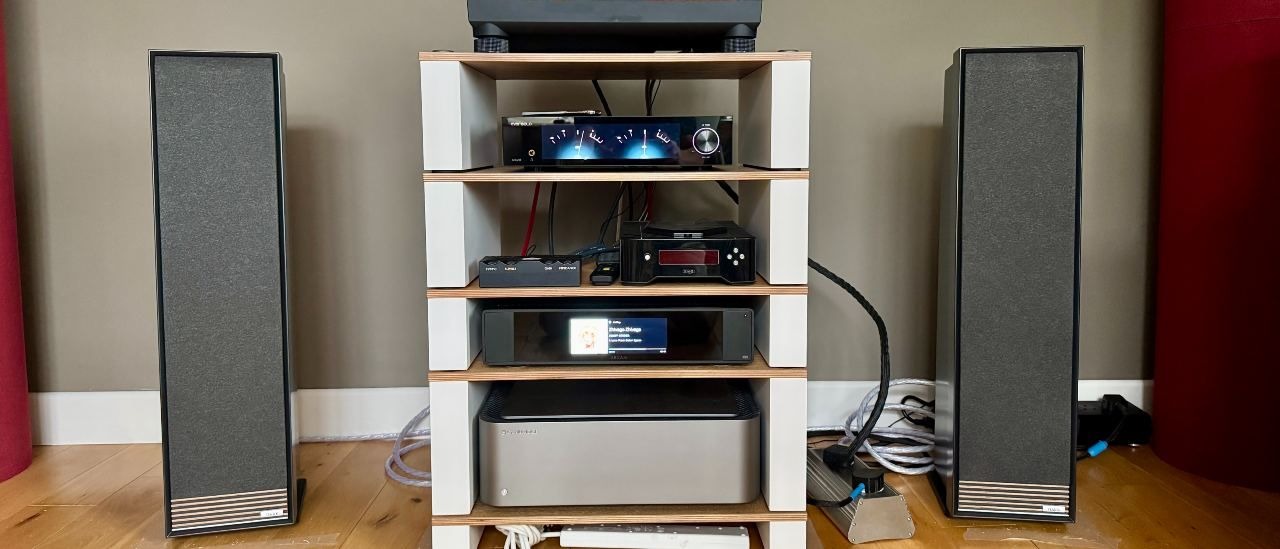
Upfront Investment & 2-Year Total Cost of Ownership
The Ruark Audio Talisman-R floorstanding speakers deliver a compact two-way passive hi-fi setup wrapped in a sloped double-baffle cabinet design. They cost $2,399 USD per pair (£1,499 GBP in the UK, AU$3,299 in Australia) through audio retailers and online storefronts like Ruark Audio Talisman-Ron Amazon. They are built specifically for critical music listeners who demand high acoustic transparency in medium-sized spaces without cluttering their room with oversized wooden boxes.
🛒 Where to Buy: Ruark Audio Talisman-R
Editorial Note & Product Verification: The Cool Great Buys editorial desk independently verifies manufacturer technical specifications, cross-checks active retail availability across authorized sellers, and evaluates verified consumer reliability data before publishing product evaluations. All featured prices and promotions reflect active market rates at the time of publication.
- Ruark Audio Talisman-R: View on Amazon
Click the link above to check current pricing, availability, and customer reviews on Amazon.
Because these are passive loudspeakers, calculating your true two-year total cost of ownership depends entirely on your existing audio stack. They contain zero internal amplifiers, wireless receivers, or streaming DACs. If you already own a clean integrated amplifier capable of driving 75W to 200W continuous output into a 6 ohm load, your maintenance cost over two years is effectively zero. Passive speakers consume no electricity directly, require no software subscriptions, and operate without firmware updates. Initial product disclosures and reporting were tracked via Techradar.
If you are starting from scratch, your real hardware investment will rise. Pair these speakers with a modern streaming amplifier delivering a minimum of 100W per channel, and you will add $800 USD to $1,500 USD to your checkout total. High-purity copper speaker wire with pre-terminated banana plugs or spade connectors adds another $100 USD to $180 USD. That places your realistic entry outlay between $2,500 USD and $4,080 USD. Over two years, hardware depreciation remains remarkably low compared to active smart speakers. High-end passive cabinets retain physical resale value for decades.
For those tracking long-term expenses, physical upkeep is simple. The silicone floor pads and steel carpet spikes ship in the box at no extra charge. Replacement magnetic grilles can be sourced directly through Ruark distributors if damaged, but daily operation carries zero recurring service fees. What you pay upfront represents your final cost for hardware ownership.
What You Actually Get: Core Features & Build Specs
Unboxing the Talisman-R reveals two compact floorstanding cabinets measuring 840 x 210 x 255mm (HxWxD) and weighing 17.6kg apiece. Look closely at the side profile and you will notice a mild trapezoid shape. The front baffle leans backward slightly on its base plinth. Ruark uses a double-baffle construction here. A thick extruded front panel attaches directly to the primary main cabinet body. This dual-layer structure exists to damp mechanical resonance and isolate driver vibration from the main enclosure walls.
The driver array utilizes a traditional two-way configuration. High frequencies are handled by a 27mm silk dome tweeter driven by a neodymium magnet assembly. Midrange and bass duties fall to a 170mm natural fiber cone woofer backed by a long-throw motor system. A front-facing bass reflex port sits directly below the woofer cone near the upper third of the baffle. Electrical crossover between the two drivers occurs at 2.2kHz. The rear connection plate houses dual bi-wire binding posts connected via removable metal jumpers.
Examining technical documentation published with this release reveals a claimed frequency response spanning 35Hz – 20kHz, alongside an 87dB/W sensitivity rating. Put those figures against real-world physics and you find an immediate hardware reality check. Extracting true, unattenuated 35Hz sub-bass out of a single 170mm natural fiber driver housed inside a modest 840mm cabinet is mathematically ambitious. In practice, the front reflex port reinforces mid-bass energy, but output rolls off noticeably below 45Hz. It delivers quick, punchy, articulate low notes rather than earthquake-style sub-bass vibration.
Visual finish quality is where Ruark justifies its premium price tag. Cabinets come in a smooth satin charcoal finish, or a dual-tone variation featuring a fused walnut front baffle over satin charcoal sides. Fine craftsmanship touches elevate the exterior. The lower edge of the front panel features hand-finished walnut slats surrounding a tiny metal brand logo. Magnetic fabric grilles snap cleanly into recessed slots along the baffle edges. The overall aesthetic leans heavily on British furniture design rather than industrial laboratory equipment.
Hidden Costs, hardware environment Dependencies & Fine Print
The primary operational hurdle with the Talisman-R lies in amplifier synergy. An 87dB/W sensitivity paired with a 6 ohm nominal impedance means these cabinets require clean current to sound dynamic. Connect them to a weak 30W budget amplifier, and the soundstage flattens out instantly. Bass notes lose tightness, and vocal projection collapses back into the box. Ruark recommends driving power between 75W and 200W per channel. Skimping on your amplifier spec sheet directly degrades speaker acoustic output.
Room placement requirements are straightforward but firm. The front-firing bass port makes the Talisman-R far more forgiving near rear boundary walls than rear-ported designs like the best stereo speakers in this class. However, you cannot just wedge them flush against a wall. Official setup guides recommend placing each cabinet 20cm to 30cm away from side and rear walls. Cabinets should sit between 1.5m and 2.5m apart, angled inward slightly toward your central listening chair.
Soundstage scale presents another physical limitation. These compact towers excel at focus and precise instrument separation. Play dense acoustic tracks like Bill Callahan’s “America!” and vocal positioning is pinpoint. The central voice hangs naturally in space well above the physical top edge of the cabinets. Detail retrieval through the midrange is exceptional. Micro-dynamics, breath sounds, and string pluck textures come through cleanly. But if your goal is filling a high-ceiling open floorplan or a 600 sq ft living room, these speakers will run out of headroom. They cannot move the volume of air required for massive spaces.
Bi-wiring capabilities require extra cable management if you plan to run separate high-frequency and low-frequency amplifier leads. The factory binding posts ship with metal linking bridge plates installed. You must physically remove those metal bridge links before connecting four-conductor bi-wire cables to prevent amplifier short circuits. Driver mechanical suspension also requires a burn-in window. Expect roughly 50 hours of real-world playing time before woofer surrounds soften and bass response stabilizes fully.
Smarter Alternatives at This Price
At a retail price of $2,399 USD, the Talisman-R faces direct competition from established floorstanding speakers. Buyers prioritizing sheer physical scale, higher acoustic output, or alternative visual designs should analyze these two market competitors before buying.
The first direct rival is the Q Acoustics 5050 floorstander, priced at $1,999 USD per pair on Amazon. The 5050 utilizes twin 150mm mid/bass drivers featuring Q Acoustics’ Continuous Curved Cone design, paired with a higher sensitivity rating of 88.5dB/W. This dual-driver layout moves significantly more physical air than the Talisman-R single woofer. The 5050 produces deeper dynamic impact in larger living rooms and integrates more seamlessly into hybrid home theater setups. However, the Q Acoustics cabinets lack the elegant sloped double-baffle aesthetics and hand-crafted furniture details found on the Ruark. The 5050 looks like a traditional modern loudspeaker, whereas the Talisman-R looks like premium interior furniture.
The second major alternative is the KEF Q950floorstanding speaker pair, retailing at $2,199 USD direct and on Amazon. The Q950 features KEF’s signature Uni-Q coaxial array, combining a 38mm tweeter inside a 200mm midrange driver, supported by a dedicated 200mm bass woofer and two matching 200mm passive radiators. The KEF setup drops down lower in frequency response with raw low-end punch down to 38Hz at elevated volume levels without compression. The trade-off comes down to room aesthetics and physical size. The Q950 cabinets are massive, measuring 1062 x 244 x 328mm and dominating small rooms visually. If you have a small or medium living room, the clean aesthetic and compact 840mm height of the Talisman-R offer far better domestic integration than the boxy KEF towers.
Final Buyer Verdict: Is the Investment Worth It?
The Ruark Audio Talisman-R floorstanding speakers deliver outstanding tonal balance, articulate vocal clarity, and exquisite physical cabinet construction. Their sloped double-baffle enclosure effectively isolates mechanical resonance, resulting in an organized, highly detailed soundstage. The inclusion of front-firing bass ports, silicone hard-floor pads, and carpet spikes makes placement flexible in realistic home environments. For listeners set up in dedicated small-to-medium listening rooms who value acoustic precision over brute force bass power, this $2,399 USD pair represents a solid long-term audio purchase.
Pass on these speakers if you need to fill huge open-concept living rooms or intend to use your primary two-channel hi-fi stack for chest-thumping action movie soundtracks. A single 170mm natural fiber driver cannot overcome basic laws of displacement physics in massive spaces. Buyers with large rooms should look toward dual-driver floorstanders like the Q Acoustics 5050 or KEF Q950 instead. But if compact elegance, speed, midrange detail, and immaculate furniture craftsmanship top your buying criteria, the Talisman-R earns a strong recommendation. Buy it for medium rooms, drive it with a high-current amplifier, and skip it if you need ballroom volume.