

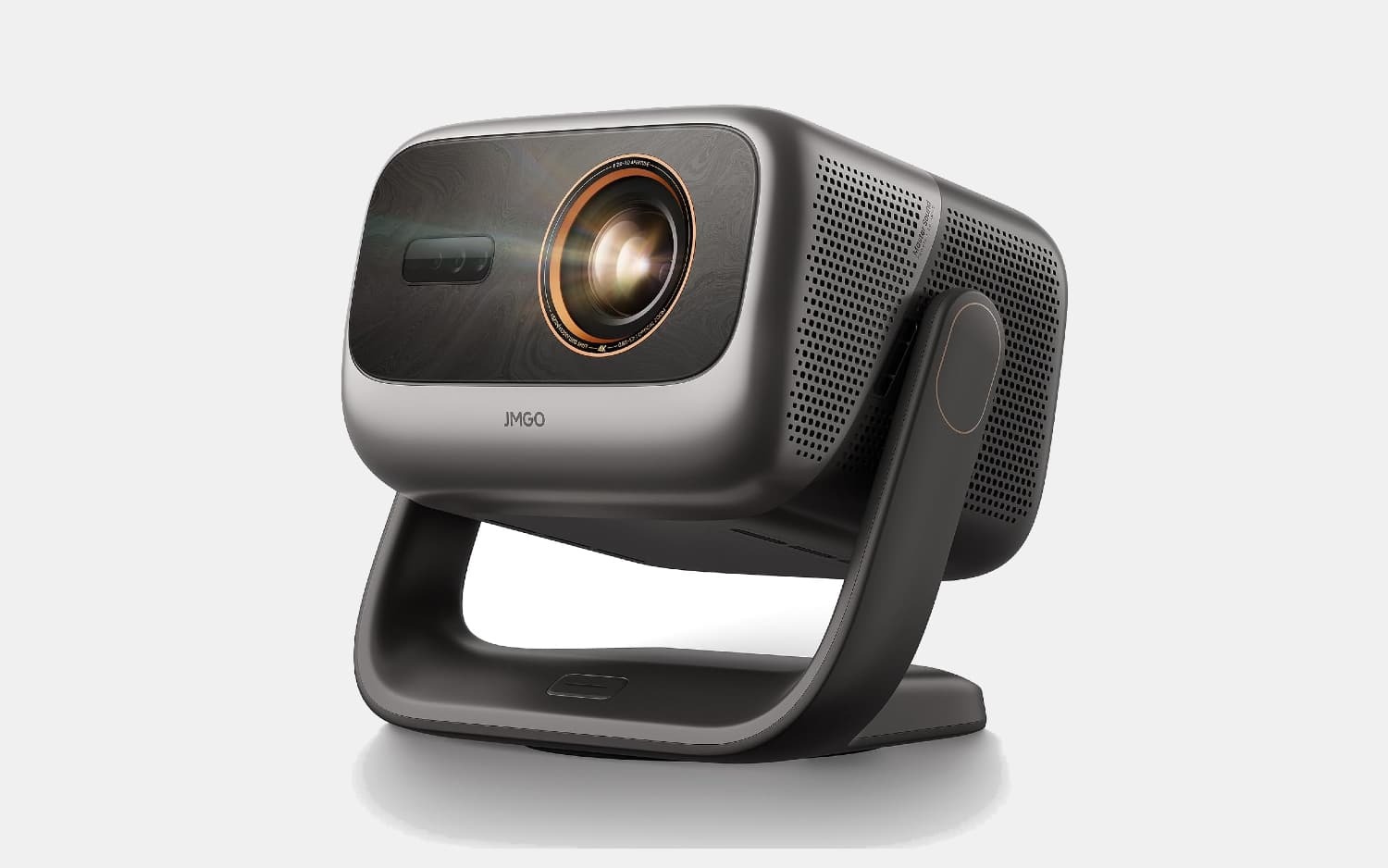
The JMGO IRIS Ultra Max 4K Projectoris a high-output home theater projection system housed in an integrated motorized gimbal chassis designed to throw up to 300 inches of 4K display without ceiling mounts or permanent structural brackets. Retailing at $2,999 USD on Amazon and direct from the manufacturer, this projector is engineered for media enthusiasts who require high ambient-light performance in multi-use living spaces without sacrificing physical placement flexibility. As detailed in product announcements covered by Gear Moose, the hardware pairing of high-lumen laser optics and automated alignment mechanics directly targets the installation frictions that have historically suppressed long-throw projector adoption in residential environments.
🛒 Where to Buy: JMGO IRIS Ultra Max
- JMGO IRIS Ultra Max: View on Amazon
Click the link above to check current pricing, availability, and customer reviews on Amazon.
Historically speaking, home projection systems forced a rigid compromise between optical quality and installation complexity. Traditional high-brightness units required precise distance calculations, manual lens shifts, or permanent ceiling joist anchors that rendered them impractical for modern living rooms with cathedral ceilings or floor-to-ceiling windows. The IRIS Ultra Max addresses these mechanical hurdles through motorized articulation and advanced optical geometry, offering high-tier display specifications inside a self-contained, desktop-friendly footprint.
Upfront Investment & 2-Year Total Cost of Ownership
Acquiring the hardware requires a baseline capital outlay of $2,999 USD at launch. Unlike legacy Ultra High Performance (UHP) mercury vapor bulb projectors—which demanded costly lamp replacements every 2,500 to 3,000 hours at approximately $350 USD per module—the solid-state laser light source in the IRIS Ultra Max carries an operational rating of 25,000 hours. In practice, this eliminates ongoing lamp replacement expenses entirely across standard operational lifespans, even under heavy daily utility.
However, running a high-lumen light engine introduces non-negligible energy costs. Analyzing the manufacturer spec sheet reveals a nominal electrical draw of approximately 380W under maximum laser output settings. Assuming an average residential electricity rate of $0.16 per kWh across a daily usage pattern of 4 hours, power consumption accounts for roughly $88.76 USD annually, or $177.52 USD over a two-year operational window. Additionally, protecting a precision laser device of this tier necessitates a quality surge suppressor rating of at least 2,160 Joules with low clamping voltage, adding roughly $45 USD in peripheral protection hardware.
Screen selection constitutes the most significant hidden line item in total ownership calculations. While the projector can function on a blank wall, maximizing a 6,500 ISO lumen light engine in ambient lighting requires a dedicated Ambient Light Rejecting (ALR) optical screen. A motorized 120-inch or 150-inch fixed-frame ALR screen adds between $800 USD and $1,500 USD to the setup. Consequently, the realistic two-year total cost of ownership ranges from $3,221.52 USD using a plain white surface to $4,721.52 USD for a fully optimized optical setup.
What You Actually Get: Core Features & Build Specs
At the center of the hardware architecture is JMGO’s proprietary MALC 6.0 (Micro-Laser Array Light Engine) triple-laser engine. The system achieves a peak brightness claim of 6,500 ISO lumens alongside a 10,000:1 native contrast ratio. Notably, the optical assembly supports 4K resolution rendering paired with a 120Hz refresh rate, Dolby Vision dynamic metadata processing, and Variable Refresh Rate (VRR) protocols via HDMI 2.1 connectivity. This spec sheet bridges the traditional performance gap between high-end home cinema and modern gaming console requirements.
The primary architectural innovation resides in the motorized gimbal chassis. The housing provides 360 degrees of horizontal rotation alongside 150 degrees of vertical tilt elevation. This mechanical freedom operates in tandem with an optical zoom lens array, four-way optical lens shift, real-time dynamic auto-focus, and AI-driven screen edge detection. Rather than relying purely on digital keystone correction—which forcibly degrades native resolution by cropping active pixels—the hardware optical adjustment preserves full pixel density across unconventional projection angles.
The engineering trade-off here is worth observing. Early generations of consumer laser projectors, such as single-laser phosphor wheel designs from the late 2010s, suffered from noticeable speckle and severe color separation artifacts (commonly referred to as rainbow effects). JMGO’s MALC 6.0 optics utilize multi-beam blending to suppress grain structure while expanding color space coverage beyond the Rec.709 spectrum into deep DCI-P3 and BT.2020 gamuts. The distinction matters here: higher lumen output without proper optical diffusion often creates harsh visual fatigue, but the IRIS Ultra Max manages luminance uniformities across variable throw distances up to 300 inches diagonal.
Operating system integration relies on Google TV natively built into the firmware, backed by hardware decoding for standard video codecs and streaming DRM layers. An integrated multi-driver speaker array is built directly into the base structure of the gimbal mount, providing localized audio output without requiring immediate external audio cabling during temporary or mobile installations.
Hidden Costs, Ecosystem Dependencies & Fine Print
While the hardware specifications appear complete on paper, deploying a projector with this level of optical energy introduces distinct environmental dependencies. Achieving the advertised contrast ratios in a well-lit living room depends heavily on surface reflectivity. Projecting directly onto painted drywall results in light diffusion that washes out black levels in high-dynamic-range (HDR) scenes. To achieve true Dolby Vision tone mapping, buyers must budget for high-contrast screen materials.
Software and DRM licensing represent another operational nuance. While Google TV provides native access to major streaming applications, field implementation of high-end projectors often reveals firmware level handshaking quirks with specific content services or external AV receivers. Passing multi-channel audio such as Dolby Atmos over eARC (Enhanced Audio Return Channel) to dedicated soundbars or surround receivers requires high-bandwidth 48Gbps HDMI 2.1 cables. Substituting standard legacy HDMI cables will throttle video refresh rates down to 60Hz or drop audio pass-through down to stereo PCM.
Examining the fine print of the hardware documentation reveals thermal and acoustic trade-offs. Generating 6,500 ISO lumens produces considerable thermal energy, requiring multi-fan active cooling assemblies. Under maximum laser output modes, internal fan noise reaches approximately 32dB. In smaller rooms or quiet dialogue scenes, fan acoustics become audible if the unit sits on a coffee table directly adjacent to the viewer. Furthermore, power management profiles dynamically throttle peak brightness if internal thermal sensors detect ambient operating temperatures exceeding 35 degrees Celsius (95 degrees Fahrenheit).
Physical footprint and packaging considerations should not be overlooked. The integrated gimbal base increases overall packaging volume, creating substantial non-compressible waste upon unboxing. For renters or buyers who move frequently, storing the reinforced transport carton requires dedicated closet or garage storage space. Buyers seeking disclosure details regarding referral links and publication compliance can review editorial policies here.
Smarter Alternatives at This Price
At the $2,999 USD price threshold, prospective buyers face strong competition from established display manufacturers offering distinct form factors and optical approaches. Evaluating these alternatives reveals clear operational trade-offs depending on room architecture and installation preferences.
The Epson EpiqVision Ultra LS800retails for $2,999 USD on Amazon and represents the primary Ultra Short Throw (UST) alternative. Utilizing a 3-chip 3LCD engine, the LS800 produces 4,000 ANSI lumens without the possibility of laser speckle or rainbow artifacts inherent to single-DLP systems. The principal advantage of the Epson unit is its extreme ultra-short throw optics: sitting just inches from a wall, it casts a 120-inch image without walking paths obstructing the light beam. However, the LS800 lacks the physical placement flexibility of a motorized gimbal, relies on pixel-shifting lower native resolution panels, and cannot be easily rotated 360 degrees for impromptu ceiling or multi-wall setups.
Another prominent competitor is the Formovie THEATER 4K Projector, priced at $2,999 USD on Amazon. Powered by ALPD 4.0 triple-laser technology and featuring integrated sound tuned by Bowers & Wilkins, the Formovie model offers industry-leading black level performance, exceptional native contrast (3,000:1 native ANSI), and meticulous factory color calibration out of the box. Its primary limitation relative to the JMGO IRIS Ultra Max lies in raw light output (2,800 ANSI lumens vs. 6,500 ISO lumens) and static positioning requirements. While the Formovie delivers superior cinematic refinement in darkroom environments, the JMGO maintains higher visual pop and usability in bright, non-dedicated living areas.
Final Buyer Verdict: Is the Investment Worth It?
The JMGO IRIS Ultra Max 4K Projectorrepresents a sophisticated engineering solution for a specific consumer dilemma: achieving a massive, high-luminance cinematic picture without committing to permanent architectural installation work. The integration of a MALC 6.0 triple-laser optical engine with a fully motorized 360-degree horizontal and 150-degree vertical gimbal transforms optical alignment from a tedious hours-long calibration exercise into an automated routine. For homeowners with open-concept living spaces, vaulted ceilings, or high ambient light levels who desire high-frame-rate gaming at 120Hz alongside Dolby Vision playback, the hardware delivers genuine functional value for its $2,999 USD MSRP.
Conversely, traditional home theater purists operating dedicated, light-controlled darkrooms may find the unit’s extreme lumen output unnecessary and its compact form factor less specialized than fixed ultra-short-throw or dedicated ceiling-mounted cine-projectors. Furthermore, buyers unwilling to invest in a complementary ALR optical screen will fail to extract the full contrast potential of the triple-laser engine. For those prioritizing placement versatility, sheer luminance, and modern high-refresh-rate gaming capability in a single chassis, the IRIS Ultra Max stands out as an exceptionally capable piece of display engineering.