

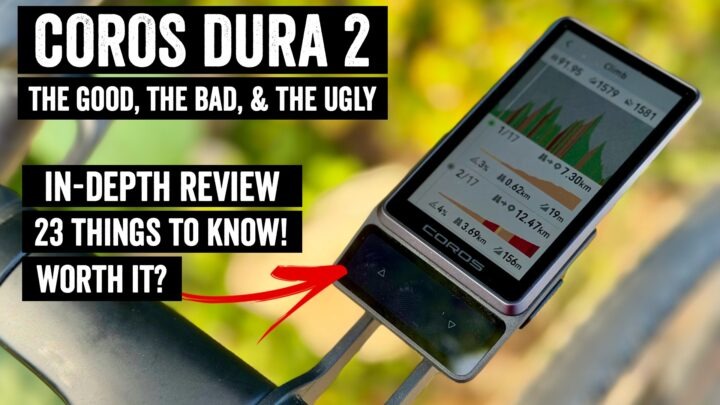
The COROS Dura 2 Solar is a full-featured GPS cycling computer built around a massive 3.5-inch solar-assisted Memory-in-Pixel display, internal speaker, and voice control microphone. Retail pricing starts at $499 USD without out-front mounts included in the box, rising to $549 USD if you purchase the bracket directly from COROS at checkout. This high-end unit targets ultra-endurance cyclists, ultra-distance racers, and remote bikepackers who demand extreme battery longevity over bright, power-hungry backlit liquid-crystal displays.
🛒 Where to Buy: COROS Dura
Editorial Note & Product Verification: The Cool Great Buys editorial desk independently verifies manufacturer technical specifications, cross-checks active retail availability across authorized sellers, and evaluates verified consumer reliability data before publishing product evaluations. All featured prices and promotions reflect active market rates at the time of publication.
- COROS Dura: View on Amazon
Click the link above to check current pricing, availability, and customer reviews on Amazon.
Hardware changes from the original Dura are drastic and far-reaching. COROS eliminated the original $249 entry-level price point entirely, shifting its product strategy squarely into the premium tier. They also officially discontinued the first-generation unit, forcing buyers to choose between this heavily revised platform or competing alternatives from established brands. The exterior housing received a total redesign from the ground up. Gone is the clumsy mechanical Digital Crown dial that plagued the initial iteration with debris collection and water ingress issues. Instead, you get dedicated physical buttons alongside pressure-sensitive touch zones located directly beneath the display glass. On paper, it looks sleek, rugged, and modern. In hand, the device feels dense, rigid, and well-constructed.
However, unboxing this $499 USD flagship unit reveals an annoying and frankly baffling omission. The retail packaging includes a braided USB-C charging cable, safety documentation, and a wrist lanyard, but it includes zero handlebar mounting hardware. Buyers must supply their own standard quarter-turn bracket or pay extra out of pocket for official mounts. You can buy an official Garmin-made mount for $9 on Amazonor pick up a multipack of replacement quarter-turn mounts for $7 on Amazon to securely anchor the head unit to your handlebar or stem. Leaving cheap rubber O-ring mounts out of a $500 bike computer box is a poor choice that alienates first-time buyers who expect a complete out-of-the-box experience.
Manufacturer Claims vs. Engineering Reality
In official launch documentation, the COROS engineering team claims the Dura 2 features the fastest refresh rate of any Memory-in-Pixel display currently on the market, hitting a remarkable 38Hz. They also claim class-leading solar charging efficiency through an entirely updated photovoltaic layout across the lower face of the computer. Examining physical performance against these bold marketing specs paints a distinctly mixed picture during day-to-day riding. The high-speed 38Hz panel certainly renders menu scrolling, map panning, and data page transitions smoother and more fluid than older 10Hz and 15Hz displays found on legacy hardware. However, screen visibility suffers significantly under common real-world riding conditions.
Direct daylight visibility is crisp, sharp, and highly legible. The reflective display layer truly thrives under unbroken, blazing sunlight where traditional LCD panels wash out completely. However, riding through dense forest shadows, overcast mountain passes, or with the low sun cast directly behind your back reveals severe visibility drops. Compared against rival cycling computers running default automatic backlight profiles, the Dura 2 display appears noticeably dark in shaded environments. COROS intentionally throttles backlight intensity and duration to inflate their battery life marketing metrics. The extra battery hours gained from this strategy are undeniably real, but you trade away screen readability in shaded woods and twilight conditions.
Solar panel positioning underwent a major structural change to optimize surface area exposure. COROS shifted the solar harvesting photovoltaic strip from the upper forehead of the device down to the bottom chin area beneath the screen. This shift eliminates the awkward top bezel bump of the original model, giving the hardware a cleaner aesthetic profile. In direct, unobstructed sunlight, solar harvesting supplies a steady trickle charge to the internal lithium-ion cell, helping to extend runtimes during long summer bikepacking trips. However, solar power remains strictly a secondary top-off system. It cannot rapidly recharge a depleted battery on its own, nor can it pull you out of a deficit if you are riding exclusively under heavy cloud cover or indoors.
Battery performance remains the primary reason to seriously consider this unit. COROS promises dozens of operating hours on a single charge, and real-world power consumption aligns remarkably close to those manufacturer battery charts. Even with full multi-constellation GNSS tracking enabled alongside dual-frequency GPS routing, battery drain proceeds at a minimal rate that leaves competitors trailing. Ultra-endurance athletes who routinely ride 200-plus miles without stopping to sleep will deeply appreciate this power efficiency. Yet, aggressive power management tricks cannot fully compensate for poor screen lighting when you are descending fast through dark forest covers where split-second map readability is vital.
Under the Hood: Technical Architecture and Build Quality
Physical casing dimensions align closely with modern large-format bike computers like the Garmin Edge 1050, offering an expansive viewing canvas. However, the Dura 2 features a notably slimmer profile that sits lower and more aerodynamically on out-front mounts. Build quality feels rigid, durable, and impact-resistant against accidental drops and trail abuse. The rear shell houses a standard quarter-turn mounting plate that attaches securely via four small physical screws. If you happen to crash hard and shear off a mounting tab, you can easily replace just the plastic plate without having to throw away the expensive electronic head unit.
Physical controls rely on an interesting hybrid interface scheme. A left-side button marks manual laps and handles power functions, while a right-side button controls activity start, stop, and general menu selection actions. Directly below the 3.5-inch screen, two pressure-sensitive zone pads sit flush on the solar chin. These pads handle menu navigation, zoom controls, and data page flipping. Unlike capacitive touchscreens that rely on electrical skin conduction, these pressure zones react strictly to physical force and mechanical pressure. Because of this design choice, they operate reliably in heavy downpours, muddy conditions, and through thick winter riding gloves.
Unfortunately, system menu logic introduces severe usability flaws that hamper daily operation. Accessing critical settings like display backlight brightness, audio volume, satellite configuration, or bike alarm parameters requires a top-down swipe gesture on the main touchscreen glass. There are no physical button shortcuts available for these vital sub-menus. During heavy rainstorms, pooled water and stray droplets on the glass register as false touches, rendering the capacitive screen unresponsive or erratic. Being locked out of basic display adjustments during a violent storm simply because the software lacks button redundancy is a glaring design fault.
The integrated audio and microphone hardware introduces even more functional problems. COROS added an electronic bike bell feature activated by double-tapping the screen glass. While the bell produces a clear high-pitched chime, the internal speaker output lacks sufficient volume. In real-world trail testing, the bell chime completely fails to cut through background wind noise, highway traffic, and spinning tire hum. Pedestrians and fellow cyclists rarely notice it in time. Furthermore, the headline voice control feature fails miserably on open roads. Wind turbulence rushing past the microphone housing at speeds above 15 kph corrupts speech recognition entirely. Holding down a physical button to yell navigation commands that fail nine times out of ten is an unnecessary distraction.
Sensor connectivity covers standard modern protocols completely. The Dura 2 pairs seamlessly with standard ANT+ and Bluetooth hardware accessories, including heart rate monitor chest straps, optical armbands, single and dual-sided power meter crank spiders, smart trainers using Bluetooth FTMS protocols for indoor resistance control, electronic drivetrain wireless shifting status tracking for SRAM AXS and Shimano Di2 systems, and cycling safety gear like ANT+ rearview radar units and smart light networks. Furthermore, COROS plans to expand sensor capacity up to 32 simultaneous connections via upcoming firmware updates, alongside planned Campagnolo electronic shifting support scheduled before the end of the year.
Verified Market Alternatives
At a $499 USD base retail price, the Dura 2 enters direct and aggressive competition with highly refined cycling computers backed by mature, feature-rich software platforms. The most obvious direct competitor in the solar category is the Garmin Edge 1040 Solar, priced at $699.99 USD on Amazon. While the Edge 1040 Solar costs significantly more up front, it ships with a complete collection of out-front and stem mounting hardware included right in the box. Garmin provides fully independent on-device re-routing, deeply integrated training load metrics, custom SRAM and Shimano shifter button mapping, and vastly superior screen backlighting performance under dynamic trail shade.
For riders looking for reliable physical button navigation without solar gimmicks inflating the price, the Wahoo ELEMNT ROAM v2represents a compelling alternative, selling for $399.99 USD on Amazon. The ROAM v2 features dedicated physical tactile buttons for every single menu operation, avoiding touchscreen lockouts completely during heavy rainstorms. While its smaller 2.7-inch display lacks solar charging capabilities, Wahoo delivers crystal-clear screen contrast under dark tree canopies, robust turn-by-turn routing prompts, and highly reliable third-party app syncing for $100 less than the base Dura 2.
Final Editorial Verdict: Long-Term Reliability Outlook
The COROS Dura 2 Solar is an ambitious hardware redesign that is unfortunately held back by flawed software decisions and disappointing retail packaging choices. Ditching the fragile mechanical Digital Crown dial was the absolute right mechanical move for long-term durability. The thinner housing, smooth 38Hz screen refresh rate, and rain-proof pressure zones demonstrate clear physical engineering progress. However, raising the base price to $499 USD while stripping basic mounting brackets out of the box harms overall consumer value. Half-baked software additions like wind-sensitive voice commands and a quiet electronic bell do not justify the steep price hike.
If you require multi-week battery performance for remote bikepacking expeditions and do not mind supplying your own quarter-turn mounts, the Dura 2 offers incredible operating efficiency. However, for average road, gravel, and mountain bike riders, the shaded display dimness and rain-vulnerable software menus make it hard to recommend over proven alternatives from Garmin and Wahoo. Skip this model for now, or wait patiently until COROS resolves their lingering software bugs and includes actual mounting hardware directly in the box.