

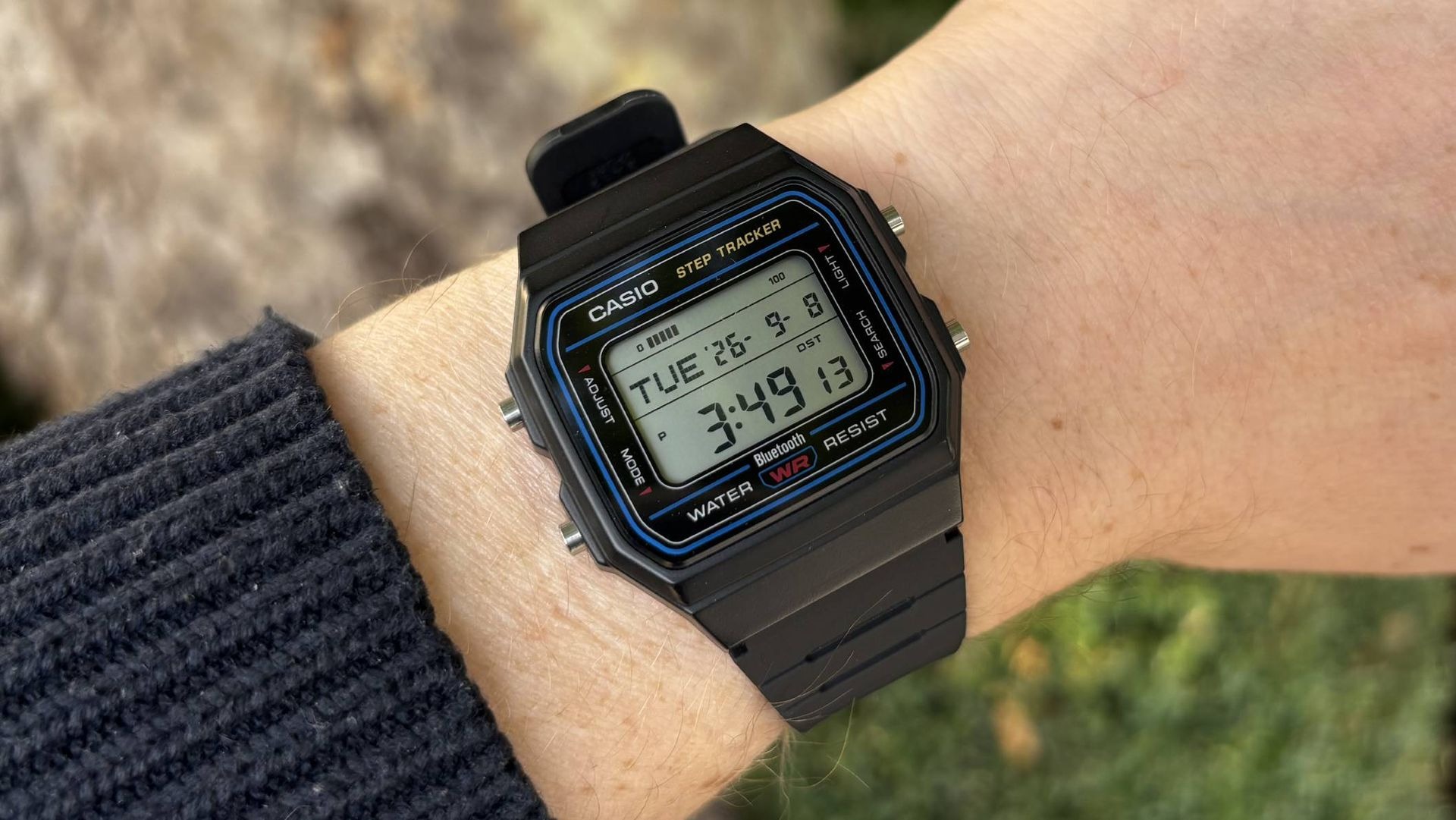
The smartwatch-is-the-f-b100w-with-step-counting-included” target=”_blank” rel=”noopener”>Casio F-B100W is a retro digital wristwatch equipped with a 3-axis accelerometer for step counting and Bluetooth connectivity for auto time adjustments. It retails for $64.95 USD direct on Casio’s website. This device targets budget-conscious buyers who want basic daily step counts without the hassle of touchscreens or daily charging cables.
🛒 Where to Buy: Casio F-B100W Smartwatch
Editorial Note & Product Verification: The Cool Great Buys editorial desk independently verifies manufacturer technical specifications, cross-checks active retail availability across authorized sellers, and evaluates verified consumer reliability data before publishing product evaluations. All featured prices and promotions reflect active market rates at the time of publication.
- Casio F-B100W Smartwatch: View on Amazon
Click the link above to check current pricing, availability, and customer reviews on Amazon.
After launching in Japan in August and selling out in hours, this lightweight digital watch has officially arrived in North America. Tech news outlets like Notebookcheck spotted the US release across three distinct colorways: black with blue trim (F-B100W-1A), stealth black (F-B100W-1B), and olive green (F-B100W-3A). Primary reporting from TechRadar highlighted fast depletion of retail inventory across UK storefronts before this US landing.
On paper, combining classic F-series styling with a pedometer sounds like an easy win. In practice, adding connected features to basic digital watch hardware creates immediate trade-offs. Examining the physical specifications, true operational costs, and software requirements reveals whether this wrist gadget earns a spot on your arm.
Upfront Investment & 2-Year Total Cost of Ownership
The initial purchase price sits at $64.95 USD direct from authorized retail listings. Japanese shoppers originally paid ¥8,800 JPY including local sales tax. That pre-tax Japanese retail price converts to approximately $50.95 USD. American buyers face a $14.00 USD regional premium for the exact same physical casing and internal module. This price increase stems from import overhead and localized distribution logistics rather than hardware upgrades.
Calculating the true two-year cost of ownership reveals where this device gains a distinct financial edge over standard smart wearables. Traditional fitness trackers rely on internal lithium-ion batteries that degrade after 300 to 500 charge cycles. Those lithium cells require proprietary USB charging cables and eventually turn into electronic waste within two to three years. The F-B100W takes a completely different path by utilizing a standard coin cell battery.
Power comes from a single CR2016 lithium coin cell. A multi-pack of brand-name replacement cells costs under $5.00 USD at retail outlets. Replacing the battery requires removing four standard Phillips screws on the stainless steel case back. Over a full 24-month operational period, your grand total expenditure stays around $64.95 USD to $69.95 USD max. There are no monthly app subscriptions, no software paywalls for historical fitness data, and no replacement charging docks to buy.
Hardware durability directly impacts long-term value. Resin cases handle impact well, but plastic lenses scratch easily under daily wear. Replacing the entire watch costs less than replacing a broken screen on a flagship wearable. From a pure operational finance stance, this timepiece represents one of the lowest ongoing costs in the personal fitness category.
What You Actually Get: Core Features & Build Specs
The physical module is housed inside a resin casing measuring 41.6mm long, 37.9mm wide, and 11.6mm thick. Total device weight sits at a minimal 28 grams including the resin strap. That featherweight footprint means you barely feel the device during daily wear or sleep. The digital display uses a classic monochrome memory LCD panel divided into distinct target zones. The upper section shows step counts and progress bars, while the main digits display time, day, and date.
Hardware specifications include a built-in 3-axis accelerometer sensor. This component registers body movement to calculate overall daily steps without requiring active mobile GPS connection. Additional core features consist of a 1/100-second stopwatch, a 24-hour countdown timer, a single daily alarm, and an LED backlight (Super Illuminator). Water resistance is rated at 30 meters (3 ATM). That rating protects against rain, splashing, and hand washing, but rules out swimming, showering, or water sports.
According to technical documentation published with this release, Casio claims a 2-year battery lifespan on a standard CR2016 cell. The fine print reveals that official battery estimate assumes step tracking active for 12 hours daily, one 10-second alarm cycle, 1.5 seconds of LED backlight illumination, and four automatic Bluetooth data syncs per day. Fact-checking these press kit metrics against real-world user habits reveals a noticeable discrepancy.
In practice, heavy Bluetooth pairing and frequent backlight activation increase energy drain on the small 90mAh capacity CR2016 coin cell. If you leave Bluetooth searching active constantly or press the illumination button frequently in dark rooms, operational battery life drops closer to 14 to 18 months. The watch does not issue low-battery app alerts until voltage drops significantly. When power runs down, step counting stops working before the main timekeeping digits finally fade out.
Hidden Costs, hardware environment Dependencies & Fine Print
Operating the smart functions requires installing the official Casio Watches application on an iOS or Android smartphone. Bluetooth Low Energy (BLE) links the wrist module to your phone for time adjustments and step count transfers. The mobile app syncs local time zone offsets automatically up to four times per day. That automatic synchronization eliminates manual time adjustments when traveling across time zones. However, the app requires continuous background permissions on your mobile operating system to maintain background Bluetooth handshake protocols.
Fitness metric tracking remains strictly primitive. The watch registers raw step totals and estimates distance based on stride length inputs inside the app. It lacks an optical heart rate sensor, a pulse oximeter, and built-in GPS positioning. The module cannot track specific workout routines like weightlifting, rowing, or cycling accurately. Arm movements during sedentary tasks like typing, folding laundry, or driving can trigger false positive step increments on the 3-axis accelerometer sensor.
Screen real estate presents another clear usability boundary. You do not get smartphone notifications, text previews, incoming call caller ID, or app notifications on this LCD screen. The built-in Phone Finder function relies on a active Bluetooth connection to trigger an audible alert tone on your paired mobile phone. If your phone drifts out of the 10-meter Bluetooth range, that finder feature becomes entirely useless.
Physical materials show clear cost-cutting decisions. The screen lens is constructed from molded acrylic resin rather than toughened mineral glass. Hard contact with brick walls, metal door frames, or abrasive surfaces will scratch the outer display surface permanently. Furthermore, the integrated resin strap uses proprietary pin attachment points. Replacing a torn band with an aftermarket NATO or metal strap requires specialized adapter lugs, limiting custom strap choices.
Smarter Alternatives at This Price
Buyers shopping in the under-$70 fitness tracking market face two distinct hardware paths. You can pick a basic connected digital watch with zero screen distraction, or choose a dedicated smart band featuring bright color screens and full health metrics. Comparing physical capabilities shows sharp differences in everyday utility across these approaches.
The Amazfit Band 7retails for $49.99 USD on Amazon. It features a bright 1.47-inch AMOLED color display, continuous optical heart rate monitoring, blood oxygen tracking, stress monitoring, and over 120 sports tracking modes. The internal 232mAh rechargeable lithium battery delivers up to 18 days of continuous operation between magnetic USB charging cycles. Water resistance reaches 50 meters (5 ATM), making it fully safe for lap swimming in pools. If your goal is actual biometric health logging, heart rate zone tracking, and detailed sleep analysis, the Amazfit Band 7 offers vastly superior sensor hardware for $15 less.
Another strong competitor in this price bracket is the Xiaomi Smart Band 8, selling for $45.00 USD on Amazon. This tracker uses a smooth 60Hz AMOLED panel with ambient light sensors for automatic brightness adjustment. It includes an optical heart rate sensor, sleep phase analysis, wrist-based workout metrics, and smartphone notification mirroring. Physical build quality features quick-release strap lugs and a metallic-coated polymer frame with 5 ATM water resistance. Battery life reaches 16 days on standard use via a magnetic charging cable.
Choosing between these devices comes down to physical display preferences and battery management habits. The Amazfit Band 7 and Xiaomi Smart Band 8 function as full health trackers with vibrant color touchscreens, but require monthly recharging and proprietary charging cables. The F-B100W trades full biometric heart tracking for standard watch hands-off simplicity, traditional button operation, and a two-year coin cell lifespan.
Final Buyer Verdict: Is the Investment Worth It?
The Casio F-B100W succeeds as a durable digital wristwatch that quietly logs basic physical movement. It strips away touchscreen distractions, frequent charging routines, and constant phone buzzes. You get accurate timekeeping via automated Bluetooth sync, clear outdoor LCD visibility, and simple daily step tracking inside a nostalgic, lightweight resin shell. For buyers who want a rugged daily driver that never needs a charging cord, it delivers solid utility at $64.95 USD.
Skip this watch if you demand detailed workout analytics, heart rate zones, sleep tracking, or smartphone notification pop-ups. Dedicated smart bands in the $45 to $50 range provide much better health hardware and superior water resistance for lower retail prices. Buy the F-B100W strictly for its lightweight retro aesthetics, multi-year battery independence, and simple daily step logging. Pass on it if you need a true fitness tracker.