

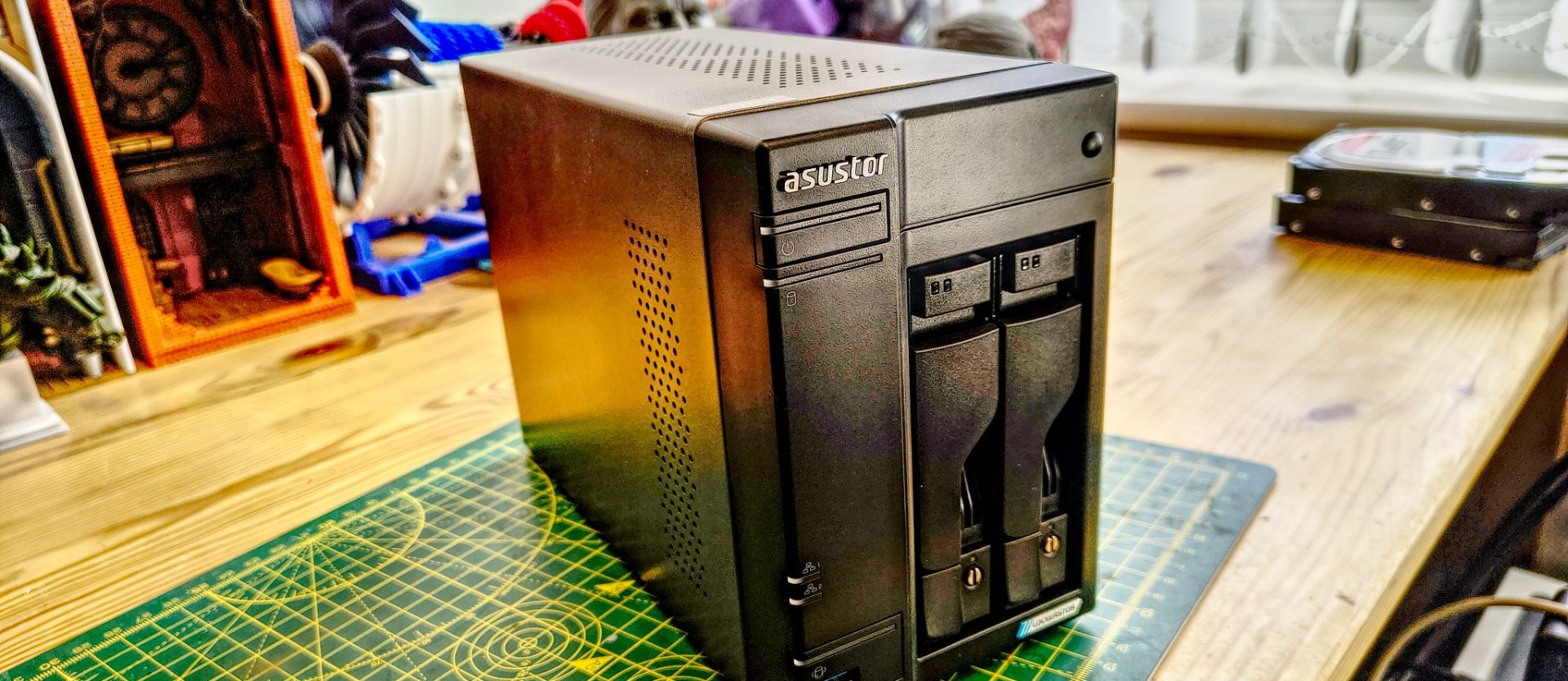
The Amazon.com/s?k=Asustor+Lockerstor+2+Gen2+AS6702T+v2″ target=”_blank” rel=”noopener”>Asustor Lockerstor 2 Gen2+ AS6702T v2 is a high-performance, two-bay network-attached storage enclosure housed in a compact all-metal chassis, engineered to bridge high-speed local networking with expandable NVMe solid-state storage pools. Available at a street price of $516.99 USD on Amazon against an official manufacturer list price of $569.99 USD, this updated desktop server is targeted at creative freelancers, remote software engineers, and small office administrative environments requiring multi-gigabit throughput for virtualization and local containerized workloads.
🛒 Where to Buy: Asustor Lockerstor
- Asustor Lockerstor: View on Amazon
Click the link above to check current pricing, availability, and customer reviews on Amazon.
Core Disclosure & Hardware Announcement
In evaluating hardware revisions across the enterprise and prosumer storage market, mid-cycle refreshes frequently signal incremental component updates designed to keep pace with evolving local network infrastructure. Asustor, the dedicated storage division of Asus, introduced this second-generation revision to address the mounting data bandwidth demands of local multi-gigabit environments. Notably, international pricing reveals a steep regional variance: European consumers face listings of €616.06, while UK buyers see pricing around £504 GBP, representing a premium of approximately 30 percent over North American retail benchmarks. According to technical documentation published with this release, the core value proposition rests on replacing the older dual 2.5GbE network interface setup with two integrated 5GbE RJ45 Ethernet ports while preserving the underlying chassis architecture.
Checking authorized retailer listings confirms initial launch stock is shipping directly across major tech vendors, positioning the AS6702T v2 above mainstream entry-level two-bay boxes. The device combines two 3.5-inch/2.5-inch SATA drive bays with four internal M.2 2280 NVMe slots, an HDMI 2.0b video output, two 10Gbps USB 3.2 Gen 2 ports, and an x86 processor architecture capable of running Docker containers and lightweight virtual machines. Detailed analysis reveals this primary hardware update is focused almost exclusively on networking throughput rather than a comprehensive system overhaul.
Historically speaking, the two-bay NAS segment occupied a predictable role: providing low-cost, redundant file mirrors for home networks or modest backup repositories. Over the past five years, however, manufacturers have attempted to transform two-bay enclosures into high-throughput storage servers capable of serving software containers, hosting virtual machines, and ingesting raw 4K video feeds. This pivot requires a careful balance between processing headroom, memory architecture, and network bandwidth. Asustor’s decision to maintain the legacy x86 processing platform in the AS6702T v2 while doubling network interface speeds illustrates a classical engineering trade-off—one where external network interface caps are lifted, yet internal computational bottlenecks remain unaddressed.
Manufacturer Claims vs. Engineering Reality
In Asustor’s official launch documentation, the engineering team highlights the inclusion of an x86-architecture Intel Celeron N5105 processor, a quad-core, four-thread chip operating at a base clock of 2.0GHz with a burst frequency up to 2.9GHz. When the original Lockerstor 2 Gen2 debuted, the N5105 represented a capable baseline for entry-level x86 storage platforms, incorporating integrated Intel UHD Graphics to manage hardware-accelerated video decoding and media transcode pipelines. In practice, retaining this specific silicon for a refreshed hardware iteration exposes clear performance limitations. Contemporary competitors have transitioned to newer processors such as the Intel N100 or AMD Ryzen Embedded series, which deliver superior instructions-per-clock performance, higher peak clock speeds up to 3.4GHz or 3.7GHz, and improved electrical efficiency.
System memory capacity reinforces this engineering ceiling. The AS6702T v2 ships configured with a single 4GB DDR4 SODIMM module, with an secondary empty SODIMM slot providing pathing to a manufacturer-specified maximum of 16GB DDR4 RAM. The distinction matters here: the Celeron N5105 hardware architecture enforces a hard 16GB system memory limit, constraining the scale of virtual machine hosting and high-concurrency container deployments. While operating in single-channel mode allows administrators to insert an 8GB module alongside the factory 4GB stick to achieve a 12GB configuration—a practical flexibility unavailable on competing models with soldered memory—the absolute overhead remains modest compared to modern prosumer alternatives that accept up to 64GB of system memory.
A primary marketing feature for the AS6702T v2 is the inclusion of 4 internal M.2 2280 NVMe slots within a compact two-bay SATA chassis. Examining the fine print of the hardware documentation reveals an essential architectural caveat regarding PCIe lane routing. Each of the four M.2 slots operates on a PCIe 3.0 x1 bus topology, restricting individual drive throughput to approximately 1GB/s (roughly 8Gbps). While this bandwidth easily surpasses traditional SATA 6Gbps spinning drives and adequately saturates a 5GbE network link, it falls far short of modern PCIe 4.0 NVMe capabilities. Buyers anticipating full multi-gigabyte drive bandwidth across four drives will instead experience an aggregate theoretical maximum ceiling of 4GB/s across the entire NVMe array.
Under the Hood: Technical Architecture and Build Quality
The physical construction of the Lockerstor 2 Gen2+ AS6702T v2 aligns with Asustor’s industrial design ethos. Measuring 163.5mm in height, 108mm in width, and 230mm in depth, the unit occupies a compact footprint similar to standard two-bay office NAS enclosures. However, its substantial 2.0kg net dry weight immediately reflects the use of a heavy-gauge black metal sheet-metal frame rather than the lightweight plastic outer shells common in budget consumer models. The front panel features two vertical drive bays accompanied by diagnostic LED indicators, system power controls, and a single 10Gbps USB 3.2 Gen 2 Type-A port for quick external drive backups. The rear panel houses two 5GbE RJ45 Ethernet ports, a second 10Gbps USB 3.2 Gen 2 connector, a legacy USB 2.0 port, an HDMI 2.0b display port, and a single 70mm cooling fan.
Despite the solid structural frame, physical drive mounting presents an unexpected ergonomic drawback. Each 3.5-inch or 2.5-inch SATA hard drive must be secured into its metal tray using four manual mounting screws, drawing from hardware packets included in the box. Tool-free drive tray mechanisms have been standard across the storage industry for years; notably, Asustor’s own entry-level AS4002T featured tool-less drive sleds nearly a decade ago. Requiring manual screw installation on a premium workstation unit costing over $500 USD represents an unwelcome operational inconvenience. Upgrading internal components requires removing three rear chassis screws to slide off the outer metal cover, though securing the M.2 drives once inside utilizes simple tool-free latch mechanisms. Upgrading the primary 4GB memory module requires deeper motherboard disassembly, as the stock RAM slot resides on the underside of the PCB assembly.
Acoustically and thermally, the single 70mm rear fan operates with commendable discipline. In steady-state operation with idle drives, noise levels register at an unobtrusive 17.7dB, making the chassis well-suited for desk-adjacent operation in quiet studio environments. Power draw remains disciplined, rated by Asustor at 21W during active file operations and 13.5W with disk hibernation engaged. On the software side, the unit runs ADM 5.1 (version 5.1.4.RM62), which introduces post-quantum cryptography support via hybrid TLS encryption protocols. Initial setup is executed via the Asustor Control Center utility or a web browser accessing port 8000. While base operating system installation completes within 10 minutes, building storage pools requires time; initial formatting and volume synchronization for dual 2TB drives in RAID 1 paired with a 1TB NVMe read cache routinely requires nearly 4 hours before reaching steady-state operational availability.
Verified Market Alternatives
When assessing direct market competitors, the value proposition of the AS6702T v2 encounters significant friction from newer entrants in the prosumer storage space. The Ugreen NASync DXP2800carries a list price of $349.99 USD on Amazon, undercutting the Asustor by more than $160 USD. The Ugreen model integrates a modern Intel N100 processor, offering improved processing efficiency and higher burst clock speeds. Furthermore, its two M.2 NVMe slots utilize a combined PCIe 4.0 x4 and PCIe 3.0 x2 allocation, yielding up to 10GB/s of potential combined SSD bus bandwidth compared to the Asustor’s 4GB/s aggregate maximum across four slots. For users seeking higher computational headroom, the upgraded Ugreen DXP2800GT presents an AMD Ryzen Embedded R2514 processor paired with a native 10GbE network interface for $399.99 USD, offering higher processing capabilities and faster out-of-the-box networking at a lower purchase price.
For organizations where software platform maturity takes precedence over raw hardware specifications, the Synology DiskStation DS225+represents the established benchmark, retailing at $310.24 USD on Amazon. The DS225+ operates on an older Intel Celeron J4125 processor with 2GB DDR4 RAM and entirely lacks native M.2 NVMe slots or multi-gigabit network interfaces out of the box. However, Synology’s DiskStation Manager (DSM) operating system provides an enterprise management ecosystem, seamless hybrid cloud synchronization, and sophisticated surveillance software tools that Asustor’s ADM platform struggles to match in operational polish. The trade-off is clear: Synology offers superior software maturity at a lower price point with modest hardware specs, whereas Asustor delivers physical networking speed and NVMe expandability at a premium price.
Final Editorial Verdict: Long-Term Reliability Outlook
The Asustor Lockerstor 2 Gen2+ AS6702T v2 is a hardware offering defined by distinct engineering contradictions. On one hand, its heavy-duty sheet metal chassis, dual 5GbE networking interfaces, and generous 3-year manufacturer warranty demonstrate a commitment to physical build quality and fast local network transfers. The inclusion of 4 internal NVMe slots inside a compact two-bay desktop footprint remains an uncommon hardware configuration, making it a functional choice for niche workflows that depend on dedicated SSD caching arrays or high-speed flash storage volumes alongside secondary spinning media. ADM 5.1 provides a stable administrative interface, supplemented by advanced security enhancements like post-quantum TLS options.
In practice, however, the financial premium demanded for this unit is difficult to justify for the broader consumer and small-business market. At an asking price exceeding $516.99 USD, the decision to re-issue aging Intel Celeron N5105 silicon paired with a modest 4GB DDR4 baseline memory configuration limits future-proofing for heavy containerized workloads and virtual machines. The insistence on manual screw-mounted drive trays further detracts from overall user convenience. For buyers specifically requiring dual 5GbE connectivity and four NVMe slots within a two-bay desktop enclosure, the AS6702T v2 fulfils a precise technical requirement. For all other prosumers, market alternatives offer newer processing architectures, higher memory ceilings, and lower entry costs, making this NAS a specialized tool rather than a broadly recommended purchase.