

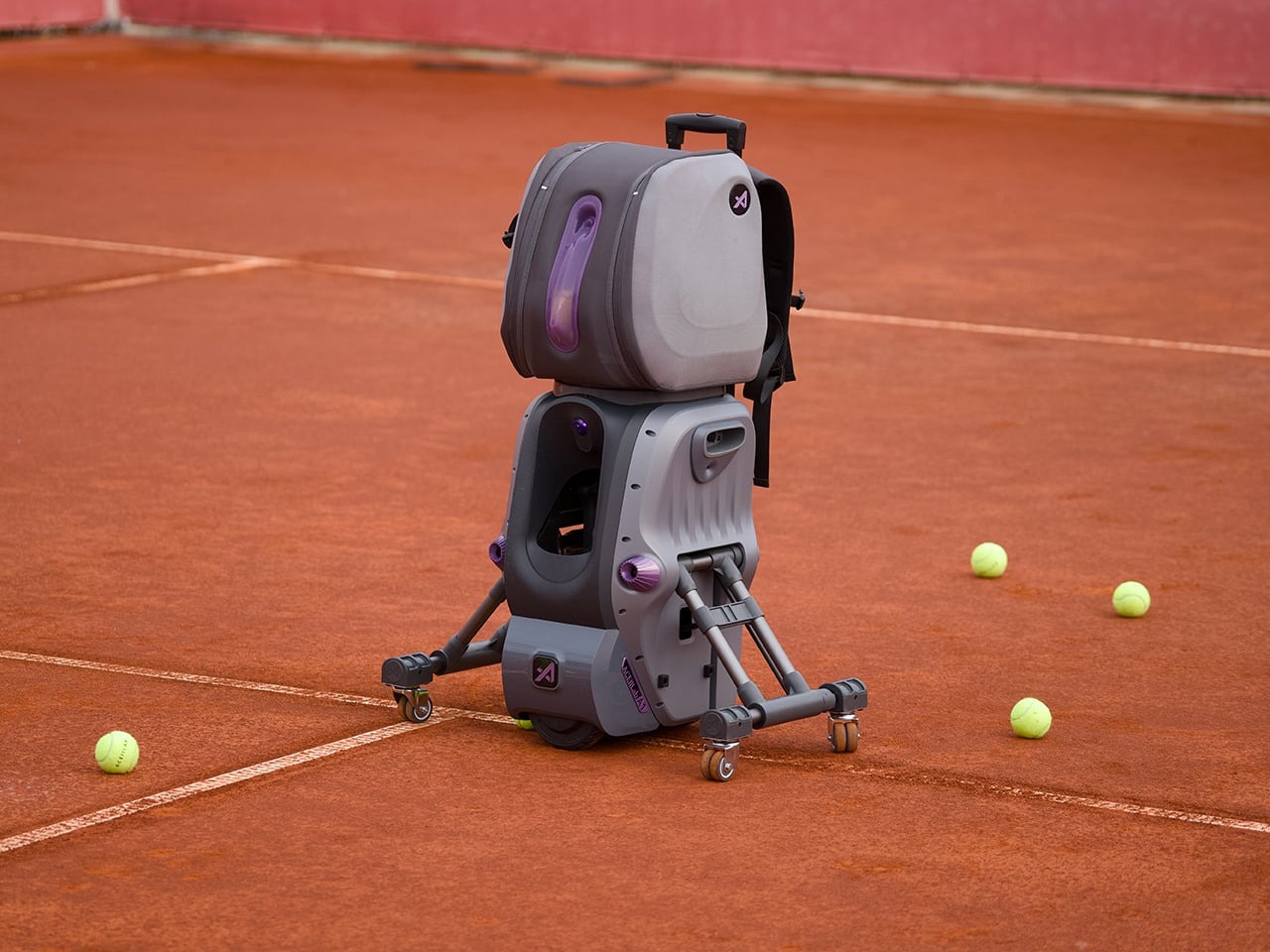
Core Disclosure & Hardware Announcement
The AceiiLab A1 is a motorized solo tennis launcher that uses dual 4K binocular depth cameras and an omnidirectional motorized chassis to track players and continuously reposition across the baseline. The machine lists for a suggested retail price of $2,599 USD direct from AceiiLab’s official site, with initial promotional pricing starting at $1,949 USD using early buyer discount codes. It targets solo players across the US NTRP 1.0 to 5.0 skill range who need variable feed angles, randomized shot depth, and realistic footwork pressure without hiring a live hitting partner or private coach.
🛒 Where to Buy: AceiiLab A1 Robotic Tennis
Editorial Note & Product Verification: The Cool Great Buys editorial desk independently verifies manufacturer technical specifications, cross-checks active retail availability across authorized sellers, and evaluates verified consumer reliability data before publishing product evaluations. All featured prices and promotions reflect active market rates at the time of publication.
- AceiiLab A1 Robotic Tennis: View on Amazon
Click the link above to check current pricing, availability, and customer reviews on Amazon.
Traditional tennis ball machines have changed very little since inventor Bob McClure built the static “Little Prince” launcher in 1970 using a modified vacuum cleaner motor. Most consumer units remain heavy, boxy plastic enclosures sitting stationary on the baseline, throwing balls at fixed intervals from a single point on the court. While stationary feeding works well for introductory stroke mechanical repetition, it creates a fundamental training flaw known as the static groove bias. In a real match, a player never hits two consecutive balls from the exact same standing position. Static feeding allows players to plant their feet, eliminate the split-step, and swing without recovering back to the court center. That builds muscle memory disconnected from real match movement.
Ex-DJI drone flight control engineer and former KUKA industrial robotics specialist Liu Liqian designed the A1 to overcome that mechanical limitation by placing the launching mechanism on an autonomous drive base. According to the original Yanko Design release report, the device successfully transitioned from an initial 2025 Kickstarter crowd-funding campaign into full commercial factory production. The core objective of the design is simple: replace predictable point-and-shoot feeds with dynamic lateral court movement that forces continuous split-stepping, recovery steps, and realistic athletic positioning between shots. Initial product disclosures and hardware announcements were tracked via Yankodesign.
Manufacturer Claims vs. Engineering Reality
AceiiLab makes bold performance claims regarding launch velocity, base mobility, and internal battery endurance. The official specification sheet promises top ball launch speeds reaching 80 mph alongside motorized chassis travel speeds of up to 13.1 feet per second (approximately 4 meters per second or 14.4 km/h). On paper, those performance figures sound significant for a portable training robot. However, when evaluated under real-world court conditions, physical law and surface dynamics introduce clear operational constraints.
Accelerating a 52.5-pound frame from a dead stop to full speed across high-friction acrylic hard courts—or through sliding friction on loose red clay—requires substantial instantaneous motor torque. Rapid directional changes generate noticeable heat buildup within the internal brushless drive controllers. On gritty outdoor hard courts, tire traction is generally excellent, allowing sharp direction changes; however, on dusty outdoor courts or synthetic grass, fast lateral shifts can cause minor tire slippage. That slippage slightly reduces positional accuracy, forcing the computer vision system to execute micro-corrections to maintain proper court alignment.
In AceiiLab’s official technical documentation, the engineering team rates the removable 36V 7Ah lithium-ion battery module (252 Wh total energy capacity) for up to 8 hours of static feeding or approximately 2 hours of high-intensity dynamic repositioning training. Scrutinizing the finer details of real-world energy consumption reveals how quickly power drains under heavy load. Running high topspin wheel differentials while simultaneously driving the motor base back and forth in continuous lateral recovery drills pulls maximum current from the battery. Players running high-frequency 4-point cross-court drills at max launch speeds will reach the lower boundary of that 2-hour battery window rapidly. For coaches conducting back-to-back lessons or players undertaking long weekend practice sessions, purchasing a second hot-swappable battery pack is practically essential.
The visual guidance array relies on dual front-mounted 4K optical cameras to perform real-time stereoscopic depth mapping, tracking human biomechanics and court geometry much like human vision. The underlying algorithms analyze player position, stroke finish posture, and recovery direction to determine optimal ball placement. Despite the sophisticated onboard processing, camera optics face unavoidable outdoor environmental challenges. Direct midday sun casting low angles directly into the lenses can introduce high-contrast lens flare. Similarly, harsh tree shadows stretching across the baseline on late afternoon public courts can briefly disrupt edge-detection algorithms. While the visual tracking operates with impressive reliability under uniform indoor lighting or overcast skies, bright direct sunlight occasionally forces brief optical recalibrations during play.
Under the Hood: Technical Architecture and Build Quality
The structural design of the AceiiLab A1 emphasizes portable trunk storage without sacrificing physical durability. The entire machine folds down into a compact rectangular suitcase shape that occupies a footprint comparable to a piece of large checked luggage. The chassis features a heavy-duty extendable aluminum pull rod and rugged rubberized transport wheels, allowing players to roll the unit seamlessly from a car trunk to the court baseline. Without the modular 36V battery pack installed, the physical chassis weighs 52.5 pounds (23.8 kg). While manageable for an adult, lifting this mass into high SUV trunks requires careful form and two hands. Nevertheless, its compact folded profile fits into standard sedan trunks far more easily than traditional bulky barrel-shaped ball machines.
Ball containment relies on a collapsible top-mounted fabric basket with a maximum capacity of 120 tennis balls. Below the hopper, a motorized agitator pushes balls sequentially into dual counter-rotating high-speed drive wheels. By modulating the differential rotational speeds of the top and bottom throwing wheels, the internal processor can instantly apply heavy topspin, aggressive slice backspin, flat flat-out drives, or high defensive lobs reaching up to 26.2 feet (8 meters) in apex altitude. Feed intervals are fully adjustable across a broad spectrum, ranging from intense 0.5-second rapid-fire volley drills up to relaxed 15-second intervals designed for full recovery practice. The exterior chassis casing also integrates practical ergonomic additions, including dedicated water bottle holders and side-mounted racket slots to keep personal gear cleanly off the court surface.
Machine control relies on a dedicated companion mobile application available for both iOS and Android platforms. The app provides access to preset stroke sequences, custom point simulation construction, and competitive target-hitting modes. Furthermore, wrist-based Apple Watch application integration allows players to start, pause, or switch drill programs directly from the baseline without interrupting their practice flow. To eliminate constant trips back and forth across the court, the system incorporates optical gesture recognition: raising a racket overhead and holding it steady for two seconds prompts the 4K vision system to halt feeds immediately. The backend software logs performance metrics over time, tracking shot placement accuracy, hit frequency, and ball speed trends across multiple training sessions.
Verified Market Alternatives
Before investing over two thousand dollars in an autonomous robotic launcher, buyers should evaluate established static alternatives from reputable tennis hardware brands. Traditional static machines trade intelligent mobility and camera tracking for mechanical simplicity, proven component longevity, and lower repair complexity. If dynamic base movement is not a priority for your training goals, traditional static launchers deliver raw velocity with fewer electronic fail points.
The Spinshot Player Tennis Ball Machineis available for $2,199 USD on Amazon. The Spinshot features a rugged aluminum housing built to withstand heavy court wear. Instead of driving the entire chassis across the floor, it uses internal mechanical guides to sweep feed angles horizontally and vertically. It offers high customization via a phone app and delivers topspin and backspin feeds at speeds up to 68 mph. However, because the outer cabinet remains stationary on the baseline, the delivery point never changes. Weighing 42 pounds, it is notably lighter to lift into a trunk than the A1, though it lacks camera tracking, autonomous chassis drives, and wrist gesture detection.
Another popular commercial option is the Lobster Sports Elite Grand Five, priced at $2,499 USD on Amazon. The Lobster uses a high-capacity plastic hopper shell holding up to 150 balls and can hurl shots at speeds up to 80 mph. It features triple-oscillation technology that randomly sweeps shots across narrow and wide angles while varying feed depths. At 44 pounds, its large rear wheels make it easy to roll across parking lots and courts. However, like the Spinshot, it lacks motorized chassis repositioning, optical camera tracking, and smartwatch integration. Instead, it offers decades of proven manufacturing reliability and readily available spare parts.
Comparing these alternative platforms highlights the engineering trade-offs inherent in modern tennis training technology. Static machines excel at delivering high volume and consistent repetition from a single court location, making them ideal for refining basic stroke mechanics. By contrast, autonomous drive systems trade a degree of mechanical simplicity for dynamic court movement, forcing players to hit under real movement pressure. Choosing between these approaches depends on whether a player needs simple stroke repetition or full-court dynamic movement training.
Final Editorial Verdict: Long-Term Reliability Outlook
The mechanical architecture of the A1 represents an innovative step forward in consumer tennis technology. By moving the feed point across the baseline, the hardware replicates the footwork demands of live point play far better than traditional static boxes. However, adding active drive wheels, steering motors, and optical sensors increases long-term maintenance requirements. Outdoor court environments expose the unit to dust, yellow felt fuzz, and fine grit, requiring regular cleaning of the dual 4K camera lenses and drive assemblies to ensure reliable multi-season operation.
For intermediate to advanced club players who frequently train solo and want realistic footwork conditioning, the AceiiLab A1 AI Tennis Robot offers strong value at its $1,949 USD promotional price. It provides a dynamic movement workout that standard static machines cannot match. Conversely, players seeking a simple, low-maintenance ball launcher with minimal app setup may prefer a traditional static machine that provides reliable service without software or sensor dependencies.