

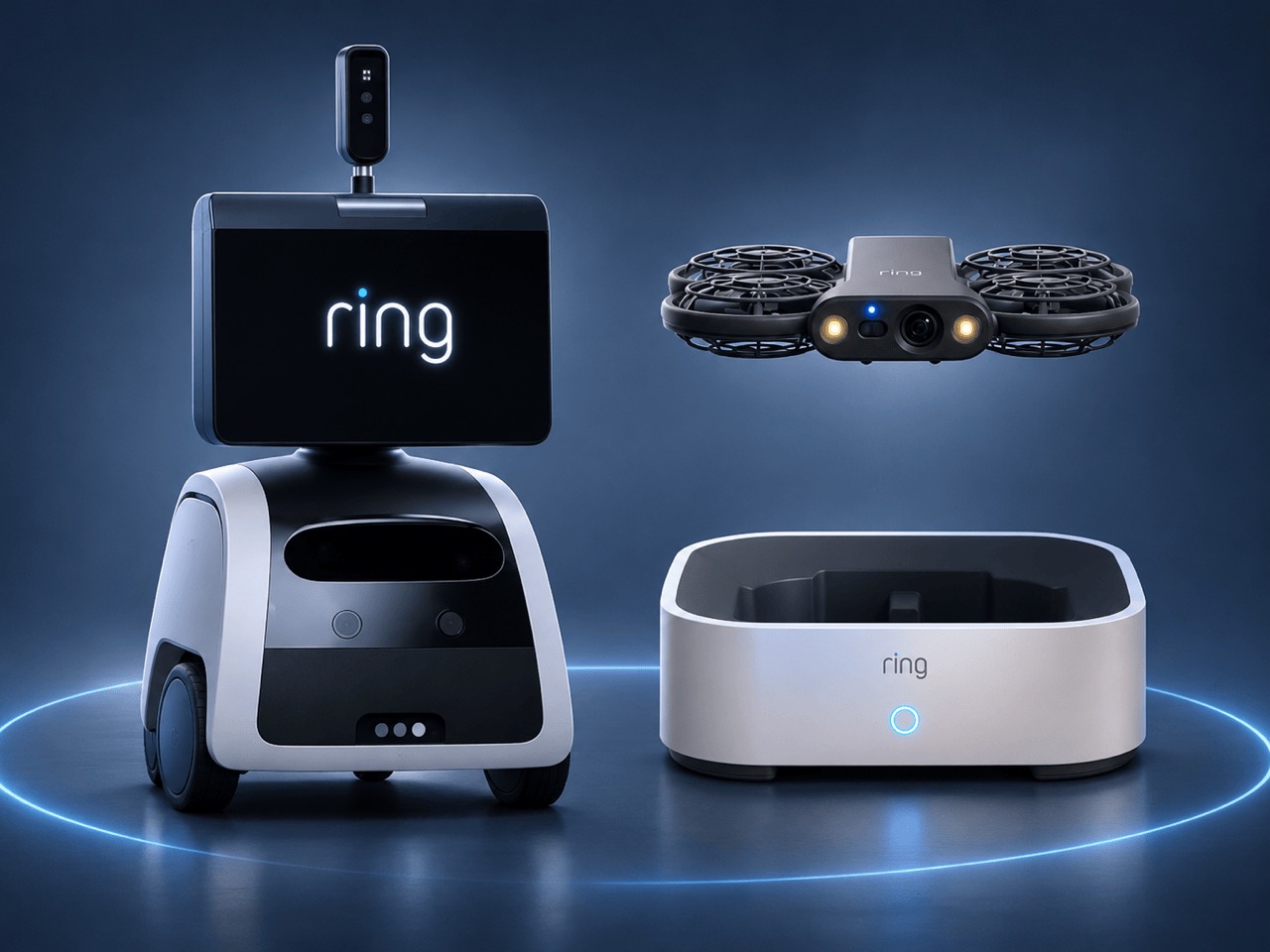
Amazon’s Ring division k=Ring+Drone+Cam” target=”_blank” rel=”noopener”>Ring Drone Cam enters the market at $249.99 USD on Amazon, while the ground-based Ring Rover Camcarries a commercial-tier $999.99 USD price tag on Amazon. These mobile security units are engineered for property owners and small business operators who want active indoor patrol capabilities and dynamic sensor-triggered visual verification without running wiring harness setups or cluttering walls with fixed lenses in every room.
🛒 Where to Buy: Ring Drone Cam
- Ring Drone Cam: View on Amazon
Click the link above to check current pricing, availability, and customer reviews on Amazon.
This release signals a broader trajectory across smart home hardware, moving away from passive sensor networks toward active robotic intervention. For years, consumer security setups relied on static field-of-view cameras that created unavoidable blind spots unless users purchased half a dozen individual units. By miniaturizing flight systems and adapting commercial spatial mapping algorithms down to consumer hardware, Ring aims to replace multi-camera installations with a single autonomous agent capable of investigating perimeter trips on demand. This shift matters because it highlights how personal hardware is shifting from reactive record-keeping to predictive, mobile telemetry.
However, this technical leap arrives during a period of heightened consumer scrutiny around home data collection. According to recent reporting on smart hardware trends from Yanko Design’s hardware analysis, municipal surveillance partnerships like Flock Safety face significant policy pushback, making the introduction of flying, cloud-connected interior mapping cameras an ambitious move. While the engineering required to stabilize a miniature indoor drone is undeniable, launching autonomous home-mapping robots requires balancing advanced spatial tracking against user privacy expectations.
State of the Category & What Changed
The consumer home security landscape spent the last decade optimized around low-power static Wi-Fi cameras, battery-powered doorbells, and localized motion sensors. While those platforms succeeded in democratizing perimeter security, their static nature introduced inherent architectural limitations. A fixed camera can only monitor a fixed cone of vision, forcing homeowners to install multiple sensors across hallways, living spaces, and entryways to achieve total interior coverage. Ring’s new mobile robotics lineup represents an attempt to collapse that multi-device footprint into single, mobile hardware units that navigate directly to tripped sensors.
Under this new hardware model, the home security ecosystem shifts from static surveillance to dynamic response. Rather than placing a dedicated lens in a private living room or hallway, a single docking station housed in an utility area serves as the launchpad for a device that remains hidden until triggered. The $249.99 USD Ring Drone Cam handles multi-story residential layouts via aerial flight paths, while the $999.99 USD Ring Rover Cam targets commercial floors, stockrooms, and retail shops using a ground-based rolling chassis derived from Amazon’s earlier Astro platform. This hardware segmentation clarifies Ring’s target demographics: residential users seeking dynamic threat checking and commercial enterprise users needing after-hours mobile security patrols.
What changed structurally is the miniaturization of internal flight components paired with off-board spatial computing. Previous attempts at indoor security robotics struggled with excessive weight, short flight windows, and loud motor acoustics that made indoor operation impractical. Ring addressed the physical weight constraint by offloading spatial pathfinding and obstacle calculation to cloud servers, keeping the physical airframe light enough to operate safely indoors. However, this architectural choice creates a fundamental trade-off: moving navigation logic to the cloud reduces localized hardware costs but mandates active internet connectivity and persistent cloud mapping for basic operation.
Generational Delta: The Engineering Upgrades That Matter
Comparing the the gear to traditional pan-tilt-zoom (PTZ) indoor cameras highlights a stark architectural departure. To achieve reliable indoor flight, Ring engineered the Drone Cam airframe down to a lightweight 165 grams (0.36 pounds). The optical module features a 2K resolution sensor pairing a wide 148-degree field of view with dual high-output LED illuminators designed for zero-light night navigation. Unlike consumer photography drones that rely on GPS signals or heavy local LiDAR modules, the Drone Cam navigates using optical flow camera sensors and Ring’s proprietary AI Pilot mapping framework, allowing it to maintain stable flight altitude without crashing into walls or ceiling fans.
The $999.99 USD Ring Rover Cam brings physical mechanical upgrades derived from industrial robotics down to small business scale. Built on a heavy-duty rolling chassis, the Rover features an motorized periscope camera arm capable of extending up to 4 feet (1.2 meters) vertically, allowing the optical sensor to peer over shop counters, inventory stacks, and office desks. The optical payload streams at up to 4K resolution, backed by a top-mounted lighting tower that projects a high-visibility blue positioning ring onto the ceiling during routine patrols, shifting to a flashing red light array accompanied by an audible siren when internal sensors flag unauthorized motion.
In Ring’s official launch documentation, the engineering team claims the off-board spatial mapping protocol significantly reduces physical thermal throttling on the aircraft. However, examining the fine print of the hardware documentation reveals a strict physical limit: the drone’s lightweight battery delivers between 5 and 10 minutes of continuous flight per charge, requiring an 8-to-1 ratio on the charging base station. For every single minute of active aerial patrol, the hardware requires approximately 8 minutes docked on its charging pad to replenish internal cells, representing a major operational bottleneck during repeated security events.
Everyday Usability Trade-Offs & Adoption Barriers
Integrating a self-flying camera into a residential environment introduces daily physical trade-offs that static wall mounts never encounter. Initial setup requires a manual calibration process where the user carries the physical drone through every room of the house to build a baseline spatial floor plan. During regular operation, indoor air currents from HVAC vents, drafty corridors, open windows, or moving household pets present physical flight hazards that fixed cameras bypass entirely. If the aircraft loses Wi-Fi connectivity mid-patrol due to network interference, the internal safety firmware defaults to an immediate emergency landing on whatever floor or surface sits directly beneath it.
Power management remains another critical usability barrier. Because the 165-gram airframe limits internal battery pack capacity, consecutive sensor alerts compound operational downtime. If a back-door motion sensor triggers an initial 5-minute flight inspection, the drone returns to its base station completely depleted, leaving it offline for up to 40 to 80 minutes while recharging. If a secondary security event occurs shortly after the initial flight, the system cannot launch to investigate, falling back exclusively on traditional stationary door and window contact sensors.
The reliance on cloud computing creates further adoption hurdles around data privacy and long-term hardware longevity. Because spatial maps live on remote Amazon servers rather than encrypted local hardware, users must trust external cloud infrastructure with detailed interior blueprints of their homes. Additionally, Amazon’s past hardware deprecation record—such as the complete bricking of the original Astro for Business hardware lineup in 2024—creates reasonable skepticism among potential buyers. Businesses that invested in previous iterations were left with non-functional hardware when server support ended, making potential adopters question whether the $999.99 USD Rover Cam will maintain long-term server support past its initial production cycle.
Category Alternatives and Rival Solutions
For users who want comprehensive home security without introducing airborne mechanical noise, complex cloud mapping dependencies, or battery recharge delays, traditional multi-camera static networks offer a proven alternative. The Eufy Cam S330, priced at $219.99 USD on Amazon, provides continuous 4K resolution monitoring paired with local AI-driven human and vehicle tracking. By housing video analytics and spatial event logging locally on an encrypted base station, Eufy eliminates monthly subscription fees entirely while keeping interior video feeds isolated from cloud servers. A pair of static outdoor and indoor cameras covers key entry points continuously without the mechanical wear, propeller noise, or recharging flight downtime inherent to mobile drones.
Alternatively, users looking for mobile ground-level inspection without cloud mapping dependencies can evaluate dedicated robotic security platforms like the Enabot Ebo SE, available for $119.99 USD on Amazon. Designed for home monitoring and pet interaction, the Ebo SE utilizes a self-righting tumbler chassis equipped with an 1080p camera, infrared night vision, and local Wi-Fi streaming. While it lacks the automated high-altitude perspective of Ring’s flying drone or the motorized periscope arm of the Rover, its low-slung physical profile and localized app control provide flexible ground-level inspections at a fraction of the cost, making it an accessible point of entry for basic mobile monitoring.
Comparing these hardware architectures underscores the clear trade-offs between static multi-point coverage and autonomous mobile patrol:
- System Architecture: Static systems like the Eufy Cam S330rely on multiple stationary lenses for instant visual redundancy, while the the itemuses a single mobile sensor to inspect tripped zones sequentially.
- Storage and Privacy: Eufy and Enabot store footage locally on HomeBase internal drives or expandable microSD media, whereas Ring mandates cloud pipeline routing via Ring Protect subscriptions for scheduled flight routines and cloud spatial pathing.
- Operational Uptime: Hardwired or solar-assisted static cameras provide continuous 24/7 coverage, compared to the 5 to 10 minute flight windows and mandatory 40-to-80 minute recharge cycles of lightweight indoor aerial drones.
Final Trajectory Verdict: Future Outlook & Buying Advice
The the product and Rover Cam represent an impressive engineering achievement in miniaturized spatial robotics, but their real-world value depends heavily on your tolerance for cloud mapping and hardware maintenance. If this generation gets off-board AI routing and real-time obstacle avoidance right, the next iteration could pave the way for true edge-computed local navigation that operates entirely offline without privacy compromises. However, as it stands today, requiring active cloud communication for spatial pathfinding means users are trading localized control for the novelty of automated flight.
For most buyers, immediate adoption is difficult to recommend over traditional static camera setups. Homeowners are far better served by installing static multi-lens systems like the Eufy Cam S330at $219.99 USD on Amazon, which deliver zero-latency coverage, local data storage, and zero mechanical flight risks. Unless your specific use case demands after-hours commercial periscope patrols via the $999.99 USD Rover Cam, waiting for the secondary hardware cycle—and awaiting finalized FCC regulatory clearances ahead of the Drone Cam’s projected shipping target—remains the most pragmatic choice for sensible consumers.