

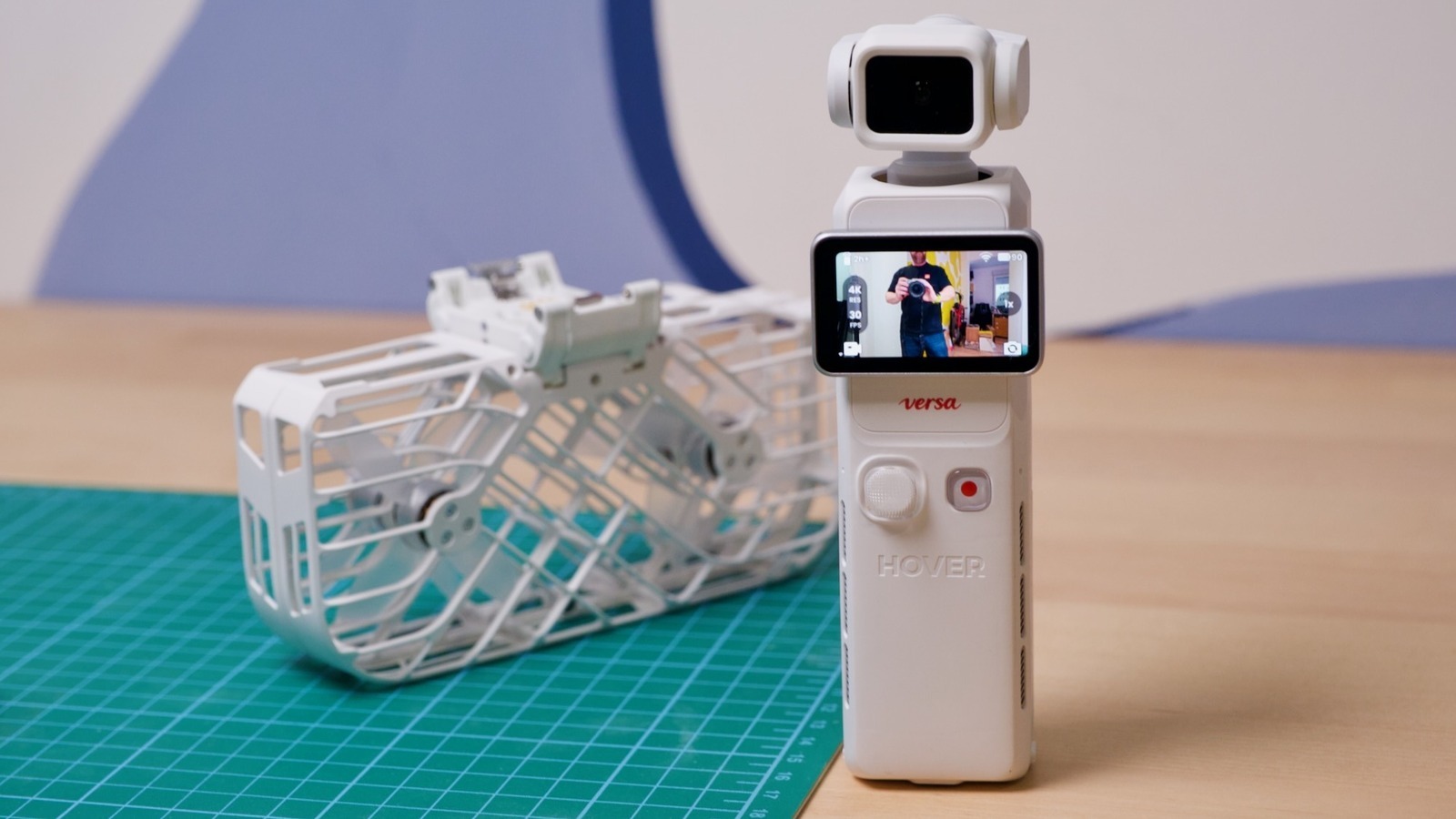
The HoverAir Versais a hybrid handheld 3-axis gimbal camera that transforms into a self-flying video drone using a magnetic snap-on propeller module. Available at $539 USD direct for the standalone handheld camera unit and $649 USD for the complete flight kit bundle, this dual-mode device targets hybrid content creators, remote workers doing video presentations, and vacationing parents who want to consolidate their gear bag without carrying a dedicated camera rig and a separate quadcopter.
🛒 Where to Buy: HoverAir Versa 2-in-1 Flying
- HoverAir Versa 2-in-1 Flying: View on Amazon
Click the link above to check current pricing, availability, and customer reviews on Amazon.
As a parent who tracks every consumer purchase down to its multi-year operational cost, I always look past flashy launch videos to see what a piece of hardware actually delivers to a normal household over time. Combining two completely different product categories into one frame sounds brilliant on paper, but dual-purpose gadgets frequently suffer from double the compromises. Analyzing the mechanical design, accessory ecosystem, and real-world utility of the Versa reveals a surprisingly capable setup, though prospective buyers must calculate the full economic footprint before opening their wallets. Initial product disclosures and reporting were tracked via Engadget.
Upfront Investment & 2-Year Total Cost of Ownership
Evaluating what this system costs you over a two-year ownership cycle requires looking well beyond the sticker price. Buying the base handheld unit at $539 USD direct from HoverAir gets you the core 3-axis camera body, but it lacks the actual flight components that make the device unique. To unlock the airborne capabilities highlighted in the marketing materials, buyers must opt for the flight kit bundle priced at $649 USD. This package includes the snap-on propeller cages, a secondary flight battery, and basic mounting hardware. However, a single extra battery is rarely enough for practical field work, especially when operating both on the ground and in the air during a single outing.
When you calculate the total cost of ownership over two years, hidden consumables and essential accessories quickly expand your baseline budget. Swappable flight batteries for mini drones generally cost between $49 USD and $69 USD each, and standard operational needs dictate carrying at least two spares to avoid extended field recharging delays. Factoring in a fast, high-end microSD card, a protective hardshell travel case, and an optional physical remote controller bring your realistic 24-month out-of-pocket tally to roughly $820 USD to $860 USD. In plain English, you are investing near top-tier smartphone money into a specialized imaging tool.
From a strict value perspective, that $850 USD two-year expenditure only makes financial sense if the Versa successfully replaces two separate standalone devices in your workflow. If you were already planning to spend $400 USD on a dedicated handheld pocket camera and another $450 USD on a compact camera drone, combining them into one unified battery ecosystem offers clear convenience and cost parity. But if your primary goal is simple aerial video or basic desk vlogging, buying this dual-capability system introduces unnecessary financial overhead.
What You Actually Get: Core Features & Build Specs
At its core, the Versa is built around a handheld camera chassis housing a 1/1.3-inch image sensor paired with a 3-axis mechanical gimbal. In official hardware documentation, the manufacturer specs out a maximum video resolution of 4K at 60 frames per second, accompanied by a 10-bit HDR recording mode and up to 17.5 stops of reported dynamic range. For photo capture, the hardware outputs 12-megapixel static images. The 1/1.3-inch sensor size positions the device directly between entry-level 1/2-inch mini drones and premium 1-inch handheld vloggers, offering respectable low-light performance without requiring a massive, heavy lens element.
The integrated lens provides a 19mm equivalent focal length with an f/2.0 aperture, delivering an ultra-wide field of view that keeps your face in frame during tight handheld shots or close-range indoor tracking. The camera system features an in-sensor 2x digital zoom, though it functions as a hard toggle between 1x and 2x rather than offering smooth, continuous optical zooming. Physical interaction takes place through a compact 1.64-inch color touchscreen display built into the main grip body, which allows users to alter shooting parameters, review recorded footage, and toggle flight patterns when the propeller module is connected.
The thing the product page buries in the footnotes is that the body houses 55GB of usable internal storage right out of the box. That is a massive practical benefit for practical users who occasionally forget their memory cards at home, though expandable storage via a microSD slot remains present on the side of the chassis. When transformed into flight mode, the system weighs in as a compact mini drone protected by a full structural propeller cage. This rigid housing prevents open-blade damage during indoor flight or low-altitude tracking around trees, absorbing minor impacts while keeping hands safe during palm takeoffs and landings.
Software intelligence on board handles tracking and flight dynamics through specialized preset modes, including automated hovering, dynamic orbiting, vertical social video capture, and algorithmic follow modes. The camera software even incorporates a unique 3D worlds capture function that flies around a target to build a three-dimensional VR model, complete with customizable 3D emojis. Ground control is managed primarily through direct touch presets on the integrated 1.64-inch screen, hand gesture commands, or an optional wireless app interface on your smartphone, eliminating the mandatory requirement of hauling around an bulky external RC transmitter.
Hidden Costs, Ecosystem Dependencies & Fine Print
While the hardware engineering is clever, several regulatory, practical, and ecosystem caveats complicate the buying decision. The most critical operational hurdle involves legal and regulatory distribution delays in the United States. Following an unexpected regulatory clearance review by the FCC (commonly referred to in tech reporting as an FCC take-backsie), the full drone functionality faces domestic availability uncertainties similar to the broader legal blockades impacting foreign drone imports. While global buyers in regions like Canada can readily purchase the complete package, US consumers may find retail availability restricted to the handheld unit alone or forced onto third-party resale channels.
Examining the fine print of the technical specifications reveals strict hardware limitations regarding memory support. The internal storage system strictly enforces a minimum card threshold, meaning microSD cards smaller than 64GB capacity are completely unsupported by the camera firmware. If you have a drawer full of older 32GB memory cards sitting around your home office, they are entirely useless here. You will need to budget specifically for high-speed UHS-I or UHS-III cards rated at 64GB or larger to support the high bitrates required for 4K/60fps and 10-bit HDR video recording.
Safety hardware is another area where compromises were made to maintain a lightweight chassis. The Versa features downward-facing optical sensors for altitude hold and automated palm landings, but it features zero obstacle avoidance sensors on the front, sides, rear, or top. When operating in automated follow mode behind a subject, the software tracks safely along your path. However, if you configure the drone to fly backward in front of you while filming your face, the aircraft is flying completely blind to trees, light poles, and walls behind it. One miscalculation in a wooded park can result in an unexpected crash.
Finally, achieving broadcast-quality audio and cinematic visuals requires extra investments in official modular accessories. Because propeller noise is an inherent issue with small quadcopters, HoverAir engineered onboard software noise-cancellation that cleans up audio when using external USB microphones. However, achieving proper cinematic shutter speeds outdoors requires purchasing an official magnetic neutral density (ND) filter set. Furthermore, locking the camera down for stationary desk vlogging demands the official magnetic tripod base. These add-ons elevate the baseline utility, but they steadily chip away at your practical budget.
Smarter Alternatives at This Price
Before locking in a purchase, prospective buyers should compare the Versa against specialized alternatives in both the dedicated handheld camera market and the compact aerial drone space. Evaluating these alternative options helps determine whether a dual-purpose hybrid or two standalone tools better fits your workflow.
For users who prioritize raw image fidelity, higher resolution, and refined vlogging features over flight, the Insta360 Luna Pro— $600 USD on Amazon represents a powerful direct handheld competitor. As highlighted in early reviews of the Luna Pro, Insta360 equips its device with a significantly larger 1-inch optical sensor capable of capturing 8K video resolution and 50-megapixel static photographs. It also features a larger 2-inch touchscreen display, superior slow-motion frame rates up to 120fps, and standard optical subject separation. The trade-off is clear: the Luna Pro is strictly grounded. It cannot fly, meaning you lose all automated aerial tracking modes, but it delivers substantially better color science, dynamic range, and low-light video performance for traditional hand-held shooting.
If your primary goal is acquiring a lightweight aerial camera for casual overhead clips, the DJI Neo 2— $300 USD on Amazon offers an aggressive budget-friendly alternative. The Neo 2 provides ultra-portable automated flight features, propeller protection, and simple palm controls at less than half the retail price of the Versa flight bundle. However, the trade-offs come in hardware specs: the Neo 2 relies on a smaller 1/2-inch image sensor, features a simpler 2-axis gimbal system, and lacks any built-in handle or dedicated screen for natural ergonomics when shooting on foot. While DJI also offers premium handheld tools like the Pocket 4, pairing a basic handheld setup with a dedicated mini drone often requires carrying two separate devices and managing two different battery systems.
Within HoverAir’s own product family, buyers must also weigh the Versa against the company’s dedicated aerial line, such as the original Passport selfie drone lineage and current high-tier quadcopters. For instance, the company offers dedicated high-spec flight models featuring 8K recording and extended flight times for similar money, but those models abandon the handheld gimbal transformation entirely. The chart below breaks down how these options stack up across price, sensor size, and primary functionality:
- HoverAir Versa Flight Bundle: $649 USD direct package; features a 1/1.3-inch sensor, 4K/60fps video, 3-axis stabilization, and modular 2-in-1 handheld/drone conversion.
- Insta360 Luna Pro: $600 USD on Amazon; features a 1-inch sensor, 8K video resolution, 50MP photo capture, and high-frame-rate slow motion; handheld only.
- DJI Neo 2: $300 USD on Amazon; features a 1/2-inch sensor, 2-axis gimbal, lightweight propeller-shielded frame, and palm takeoff; aerial drone only.
Final Buyer Verdict: Is the Investment Worth It?
The HoverAir Versais a uniquely flexible imaging tool that solves a very real friction point for creators who hate lugging multiple equipment cases into the field. By engineered a 3-axis handheld gimbal camera that quickly converts into a self-flying enclosed drone, HoverAir has created a truly convenient all-in-one package. Having 55GB of built-in storage, swappable batteries, ultra-wide 19mm optics, and effective propeller noise-cancellation makes this device an extraordinarily versatile companion for travel vlogging, family vacations, and rapid solo video production.
That convenience, however, carries concrete engineering and financial trade-offs. At a total bundle price of $649 USD — expanding past $820 USD over two years with extra batteries and accessories — the Versa costs more than dedicated entry-level drones while falling short of the raw image resolution and low-light power offered by dedicated 1-inch handheld cameras like the Insta360 Luna Pro. Furthermore, US regulatory delays and a complete lack of obstacle avoidance sensors mean users must operate the aircraft with heightened care during automated tracking modes.
For normal households and budget-conscious buyers, the recommendation comes down to how you shoot. If you are a casual user who simply wants clean overhead family videos or simple desk vlogging, buying a standalone mini drone like the DJI Neo 2for $300 USD is a much smarter financial move. But if you are a solo creator or tech enthusiast who actively needs both a handheld stabilized camera and an automated flying camera in a single compact pouch, the Versa’s unmatched convenience justifies the price premium. Just be sure to factor extra flight batteries and a 64GB or larger memory card into your upfront budget before checking out.