

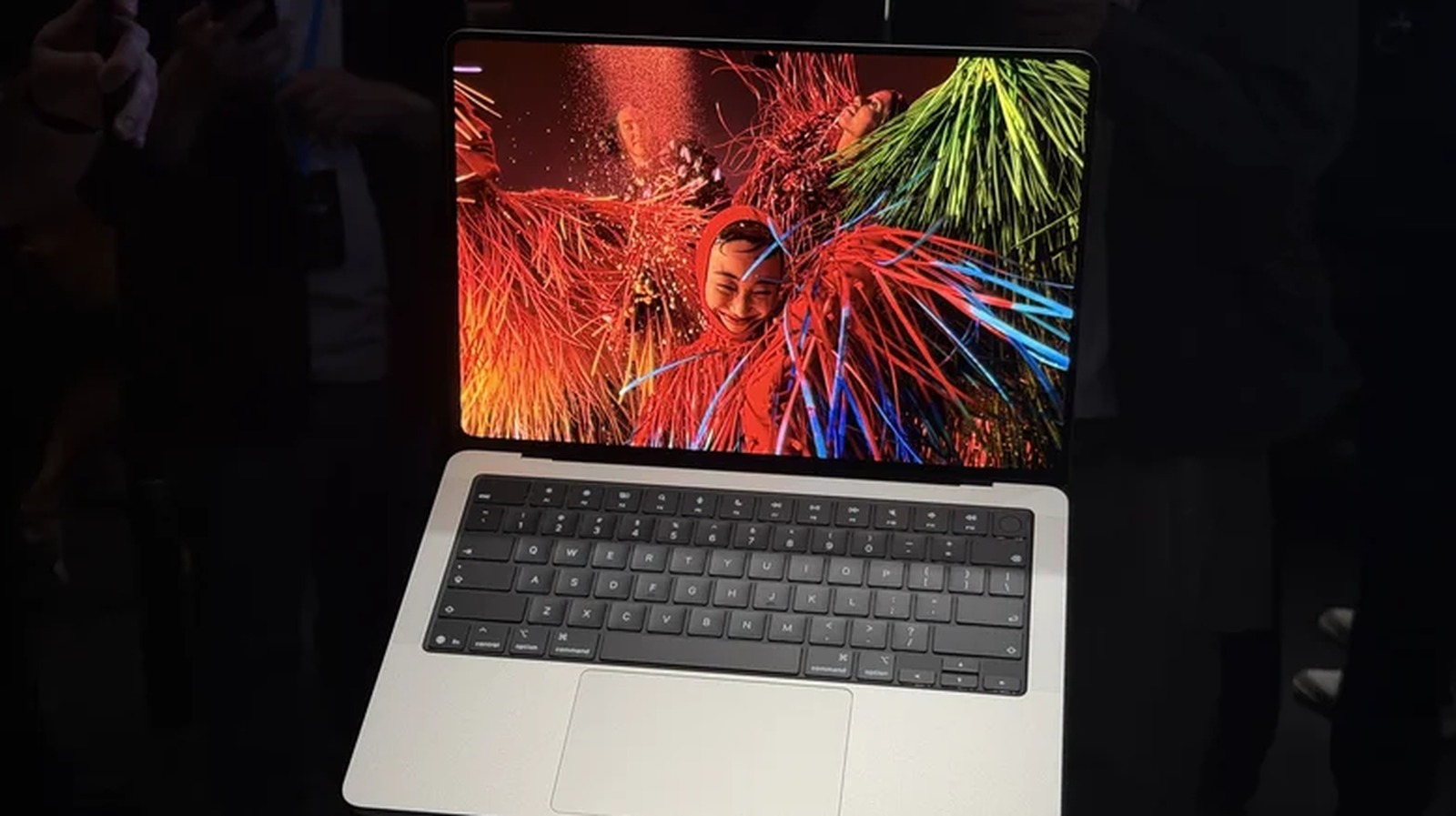
The fully configured 16-inch Apple MacBook Pro M5 Max is a high-performance workstation laptop featuring an integrated OLED touchscreen and unified memory architecture, retailing for $14,549 USD direct from Apple’s online store. This specific hardware package is engineered for machine learning researchers running local large language models, 3D graphics engineers, and high-bitrate video post-production teams who require extreme compute density in a mobile form factor. Unlike previous consumer-focused revisions, this configuration pushes laptop pricing into enterprise server territory, driven primarily by component storage scaling rather than silicon manufacturing leaps.
🛒 Where to Buy: Apple MacBook Air
- Apple MacBook Air Laptop: View on Amazon
Click the link above to check current pricing, availability, and customer reviews on Amazon.
Historically speaking, this is Apple’s second major attempt at transforming the Mac interaction model through touch input. The company’s first endeavor—the 2016 Touch Bar generation—failed over a five-year lifecycle because it segregated touch commands to a secondary OLED strip while leaving the primary panel non-touch, creating ergonomic friction and fragmented developer support. The new 16.3-inch PROLED XDR Display resolves that historical disconnect by bringing direct touch functionality and a Dynamic Island interface directly to the primary screen. However, evaluating the $14,549 USD total investment requires examining how much hardware capability is actually delivered once memory and NAND storage markups are isolated from the core system package. Initial product disclosures and reporting were tracked via Engadget.
Over a standard 24-month enterprise deployment cycle, the total cost of ownership extends beyond the base sticker price. Factoring in compulsory extended coverage via AppleCare+ at $499 USD, estimated local sales taxes averaging 8 percent ($1,163 USD), and baseline professional peripherals, the initial outlay reaches approximately $16,211 USD. When amortized across two years of active production, the system costs roughly $675 USD per month. Historically, top-tier Mac notebooks retain approximately 45 to 50 percent of their original retail value after two years; however, custom maxed-out storage options typically suffer steeper depreciation curves on the secondary market, as buyers rarely pay proportional premiums for used fixed internal storage.
Upfront Investment & 2-Year Total Cost of Ownership
To understand how a laptop reaches a $14,549 USD price point, one must analyze Apple’s component tiering structure. The base entry 16-inch MacBook Pro with an M5 Pro chip starts at $3,399 USD, while selecting the top-spec M5 Max silicon—featuring an 18-core CPU and 40-core GPU—establishes a base hardware platform price of $5,399 USD when paired with 48GB of unified memory and a 2TB solid-state drive. Upgrading the display to the nano-texture anti-glare glass adds $150 USD, while the step up to the touchscreen PROLED XDR panel accounts for a modest $400 USD price differential compared to equivalent non-touch models.
The vast majority of the overall expense stems from internal memory and solid-state storage upgrades, which together represent 62 percent of the final system cost. Upgrading the unified memory from 48GB to 128GB requires an additional $2,000 USD outlay. Storage expansion is even more punitive: transitioning from the baseline 2TB SSD to 4TB costs $1,000 USD, expanding to 8TB adds $3,000 USD, and maximum capacity at 16TB adds a staggering $7,000 USD. Apple applies a linear pricing scale of $500 USD per additional terabyte across all tiers, offering zero volume discounts for higher-capacity configurations.
In enterprise operational environments, ongoing maintenance and infrastructure protection must be factored into the purchase calculation. The standard one-year warranty provides minimal insulation against accidental display damage, which on a tandem OLED panel of this resolution carry out-of-warranty replacement costs exceeding $1,200 USD. Purchasing three years of AppleCare+ for $499 USD is practically mandatory for field deployments. Software maintenance remains minimal due to macOS updates being provided without license fees, though software suites capable of utilizing 128GB of unified VRAM often carry recurring enterprise subscription costs that dwarf standard creative tool licenses.
From an accounting perspective, capital expenditure depreciation on a $14,549 USD portable workstation presents distinct financial trade-offs. While IT departments can depreciate the hardware asset over a standard three-to-five-year schedule, the rapid pacing of Apple Silicon iterations means that processing power parity will likely be achieved by lower-tier configurations within two product cycles. Consequently, the real cost of ownership is defined by whether the localized workflow explicitly generates immediate billable efficiency gains that offset the steep initial capital commitment.
What You Actually Get: Core Features & Build Specs
According to technical documentation published with this release, the flagship configuration centers on the M5 Max system-on-chip, fabricated on a 3-nanometer architecture. The chip combines an 18-core central processing unit with a 40-core graphics processing unit, backed by a unified memory interface delivering 614GB/s of memory bandwidth. Crucially, because Apple Silicon utilizes a unified memory architecture, the full 128GB pool of RAM is instantly accessible by both the CPU and the GPU. This architectural characteristic allows the machine to load and execute large language models containing up to 70 billion parameters entirely within local memory—a task that traditionally requires dedicated multi-GPU desktop server nodes.
The primary display update centers on Apple’s PROLED XDR Display, a 16.3-inch tandem OLED panel engineered to resolve historical single-layer OLED brightness limitations. In official product documentation, Apple specifies a sustained full-screen brightness of 1,000 nits for High Dynamic Range content, with local peak brightness reaching 2,000 nits. The panel covers 100 percent of the DCI-P3 wide color space and the Adobe RGB gamut, utilizing ProMotion variable refresh rate technology up to 120Hz. The optional nano-texture glass layer, etched directly into the cover glass rather than applied as a surface coating, effectively diffuses ambient specular reflections without degrading spatial contrast or sharpness.
Physical construction maintains Apple’s established precision-machined aluminum unibody chassis standards. The 16-inch model weighs exactly 4.1 pounds and maintains a uniform thickness of 0.63 inches. Thermal management relies on dual internal high-efficiency fans linked to vapor chamber heat pipes designed to exhaust thermal energy through side vents without invoking aggressive acoustic throttling during sustained workloads. Power delivery is managed by an internal 100Wh lithium-polymer battery—the maximum capacity permitted on commercial passenger aircraft by Federal Aviation Administration regulations—rated for up to 22 hours of video streaming or light productivity work.
Port selection remains conservative but functionally complete for modern high-bandwidth workflows. The hardware includes three Thunderbolt 5 ports capable of bi-directional throughput up to 120Gbps, an HDMI 2.1 port supporting external displays up to 8K resolution at 60Hz, an SDXC card slot utilizing the UHS-II bus protocol, a high-impedance 3.5mm headphone jack with internal digital-to-analog converter upgrades, and a dedicated MagSafe 3 charging interface. The physical keyboard retains traditional scissor-switch key caps with 1mm of travel, paired with a force-touch glass trackpad that operates alongside the new capacitive touch screen overlay.
Hidden Costs, Ecosystem Dependencies & Fine Print
Examining the fine print of Apple’s hardware configurator reveals strict architectural dependencies that restrict component customization. Most notably, the top-tier 128GB memory allocation cannot be paired with lower-cost processor tiers. Customers cannot select 128GB of memory on the entry-level M5 Pro chip or even on the 32-core GPU variant of the M5 Max, which caps out at 36GB of RAM. Anyone requiring maximum memory capacity for AI model execution is forced to first select the most expensive 40-core M5 Max chip option, artificially elevating the baseline cost of entry to $5,399 USD before memory or storage upgrades are applied.
Macroeconomic memory volatility represents another critical factor driving this pricing structure. Industry market research from analyst firm Counterpoint indicates that global smartphone and PC DRAM contract prices rose 50 percent, while NAND flash storage prices escalated over 90 percent quarter-over-quarter in early 2026. This industry-wide price surge, driven by hyper-scaler AI data center procurement, led Apple to implement broad price increases across its Mac hardware lineup in late June 2026. Consequently, an identical hardware configuration that retailed for $7,349 USD in March 2026 escalated to $10,149 USD by mid-summer, before the addition of the 16TB SSD tier pushed the absolute ceiling to $14,549 USD.
The financial rationale for internal storage upgrades remains exceptionally difficult to justify when compared against modern high-speed external storage solutions. Apple charges $7,000 USD to step from a standard 2TB SSD to a 16TB SSD internal module. In practice, a professional user can purchase an external 4TB PCIe 4.0 NVMe M.2 solid-state drive housed within a ruggedized Thunderbolt 5 enclosure delivering transfer speeds up to 6,000MB/s for approximately $450 USD. Purchasing four such external modules yields 16TB of total operational capacity for under $1,800 USD, representing a cost savings of more than $5,000 USD compared to Apple’s internal NAND upgrade.
Ecosystem dependencies present additional hidden operational expenses. To fully utilize the 120Gbps throughput of the integrated Thunderbolt 5 controllers, facilities must invest in updated Thunderbolt 5 docking stations and certified active optical cables, which average between $100 USD and $350 USD each. Furthermore, power delivery demands during maximum simultaneous CPU and GPU loads necessitate the included 140W USB-C Power Adapter; utilizing standard 65W or 100W legacy USB-PD chargers during heavy computational runs results in slow battery drain even while connected to wall outlets.
Smarter Alternatives at This Price
For professionals weighing an investment of this magnitude, evaluating competing mobile workstations built on x86 architecture and Windows/Linux environments provides critical context regarding performance density and market value. The workstation landscape features several compelling alternatives that trade unified memory integration for field serviceability and modular upgradability.
The first major alternative is the Lenovo ThinkPad P1 Gen 7, which retails for $4 USD,299 USD on Amazon when equipped with an Intel Core Ultra 9 185H processor, an Nvidia RTX 4090 Mobile GPU with 16GB of VRAM, 64GB of LPDDR5X RAM, and a 2TB PCIe Gen4 SSD. The ThinkPad features a 16-inch OLED touch display running at 3.2K resolution and offers user-accessible dual M.2 storage slots. Pros of the Lenovo architecture include significantly broader native CAD and ISV enterprise software certifications, repairable dual-channel memory modules, and a lower purchase price that leaves budget for peripheral arrays. However, its primary cons include lower thermal battery life (typically 4 to 6 hours under load), a split memory architecture where discrete VRAM is limited to 16GB, and audible fan profiles under sustained rendering passes.
The second direct rival is the Dell Precision 7780 Workstation, available for roughly $5,899 USD on Amazon in a high-tier configuration featuring an Intel Core i9-13985HX CPU, Nvidia RTX 5000 Ada Generation graphics with 24GB VRAM, 128GB of CAMM2 DDR5 memory, and a 4TB SSD. The Precision 7780 serves as a heavy-duty desktop replacement built around a 17.3-inch panel. Its primary advantages stem from massive internal expandability—supporting up to four discrete M.2 NVMe SSDs in RAID arrays—and superior sustained thermal headroom for multi-day batch rendering operations. The drawbacks are substantial: the chassis weighs 6.7 pounds, requires a bulky 330W proprietary AC power brick, and lacks the color accuracy and contrast response delivered by Apple’s tandem OLED PROLED display.
Evaluating these options highlights clear architectural divergence. While the ThinkPad and Dell workstations offer modular repairability and familiar Windows enterprise integration at a lower initial capital investment, neither system can replicate Apple’s 614GB/s memory bandwidth or offer a continuous 128GB VRAM footprint on a single mobile die. However, for traditional 3D rendering in Blender or Premier Pro editing, the $10,000 USD price delta between a top-spec ThinkPad and the fully loaded MacBook Pro makes the x86 alternatives vastly more economical for standard corporate IT procurement.
Final Buyer Verdict: Is the Investment Worth It?
The $14,549 USD 16-inch MacBook Pro M5 Max represents a specialized engineering showcase rather than a practical purchase recommendation for the vast majority of consumer or professional buyers. The primary justification for this specific top-tier build lies almost exclusively with machine learning engineers and data science researchers who require a localized, self-contained 128GB unified memory environment to fine-tune and execute large language models in field environments without relying on cloud server latency or internet connectivity. For this specific micro-demographic, the ability to deploy complex local models on a 4.1-pound laptop with a high-contrast PROLED screen provides genuine operational value that can justify the extreme capital expenditure.
For standard creative professionals—including 8K video editors, colorists, commercial photographers, and software developers—the maxed-out 16TB storage configuration is an financial misstep. A far smarter purchasing strategy is to select the 16-inch MacBook Pro with the M5 Max chip, 48GB or 64GB of RAM, and a standard 2TB internal SSD for between $5,399 USD and $6,399 USD, pairing the machine with high-speed external Thunderbolt 5 storage drives. Bypassing Apple’s $7,000 USD internal 16TB NAND upgrade preserves over 50 percent of the system cost while delivering identical processing speeds, optimal thermal management, and equal visual performance from the tandem OLED screen.