

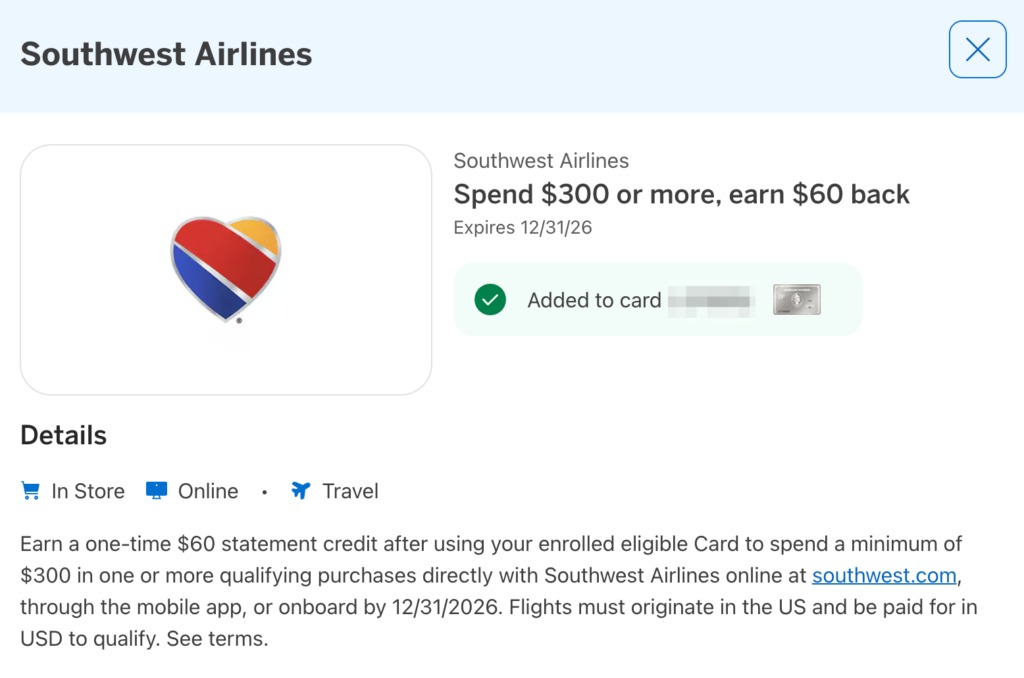
The targeted statement credit mechanism structured by American Express yields a $60 USD statement credit upon completing a cumulative spend of $300 USD or more directly with Southwest Airlines. Available across select personal and small-business card accounts through December 31, 2026, the promotion translates to an effective 20% cash-back return on qualifying domestic air travel bookings made via the Southwest Airlines official portal or mobile application. This offer targets domestic leisure travelers, small-business commuters, and point-to-point regional flyers seeking immediate yield optimization on short-haul to mid-haul air travel without altering their primary card strategy.
🛒 Where to Buy: Business Travel Luggage
- Samsonite Freeform Hardside Expandable Luggage: View on Amazon
Click the link above to check current pricing, availability, and customer reviews on Amazon.
Historically speaking, targeted card member promotions from major issuers have functioned as tactical customer acquisition tools designed to shift marginal bookings away from rival carriers. In practice, evaluating these financial incentives requires scrutinizing execution thresholds, transaction routing rules, and opportunity costs compared to primary loyalty program earning structures. While direct consumer promotions frequently obscure limitations within complex terms of service, this specific release warrants precise analytical review to determine its true economic return within a broader travel portfolio.
The timing of this release aligns with broader industry yield adjustments across low-cost domestic carriers. As seat capacity fluctuates and regional ticket prices stabilize, targeted discounts of this magnitude represent a rare fixed-percentage yield improvement. However, because allocation is governed by algorithmic selection algorithms rather than universal availability, cardholders must assess both account eligibility and execution rules before structuring flight purchases around the statement credit.
Real-World Context and Target Buyer Profile
To understand the utility of this promotional credit, one must examine the operational structure of Southwest Airlines alongside American Express’s target demographic. Unlike legacy legacy carriers that rely heavily on international hub-and-spoke networks, Southwest operates a high-density, point-to-point domestic route model. The primary target buyer for this targeted credit is a U.S.-based traveler who books point-to-point domestic itineraries, frequently utilizes two complimentary checked bags per fare tier, and maintains a disciplined approach to cash-outlay management. For an individual or business entity spending $300 USD on regional routes, securing a $60 USD rebate represents an immediate margin improvement that outpaces standard credit card rewards returns.
In practice, the target profile extends beyond individual flyers to encompass families and small-business operators managing multiple regional trips. Because Southwest’s fare structure features tiered pricing—ranging from Wanna Get Away up to Business Select—a standard round-trip ticket for a single passenger or a pair of one-way tickets for two travelers easily reaches the $300 USD minimum transaction threshold. Historically, similar promotions required single-transaction thresholds, creating friction for buyers purchasing lower-cost segment tickets. The distinction matters here: by allowing cumulative transactions to satisfy the expenditure baseline, the offer accommodates incremental purchases such as inflight Wi-Fi, upgraded boarding positions, or separate ticketed legs.
From an allocation perspective, American Express distributes these promotions selectively across its portfolio. As documented in the Southwest Airlines Amex Offer dispatch, targeted notifications have appeared on high-tier travel products alongside cash-back business cards. Cardholders managing multiple accounts must evaluate where the offer lands, as pairing the rebate with an optimal base-earning card architecture significantly alters the net financial benefit. Applying a 20% rebate to routine business travel or planned personal itineraries provides a rare, non-dilutive reduction in baseline travel expenditure.
Hardware Engineering, Materials, and Core Specs
Evaluating financial promotions requires treating the programmatic architecture of the card issuer’s reward engine with the same scrutiny one applies to physical hardware specifications. The operational parameters of this targeted offer are defined by rigid transactional constraints and clearinghouse rules. The system is programmed to track qualifying purchases clearing under Southwest Airlines’ primary Merchant Category Code (MCC) through December 31, 2026. Purchases must originate within the United States, and statement credits post to the cardholder’s ledger following verification by American Express’s clearing system.
- Minimum Spend Threshold: $300 USD cumulative across eligible transactions.
- Statement Credit Value: $60 USD one-time ledger credit per targeted card account.
- Effective Rebate Percentage: 20% net savings at exactly the $300 USD spend mark.
- Expiration Expiry Window: Valid for qualifying transactions settling on or before December 31, 2026.
- Channel Eligibility: Direct bookings via southwest.com, the Southwest mobile app, and onboard point-of-sale systems.
- Base Earnings Stacking: Fully stackable with card-level point multipliers, including 5x Membership Rewards points on eligible cards.
The mathematical interaction between this statement credit and premium card earning structures reveals notable efficiencies. For example, when targeted on the American Express Platinum Card®, the cardholder earns 5x Membership Rewards points per dollar spent on airfare booked directly with the airline on up to $500,000 USD per calendar year. On a qualifying expenditure of exactly $300 USD, the cardholder secures the $60 USD credit alongside 1,500 Membership Rewards points. Valuing those points at a conservative baseline of 1.5 cents each yields an additional $22.50 USD in return, driving the aggregate financial rebate to $82.50 USD, or an effective 27.5% total return on outlay.
Examining the fine print of the underlying platform documentation reveals critical transaction routing boundaries. The promotional engine tracks transactions directly settled by Southwest Airlines. Standard travel agency bookings, third-party flight aggregators, and alternative payment portals fail to trigger the credit because they settle under distinct corporate billing descriptors. Furthermore, while flight purchases and onboard food or connectivity services qualify, third-party add-ons managed via Southwest partners—such as car rentals or hotel stays booked through external affiliate links—are excluded from the cumulative tally. The system infrastructure demands absolute fidelity to direct merchant billing protocols.
Everyday Usability & Design Compromises
Despite the compelling paper mathematics, practical execution exposes key user experience limitations inherent to the Amex Offers infrastructure. The primary functional friction point lies in the targeted distribution mechanism. American Express limits account dashboards to display a maximum of 100 active offers simultaneously. Cardholders maintaining extensive card portfolios who fail to regularly manage or add visible offers may find the Southwest promotion hidden beneath low-yield retail promotions. Utilizing the known platform workaround—adding unwanted offers to clear interface space and re-logging into the application—is frequently required to force hidden promotions to surface.
A secondary operational limitation involves transaction settlement timing and currency routing. The policy dictates that all flights must originate within the United States and be priced in U.S. dollars. A traveler attempting to book an international return segment billed in a foreign currency or processed through an international ticket counter risks failing the MCC qualification filter. Additionally, because the statement credit is strictly a single-use entitlement per card account (capping total statement savings at $60 USD regardless of total spend over $300 USD), high-frequency business flyers spending thousands of dollars with the carrier will observe rapidly diminishing percentage returns beyond the initial spend floor.
Furthermore, cardholders must navigate merchant settlement delay risks near the promotional window’s conclusion. Booking a flight on or immediately preceding December 31, 2026, does not guarantee credit posting if the ticketing transaction remains in a pending state until after the cutoff date. Historically, card networks register qualifying transactions based on the final authorization clearing date rather than the button-press timestamp. Those seeking detailed management instructions can consult a complete guide to using Amex Offers to minimize transactional friction and ensure proper ledger tracking.
Category Alternatives and Value Comparison
To accurately gauge the market position of this promotion, it must be evaluated alongside competing credit products and standard airline co-branded card structures. The domestic airline loyalty landscape relies heavily on persistent co-branded credit products issued by major financial institutions. Evaluating the net value of a single targeted statement credit requires comparing it against permanent card benefits and rival issuer promotions operating within the same category.
Consider the co-branded Chase Southwest Rapid Rewards Priority Credit Card, which carries a $149 USD annual fee. The Chase card provides a built-in $75 USD annual Southwest travel credit alongside 7,500 anniversary bonus points (valued at roughly $100 USD in Wanna Get Away fare redemptions). While the co-branded card delivers ongoing structural value for committed Southwest loyalists, it requires taking on a persistent annual fee commitment. By contrast, the targeted Amex Offer delivers a comparable $60 USD direct cash offset on existing card accounts without adding recurring fee overhead or requiring credit line applications.
When evaluated against rival network carrier promotions, the 20% cash-equivalent return of this offer stands out as exceptionally strong. Standard airline targeted promotions from issuers like Chase or Citi frequently cap rebates at 10% to 15% with restrictive ceilings (for instance, spending $250 USD to receive a $25 USD or $35 USD statement credit on carriers like United Airlines or Delta Air Lines). The comparative breakdown highlights how these competing options perform alongside the Southwest promotion:
- Amex Southwest Offer: $300 USD spend requirement for a $60 USD credit (20% return, cumulative transactions permitted).
- Chase Southwest Rapid Rewards Priority Card: Built-in $75 USD credit offset against a $149 USD annual fee (structural co-branded benefit).
- Standard Issuer Airline Targeted Offers: Typical 10% to 15% rebate tiers, frequently capped at $25 USD–$40 USD maximum return.
- Amex Delta Air Lines Targeted Offers: Historically structured as $75 USD back on $350 USD spend (approximate 21.4% return when targeted).
The operational trade-off comes down to flexibility versus specificity. While co-branded airline cards offer permanent perks such as upgraded boarding passes or fee credits, targeted Amex Offers allow cardholders to capture episodic value on secondary carriers without diluting their primary credit setup. For travelers who do not fly Southwest exclusively, relying on targeted 20% rebates on flexible rewards cards provides superior agility compared to locking capital into carrier-specific annual fee cards.
Final Buyer Verdict: Long-Term Ownership Value
The targeted American Express offer providing a $60 USD statement credit on $300 USD of cumulative Southwest Airlines spend is a precisely engineered, high-yield tactical promotion. For eligible cardholders who maintain active domestic travel schedules or plan specific leisure itineraries before December 31, 2026, the offer delivers a clean 20% financial offset with minimal friction. The ability to aggregate spending across multiple transactions—including flights, onboard services, and seat upgrades—substantially lowers the barrier to entry compared to single-purchase promo codes.
From an optimization perspective, the recommendation is clear: cardholders should audit all personal and business American Express accounts immediately, clear offer queues if the 100-item limit is reached, and manually enroll eligible cards before placing airfare orders. When combined with premium base earning cards like the Platinum Card®, the effective total yield approaches 27.5%. Provided transactions are executed directly with Southwest Airlines in U.S. dollars before the cutoff date, this offer represents one of the most efficient domestic travel cost-reduction tools currently available in the consumer finance market.