

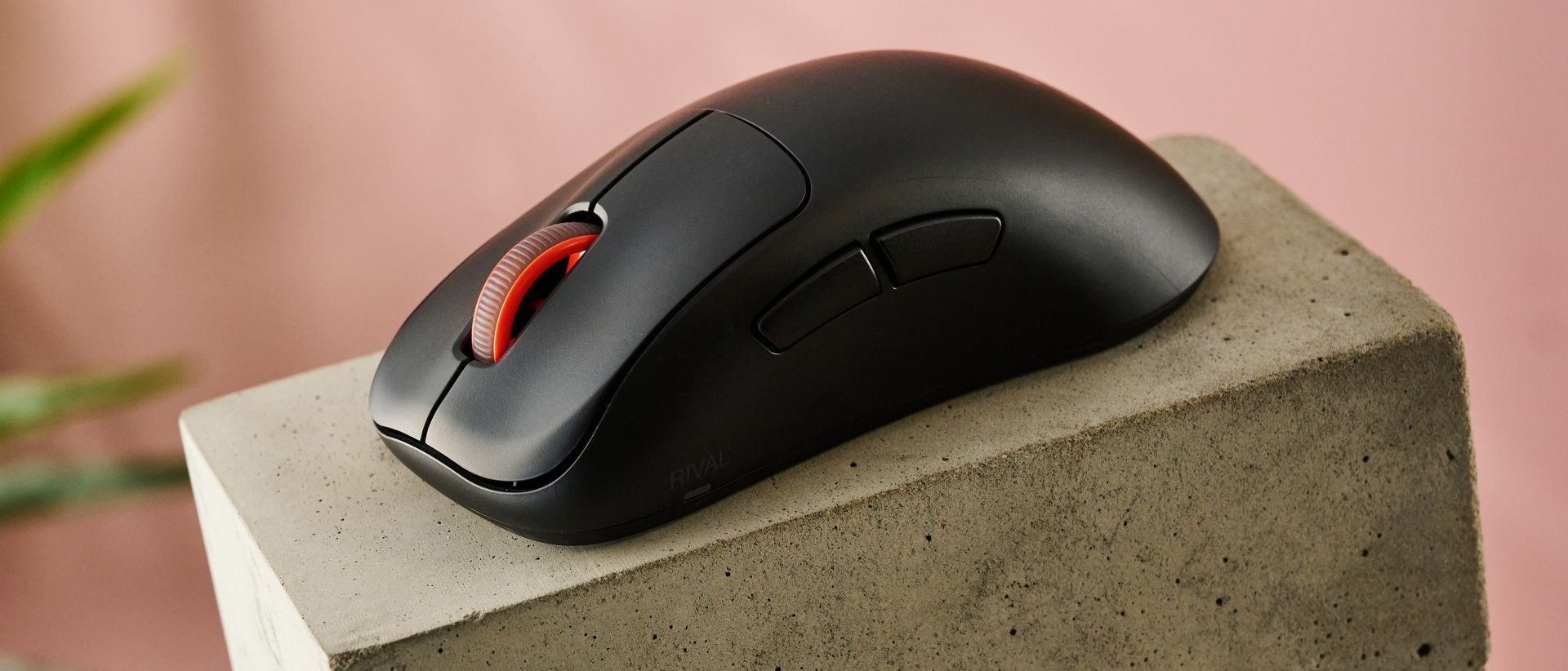
The SteelSeries Rival Pro Miniis a compact wireless peripheral designed to deliver zero-downtime desktop tracking, ultra-high polling rates, and custom ergonomic control. Retailing at an exact price of $179.99 USD (or £169.99 GBP) direct from SteelSeries and on Amazon, this premium hardware targets competitive gamers, high-speed office power users, and hybrid workers who require top-tier responsiveness in a scaled-down form factor. It aims to eliminate cable clutter entirely while providing high-end sensor precision across demanding workstation environments.
🛒 Where to Buy: SteelSeries Rival Pro
- SteelSeries Rival Pro: View on Amazon
Click the link above to check current pricing, availability, and customer reviews on Amazon.
For a normal household, dropping nearly two hundred dollars on a computer pointer is a significant investment that demands strict practical justification. In typical home offices and gaming setups, mouse frustration usually comes down to two major pain points: battery death right in the middle of a critical task, and bulky ergonomics that crowd small work surfaces. Many compact travel mice sacrifice tracking accuracy and sensor quality to shrink their physical footprint, while flagship gaming mice often become oversized desktop anchors that require frequent plug-in charging breaks. Evaluating whether a device at this price point delivers true long-term utility requires looking past promotional hype to measure actual day-to-day total cost of ownership and physical usability. Initial product disclosures and reporting were tracked via Techradar.
When analyzing high-end hardware for everyday family budgets and dedicated workspaces alike, every feature must justify its line item on the receipt. SteelSeries launched the Rival Pro Mini alongside its full-sized sibling in late 2026, positioning both models at identical price points despite the difference in physical dimensions. Understanding how this compact unit handles long work shifts, rapid battery swaps, and heavy software customization reveals whether its premium asking price translates into genuine productivity and gaming returns, or if a standard budget mouse remains the smarter household purchase.
The Problem and Hardware Purpose
Modern hybrid desktop environments demand peripherals that can transition seamlessly between precise spreadsheet navigation, high-resolution photo and video editing, and fast-paced competitive gaming. Traditional office mice frequently rely on low polling rates around 125Hz to conserve energy, resulting in subtle cursor jitter or sluggish movement on high-refresh-rate displays. Conversely, performance gaming mice hit high tracking metrics but often demand frequent wired charging breaks that turn a wireless setup back into a tethered desk mess. The Rival Pro Mini attempts to solve this fundamental workflow friction by combining high-end sensor architecture with a continuous power delivery system.
The peripheral achieves its core purpose by integrating an internal hot-swappable battery compartment alongside a dedicated Ultra Wideband wireless base station. Rather than forcing users to stop working or gaming to plug in a charging cable, the base station acts as both a high-frequency wireless receiver and a secondary battery charger. This structural design guarantees that a fresh power cell is always ready on your desk, effectively eliminating device downtime. It caters directly to users who manage dual-monitor workstations, high-DPI canvas editing, or fast-action gaming where tracking interruptions destroy performance.
From a financial standpoint, buying into a premium ecosystem means evaluating total cost of ownership rather than just the initial checkout total. Because the package includes two proprietary battery cells and the multi-function wireless base station out of the box, buyers are not forced to purchase separate charging docks or recurring replacement batteries down the line. That is fair value for an all-in-one bundle, though the initial barrier to entry remains steep for casual computer users who only need basic point-and-click functionality for daily Web browsing.
Engineering Architecture & How It Works
Under the shell, the engineering driving the Rival Pro Mini focuses on maximum signal throughput and physical customization. Technical documentation published with this release specifies a high-end optical sensor capable of up to 42,000 DPI sensitivity and true 8,000Hz (8K) wireless polling. In plain English, an 8K polling rate means the mouse reports its physical position to your computer 8,000 times per second, compared to the 1,000 times per second standard on typical high-performance pointers. The hardware also incorporates SteelSeries SuperSync technology, enabling users to independently configure tracking polling rates and button click reporting frequency to optimize computer processor load.
Physical input relies on primary optical micro-switches rated for high-speed actuation, paired with a tactile mechanical scroll wheel featuring distinct ridged step indents for precise line scrolling. The top shell houses six fully programmable buttons, allowing users to map complex productivity macros, keyboard shortcuts, or game commands directly to the mouse body. System settings, sensor calibration, and lighting controls are managed via the SteelSeries GG desktop software suite or a streamlined Web interface, giving users access to sensitivity steps, power-saving sleep timers, and profile storage without bloated background background services.
What caught my eye reading the full spec sheet is that the physical mouse chassis lacks a standard USB port for direct cable plug-in charging. SteelSeries committed entirely to its hot-swappable battery architecture: when the battery inside the mouse drains, you unlatch the underside cell cover, pop out the depleted battery, and swap in the fully charged unit sitting inside the base station dock. Operating at a standard 1,000Hz polling rate yields roughly 60 hours of continuous battery life per charge, while running at maximum 8,000Hz drops operational stamina down to approximately 16 hours per cell.
The exterior hardware relies on an ergonomically molded right-handed shell finished with a lightly textured matte coating designed to improve hand grip during long computer sessions. The compact frame reduces physical mass compared to standard desktop mice, making it nimble for quick hand gestures. However, examining the fine print of the hardware build reveals that the smooth matte black coating naturally picks up oils and finger smudges over time, requiring routine wiping to maintain a clean aesthetic across heavy work shifts.
Real-World Performance Reality
Translating theoretical sensor benchmarks into practical day-to-day outcomes reveals clear real-world performance advantages alongside a few operational trade-offs. In high-demand gaming environments like Cyberpunk 2077 running on ultra-fast displays such as the LG UltraGear 25G590B 1000Hz gaming monitor, tracking consistency remains flawless. Screen turns, micro-aiming adjustments, and fast cursor sweeps show zero sensor smoothing or tracking skip, proving that the hardware inside handles demanding graphical scenarios effortlessly.
For general office and creative productivity, the optical switches deliver clear, crisp click feedback with instant registration. Whether selecting micro-cells across giant financial spreadsheets or executing precision vector cutouts in graphics suites, the physical response of the buttons feels tight and mechanical. The scroll wheel step indents provide strong tactile feedback, preventing accidental over-scrolling when navigating through lengthy PDF documents or switching tool palettes during work hours.
The hot-swappable battery mechanism completely changes routine power management habits. Swapping a battery cell takes less than 5 seconds once you get used to the latch geometry. However, for a normal household or office worker, running the mouse at a full 8,000Hz polling rate makes little practical sense. The drop from 60 hours of battery life down to 16 hours requires swapping batteries every single day. Setting the mouse to 1,000Hz or 2,000Hz mode provides virtually indistinguishable cursor smoothness for human eyes while stretching battery runtime across an entire week of 8-hour workdays per cell.
Physical sizing remains the most critical comfort boundary. Because this is explicitly a mini model built for compact portability and smaller grip styles, users with large hands will experience palm overhang or wrist fatigue if attempting a full palm grip over extended hours. The contoured right-handed asymmetry offers excellent ergonomic support for claw and fingertip grips, but anyone with above-average hand dimensions will be far better served by stepping up to the standard full-sized SteelSeries Rival Pro chassis to avoid hand cramping during back-to-back work shifts.
Competitive Landscape: Named Rivals Compared
Navigating the ultra-premium wireless peripheral market requires directly comparing the Rival Pro Mini against established market competitors sitting at identical price points. Evaluating features, power systems, and physical design choices side-by-side helps clarify where your dollar delivers the strongest return.
The primary competitor in this price tier is the Logitech G Pro X2 Superstrike, which retails at an identical $179.99 USD price tag on Amazon (detailed extensively in editorial coverage like the Logitech G Pro X2 Superstrike review). Logitech focuses heavily on an ultra-lightweight, symmetrical ambidextrous shell paired with low-latency optical switches. However, Logitech relies on traditional USB-C cable charging or proprietary continuous wireless charging desk pads that cost extra money. If you prefer a completely symmetrical shell and ultra-light physical weight, Logitech is a formidable contender, but SteelSeries wins on out-of-the-box battery convenience thanks to its included dual-cell swapping system.
Another major rival in the compact performance category is the Razer DeathAdder V4 Pro, selling for $179.99 USD. Razer delivers an exceptional right-handed ergonomic shape, high-grade optical scroll wheel, and smooth tracking software features. Razer often sees promotional sales down to lower price brackets, giving it a potential edge for deal-seekers. However, when Razer’s battery depletes, you must connect a flexible USB cable to continue working, temporarily cluttering your desk. SteelSeries avoids tethering entirely with its base station dock setup.
- SteelSeries Rival Pro Mini ($179.99 USD): Features 42K DPI optical sensor, true 8K wireless polling, molded compact right-hand ergonomics, and zero-downtime hot-swappable dual batteries via an Ultra Wideband base station.
- Logitech G Pro X2 Superstrike ($179.99 USD): Features ultralight ambidextrous chassis, sub-millisecond click latency, low-friction glide feet, and traditional USB-C charging with long single-charge endurance.
- Razer DeathAdder V4 Pro ($179.99 USD): Features iconic ergonomic sculpting, optical wheel encoding, high-speed wireless dongle support, and frequent retail sale pricing.
Evaluating these options through a practical lens comes down to hardware priorities. If absolute minimal weight and ambidextrous shaping matter most, Logitech holds a narrow edge. If you want maximum ergonomic sculpting and proven brand longevity, Razer is a standout choice. But if eliminating charging cables completely while maintaining high-end tracking accuracy is your top priority, SteelSeries’ engineering design holds a distinct hardware advantage.
Final Buyer Recommendation: Practical Value Decision
The the item Mini is an undeniably impressive piece of desktop engineering that delivers S-tier sensor accuracy, crisp mechanical inputs, and a genuinely useful battery system. Its $179.99 USD retail price places it firmly in the luxury tier of computer peripherals, meaning it is not a casual impulse buy for a standard home office setup. However, for users who rely on their desktop setup for hours of uninterrupted work and competitive gaming every day, the total cost of ownership is backed by high-end performance, durable construction, and zero battery downtime.
I recommend buying the the product Mini if you have small-to-medium hands, prefer a lightweight compact right-handed mouse, and hate dealing with charging cables during long workstation shifts or gaming sessions. Setting the polling rate to a practical 1,000Hz or 2,000Hz tier delivers an optimal balance of laser-sharp precision and multiday battery endurance per cell. Conversely, if you have large hands, prefer ambidextrous pointer shapes, or simply need a reliable mouse for routine email and document editing, save your hard-earned money and consider a standard productivity model under $80 USD or step up to the full-sized Rival Pro chassis instead.