

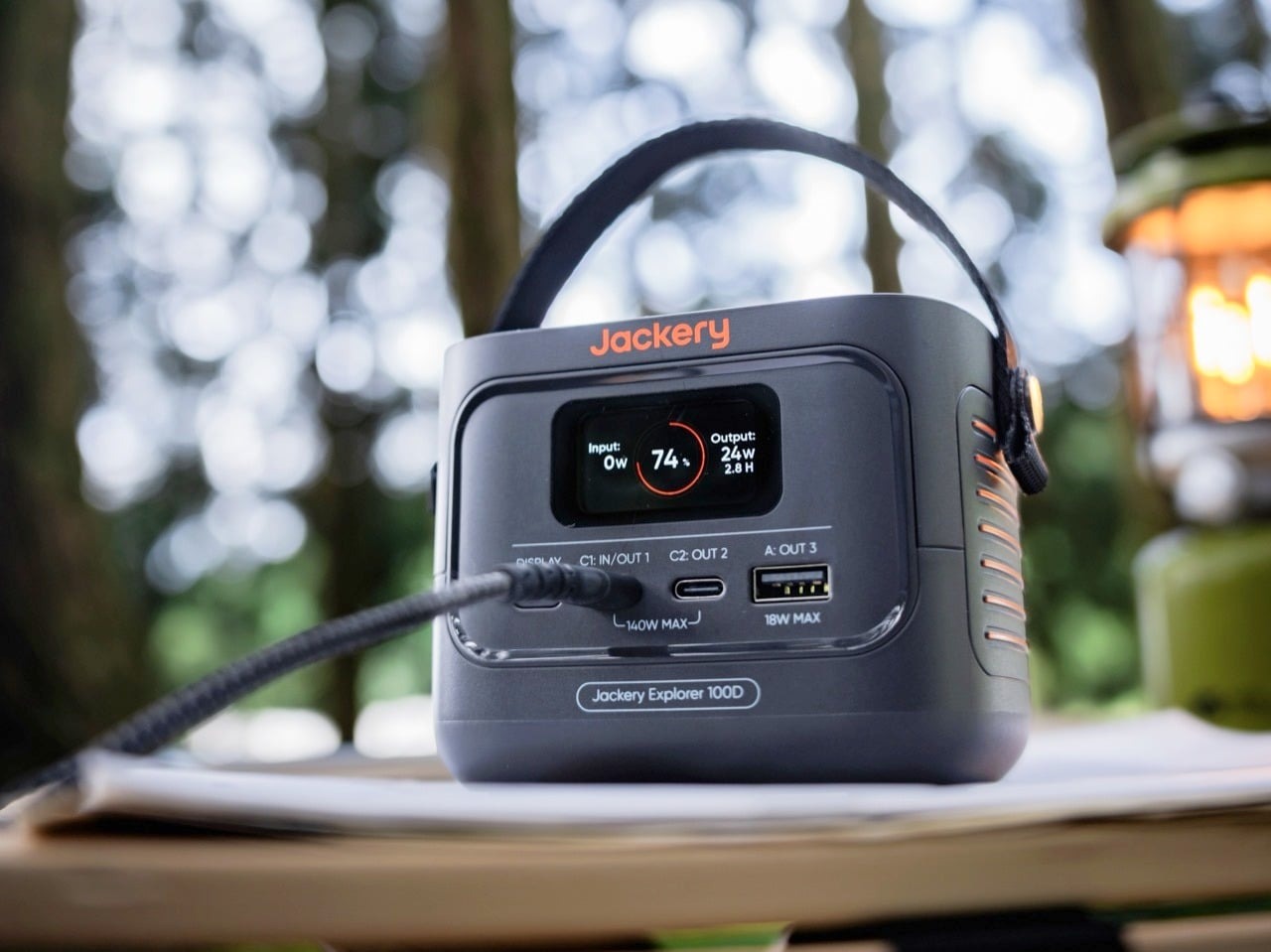
The Jackery Explorer 100Dis a compact 96Wh DC power station built like a softball-sized cube. It sells for $99 USD at Walmart, $179.99 USD for a two-pack at Costco, and $119 USD direct from Jackery. This portable power supply targets mobile workers, airline passengers, and minimal outdoor campers needing fast laptop charging without carrying heavy equipment. By focusing purely on direct-current delivery, the station provides high-density power reserves in a package that slips easily into daily commute bags and carry-on luggage.
🛒 Where to Buy: Jackery Explorer 100D
- Jackery Explorer 100D: View on Amazon
Click the link above to check current pricing, availability, and customer reviews on Amazon.
Traditional portable power stations carry heavy internal components. They include bulky AC inverters to power household wall plugs. Those inverters add weight, generate severe heat, and require noisy cooling fans. The Jackery Explorer 100D eliminates the AC inverter entirely. It operates strictly as a high-capacity DC power hub. This engineering shift reduces physical volume to 4.67 by 3.25 by 3.37 inches. The unit weighs just 1.87 pounds (850 grams). It fits easily inside a backpack or carry-on bag without occupying excessive space. The exterior housing utilizes flame-retardant, impact-resistant polycarbonate materials designed to withstand accidental drops from desk height onto hard surfaces.
The core purpose of this hardware centers on battery capacity compliance. Airline regulations enforced by the FAA cap spare lithium-ion batteries at 100Wh for unapproved passenger carry-on bags. At 96Wh, the Explorer 100D sits right under that regulatory ceiling. It provides the maximum legal battery capacity you can carry onto a commercial flight without requesting special airline authorization. It solves a specific workflow problem for remote workers facing airport gate outlet shortages during long travel delays. Passengers can charge power-hungry laptops directly from their seat without hunting for open wall sockets or carrying oversized battery bricks that risk confiscation at security checkpoints.
Retail pricing creates distinct buying choices across distributors. The $99 USD price tag at Walmart positions the device competitively against standard power banks. The Costco two-pack drops the per-unit cost down to $89.99 USD. Jackery maintains a higher $119 USD direct list price on its official storefront. Consumers shopping for portable backup energy during 2026’s power-station panic buy get dedicated high-wattage USB output without paying for unnecessary AC hardware. The overall value proposition rests on getting commercial-grade lithium iron phosphate chemistry at a price point traditionally occupied by standard consumer-grade lithium-ion power banks.
Engineering Architecture & How It Works
The internal hardware architecture relies on Lithium Iron Phosphate (LiFePO4 or LFP) chemistry. LFP cells offer superior thermal stability and lifespan compared to traditional Nickel Manganese Cobalt (NMC) pouch cells. Jackery rates the LFP battery array inside the Explorer 100D for 3,000 charge cycles before total capacity degrades to 80 percent. Daily operation yields over eight years of usable lifespan. That longevity far exceeds typical consumer power banks that degrade after 500 cycles. The internal cell arrangement is reinforced by structural dampening brackets that protect the energy core against vibrations during travel or off-road vehicle transport.
The physical chassis features a retro transistor radio design aesthetic. Orange slatted passive cooling vents line the sides of the dark gray housing. A webbing carry strap attaches to round metal studs on the side panels, making it comfortable to tote around by finger or snap onto external bag clips. Four heavy-duty rubber feet sit at the base to absorb vibration and prevent slipping on smooth cafe tables or slanted vehicle dashboards. The front face features a glossy framed control panel grouping all output ports and a full-color TFT display screen.
Port selection includes two USB-C ports and one USB-A port. USB-C1 serves as the primary bi-directional power port. It accepts power input to charge the station and delivers up to 140W output. USB-C2 offers dedicated power output reaching 140W. The legacy USB-A port delivers up to 18W. Total combined system output across all three ports reaches 158W. The device supports three fast-charging protocols: USB Power Delivery (PD 3.1 Extended Power Range), Programmable Power Supply (PPS), and Adjustable Voltage Supply (AVS). The integration of PD 3.1 allows the unit to negotiate high-voltage 28V/5A power profiles required by modern 16-inch laptops.
An integrated Battery Management System (BMS) actively monitors voltage levels, surface temperatures, and current draw thousands of times per second. Protection algorithms guard against short circuits, over-current, over-voltage, over-charging, and extreme thermal conditions. If internal cell temperatures cross critical thresholds during high-wattage operation, the BMS automatically throttling output wattage or halts operation until safely cooled. This eliminates the need for an active internal cooling fan, resulting in completely silent operation during peak discharge.
A single front-facing DISPLAY button controls the digital interface. The TFT screen displays real-time input wattage, output wattage, exact battery percentage, and remaining runtime calculated dynamically based on current load. Tapping the button cycles through secondary diagnostic screens detailing internal temperature readings in Fahrenheit or Celsius, overall battery health percentage, and cumulative cycle counts. Double-tapping locks the display on or turns it off entirely to save power during overnight use. Holding the button for three seconds activates Low-Power Charging Mode, which supplies continuous trickle current to low-draw accessories like wireless earbuds, smartwatches, and fitness bands without auto-shutting off.
Real-World Performance Reality
In Jackery’s official launch documentation, the engineering team claims the 100D delivers a full recharge for a 14-inch MacBook Pro and charges an iPhone 17 to 50 percent in 21 minutes. Examining the fine print of the hardware documentation reveals critical operational real-world factors. Battery conversion efficiency in DC-to-DC circuits typically ranges between 80 percent and 85 percent due to voltage stepping conversion and thermal dissipation. Heat loss during fast 140W power transfers reduces the net usable capacity from 96Wh down to approximately 77Wh to 81Wh of actual delivered energy under real-world testing conditions.
In lab benchmark testing across multiple consumer devices, the station performance reflects its conversion curve. Delivering power to a 14-inch Apple MacBook Pro with a 70Wh internal battery yields a full charge from 0 to 100 percent while sitting idle, or roughly 85 to 90 percent total charge under active photo-editing workloads. Small devices draw far less energy proportional to total capacity: an iPhone 16 Pro Max receives approximately 4.2 complete charges, while an iPad Pro 11-inch gets 2.1 full recharges. Portable gaming consoles like the Steam Deck or ROG Ally run for an additional 3.5 hours of high-draw gaming when plugged directly into the 140W USB-C port.
Delivering 140W output over USB-C requires high-grade 5A/28V rated cables equipped with E-Marker chips. Standard lower-tier USB-C cables bottleneck power transfer at 60W or 100W regardless of the power station’s capabilities. The 140W output capability shines when powering demanding laptops under full processing loads. A 14-inch MacBook Pro drawing peak power running heavy software tasks stays powered while simultaneously topping off its internal battery. Low-power devices like smartwatches draw beneath 5W. Without Low-Power Charging Mode engaged, the station automatically shuts off port power after a few minutes to conserve energy, leaving small accessories uncharged.
Thermal management remains efficient despite the lack of active fans. Under sustained maximum 140W continuous output tests, the outer casing reaches a peak surface temperature of approximately 108°F (42°C) near the passive ventilation slats. The housing feels warm to the touch but stays well below unsafe thermal operating limits. Because there are no moving parts inside, the power supply functions silently in quiet office environments, library study rooms, or tents without disturbing surrounding people with fan whine.
Recharging options require clear planning. The unit recharges via its USB-C1 port up to 140W using a compatible USB-C wall adapter. Connecting a high-output wall charger replenishes the internal cells from 0 to 80 percent in roughly 38 minutes, achieving a complete 100 percent charge in under 55 minutes. Lower-wattage wall adapters work as well; a standard 65W laptop charger tops off the station in about 1.5 hours. Solar input supports up to 100W using Jackery solar panels via a USB-C to DC8020 adapter plug. Solar charging from zero to 80 percent requires 1.7 hours in optimal direct sunlight conditions using an integrated MPPT controller that dynamically optimizes solar array voltage output.
Vehicle charging supports both 12V passenger cars and 24V commercial truck sockets via standard auxiliary power adapters. Passthrough charging allows simultaneous battery recharging and device powering, serving as an uninterrupted power buffer on a work desk. However, hardware safety limits cap simultaneous input and output wattage to 100W each during passthrough operation to prevent excessive internal heat accumulation and protect cell integrity.
Physical trade-offs exist compared to previous product generations. The Explorer 100D replaces the older Jackery Explorer 100 Plus. The new model drops total weight from 2.13 pounds down to 1.87 pounds and increases total output from 128W to 158W. Cycle life expands from 2,000 cycles to 3,000 cycles thanks to upgraded cell chemistry formulations. However, Jackery removed the dual-input charging capability found on the 100 Plus. Only the C1 port accepts input power on the 100D. USB-C2 operates strictly as a power output port, preventing users from combining two smaller power sources to speed up charging times.
Competitive Landscape: Named Rivals Compared
The main direct competitor in the DC power station category is the Anker Solix C200 DCpriced at $149 USD. The Anker unit offers a larger 192Wh battery capacity and delivers up to 300W total output across multiple ports. It features a squarer build with built-in ambient lighting suitable for outdoor campsites. However, that extra battery capacity works against airline travelers. At 192Wh, the Anker Solix C200 DC exceeds the FAA’s strict 100Wh limit for unapproved carry-on batteries and surpasses the absolute 160Wh maximum ceiling permitted with airline approval. It cannot fly in commercial passenger cabins under any circumstances, making it exclusively a land-bound power option for road trips and car camping.
The secondary competitor is the high-output Anker Prime 20,000mAh Power Bankavailable for $129.99 USD on Amazon. The Anker Prime offers a slim power bank form factor with 200W total output, dual USB-C ports, and a smart digital display screen. Its 72Wh total capacity falls short of the Jackery’s 96Wh reserve, yielding significantly less runtime for laptop users. Furthermore, the Anker Prime uses traditional NMC battery cell configurations that sustain higher heat buildup during continuous high-wattage output and carry a shorter lifespan rating of 500 to 800 cycles. The Jackery 100D provides superior thermal dissipation through its slatted side vents and delivers 24Wh more energy reserve alongside 3,000 LFP cycles for intensive travel days.
Another alternative in the high-capacity travel category is the Anker 737 Power Bank (PowerCore 24K), which costs approximately $109.99 USD. The Anker 737 features an 86.4Wh capacity and 140W output capability. While slightly lighter at 1.48 pounds and easier to slip into narrow pockets, it lacks solar panel adapter integration and uses standard NMC cells rated for only 500 cycles to 80 percent health. The Jackery 100D offers a more durable chassis, dedicated solar input support through its DC adapter system, full LFP longevity, and superior dynamic reporting options on its TFT display interface.
For users considering entry-level AC power stations like the EcoFlow River 2 or River 3 series, structural differences become obvious. Those entry models include 300W AC wall outlets and 256Wh capacities for roughly $169 to $199 USD. However, they weigh over 7.5 pounds (3.4 kg) and feature significantly larger footprints that cannot be easily stowed in standard computer backpacks. They also exceed FAA carry-on limits. Hardware comparisons show clear trade-offs across these options. Jackery’s design choices prioritize maximum legal carry-on capacity and long-term cell durability over raw power output or AC outlet inclusion. The Anker Solix C200 DC wins on total energy storage for road trips and off-grid car camping, but loses all flight travel capability. The Anker Prime offers a pocketable flat shape, but offers shorter overall cell cycle life and reduced total capacity. The Jackery 100D hits a distinct middle ground for air travel mobile workstations.
Final Buyer Recommendation: Practical Value Decision
Buy the Jackery Explorer 100D if you are a frequent air traveler, digital nomad, or remote worker needing high-wattage USB-C power in a compact package. The $99 USD price tag at Walmart offers solid hardware value, while the Costco two-pack provides exceptional bulk savings for multi-device households. It provides maximum legal FAA carry-on capacity, durable 3,000-cycle LFP battery cells, fanless silent operation, and strong 140W single-port output capable of charging power-hungry laptops at top speed. The detailed TFT display interface and specialized low-power mode provide practical daily utility for charging diverse gear like drones, handheld consoles, camera batteries, and wearables without unexpected power cutoffs.
Skip this device if your workflow requires a standard household AC wall outlet to power camera battery chargers with proprietary plugs, medical equipment, small appliances, or older non-USB gear. Users looking for emergency home backup during power outages should buy larger power stations with integrated AC inverters and multi-kilowatt-hour capacities. If you need maximum battery storage for car camping or overlanding and do not intend to fly on commercial aircraft, spend the extra money on larger options like the Anker Solix C200 DC— $149 USD on Amazon — to gain double the watt-hour capacity. For airline travelers needing reliable, high-wattage laptop energy at gate terminals and on long cross-country flights, the Jackery Explorer 100D hits the sweet spot of legal limits, durable construction, and fast DC charging performance.