

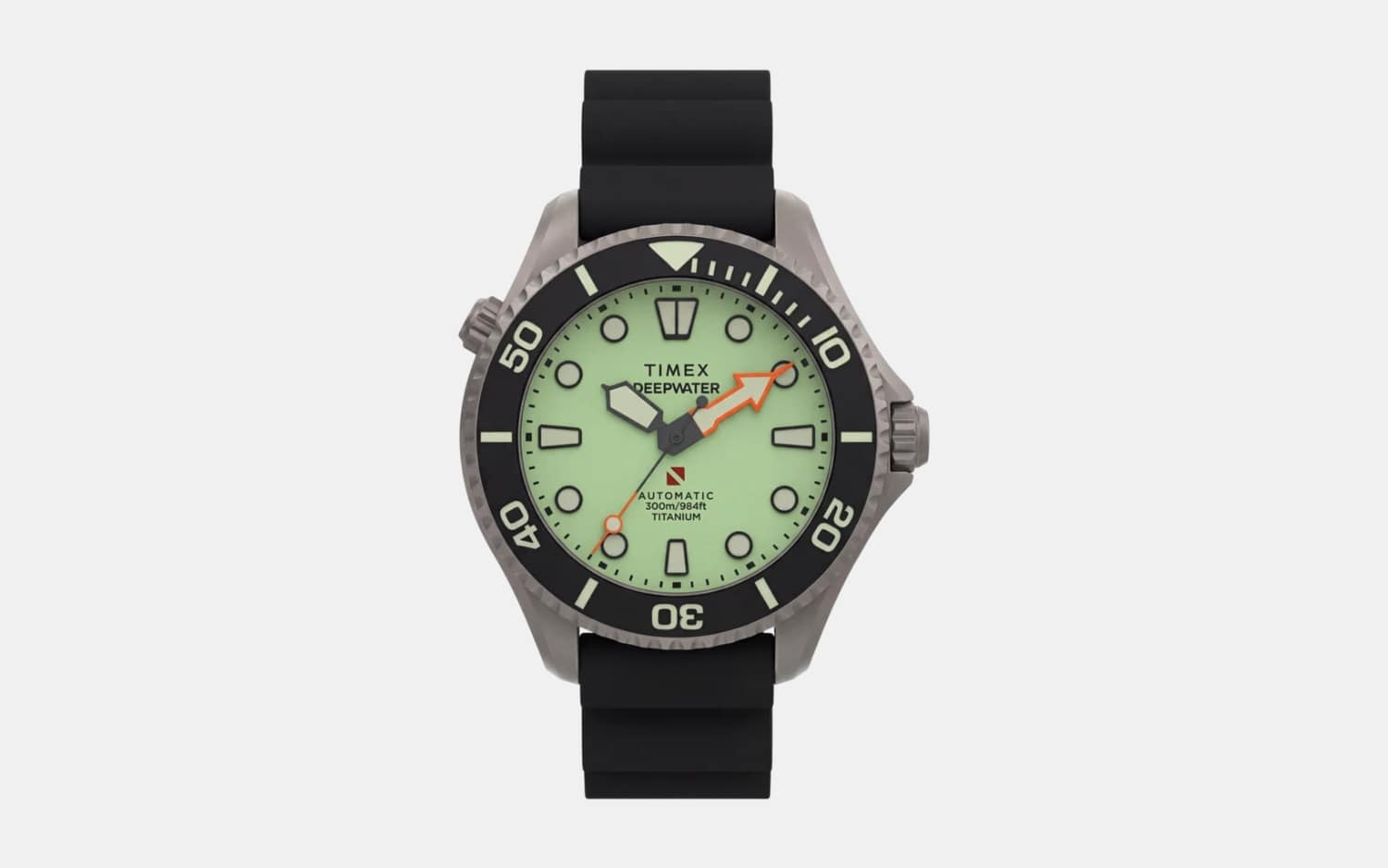
The Timex Deepwater Meridian 300Titanium HEV Automatic is a purpose-built mechanical dive watch featuring a lightweight 44mm titanium case, a ceramic bezel, and a integrated helium escape valve rated to 300 meters of water resistance. Priced at $999 USD direct from Timex and authorized retailers on Amazon, the timepiece targets watch collectors and marine activity enthusiasts seeking professional-grade material specifications without paying luxury Swiss brand premiums. The release represents the brand’s most ambitious attempt to move beyond its entry-level quartz legacy into higher-tier tool watch horology.
🛒 Where to Buy: Timex Deepwater Meridian 300
Editorial Note & Product Verification: The Cool Great Buys editorial desk independently verifies manufacturer technical specifications, cross-checks active retail availability across authorized sellers, and evaluates verified consumer reliability data before publishing product evaluations. All featured prices and promotions reflect active market rates at the time of publication.
- Timex Deepwater Meridian 300: View on Amazon
Click the link above to check current pricing, availability, and customer reviews on Amazon.
By pairing corrosion-resistant titanium with a specialized luminescent dial and deep-water capability, Timex challenges established players in the sub-$1,000 mechanical diver category. However, evaluating whether this reference warrants a four-figure expenditure requires scrutinizing its component selection, movement architecture, and ongoing ownership costs against established rivals.
Upfront Investment & 2-Year Total Cost of Ownership
The initial purchase price of $999 USD positions the Deepwater Meridian 300 at the absolute top tier of the Timex catalog. Historically, consumer expectations for the brand have gravitated around the $50 to $250 USD price range. Stepping into the $1,000 USD territory puts the watch in direct competition with established Japanese tool watches and independent microbrands. For this upfront capital expenditure, buyers receive the complete watch module mounted on a specialized HNBR synthetic rubber strap, packaged in a water-resistant display case.
From an ongoing maintenance perspective, the two-year cost of ownership remains notably modest compared to Swiss mechanical timepieces. The internal power source is a Japanese Miyota 8215 caliber. Because the Miyota 8215 is an industrial workhorse movement produced in high volume, routine servicing at a traditional watchmaker is rarely required or cost-effective within the first two years. Should mechanical failure occur outside the standard manufacturer warranty, complete movement replacement typically costs between $40 USD and $60 USD for the bare movement component, excluding local bench labor. Routine operational expenses over a 24-month period are largely limited to voluntary pressure testing—recommended at $50 USD to $80 USD biennially if the watch is regularly used in deep saltwater environments—bringing the total two-year cost of ownership to $999 USD USD to $1,080 USD.
Strap longevity also plays a role in overall operating costs. The stock perforated HNBR (Hydrogenated Nitrile Butadiene Rubber) strap offers superior resistance to thermal degradation, ultraviolet light exposure, and salt corrosion compared to standard silicone or natural rubber alternatives. Consequently, strap replacement within the first 24 months is improbable under standard wear conditions. If a secondary replacement strap is desired, the standard 22mm lug width allows compatibility with aftermarket options ranging from $30 USD to $75 USD.
What You Actually Get: Core Features & Build Specs
The core value proposition of the Deepwater Meridian 300 rests on its physical bill of materials. The primary case housing measures 44mm in diameter and is machined from titanium. In practice, titanium yields a strength-to-weight ratio superior to traditional 316L stainless steel, significantly dampening wrist fatigue during extended aquatic operations or daily wear. The outer bezel features a unidirectional rotating mechanism fitted with a scratch-resistant ceramic inlay, ensuring the elapsed time markers remain immune to abrasive scuffs from rocks or diving equipment.
According to technical documentation published with this release, the watch integrates a manual or automatic helium escape valve (HEV) on the lateral side of the case, designed to relieve built-in internal gas pressure during commercial saturation diving decompression phases. The front dial is protected by a flat sapphire crystal treated with an anti-reflective coating to suppress harsh surface glares under direct sunlight or underwater conditions. Screw-down construction on both the crown and caseback guarantees structural integrity down to a depth rating of 300 meters (approx. 1,000 feet).
Legibility is handled via a full-lume dial surface featuring Nemoto LumiNova SG2200, a high-performance photoluminescent compound applied in a vivid green hue across the dial base. Under ambient light, the dial presents a muted lime tone, but in low-light environments, the entirety of the dial glows continuously to illuminate the high-contrast hour markers and hands. Under the hood, the Miyota 8215 automatic movement operates at a frequency of 21,600 vibrations per hour (3Hz), delivering a 40-hour power reserve and basic automatic self-winding functionality via a central oscillating rotor.
Hidden Costs, Ecosystem Dependencies & Fine Print
While the exterior specifications read impressively on paper, scrutinizing the fine print reveals several engineering trade-offs that prospective buyers must consider. The primary point of friction lies in the movement selection. The Miyota 8215 is an entry-level caliber introduced decades ago. It features an indirect-drive center second hand system, which can occasionally exhibit a visual “stutter” when subjected to sharp wrist impacts, though timekeeping accuracy remains uncompromised. Furthermore, the 21,600 vph beat rate produces a noticeable 6-tick-per-second sweeping hand, which lacks the visual fluidity of higher-beat 28,800 vph (4Hz) movements found in competing timepieces at this exact price point.
Case dimensions present another physical constraint. A 44mm case diameter combined with extended lug geometries creates a substantial footprint. Although the density of titanium reduces the overall weight, the physical bulk remains pronounced. Wearers with wrist circumferences below 6.75 inches will likely experience lug overhang, making the watch less suitable for formal wear or tight shirt cuffs. The distinction matters here: this is an uncompromising tool watch form factor, not a versatile desktop diver.
Historically speaking, Timex previously attempted to venture into high-performance marine territory with its Intelligent Quartz depth gauge models in the early 2010s. Those earlier references failed to gain long-term traction among serious collectors due to overly dense stainless steel cases, mineral glass crystals that scratched easily under hard outdoor use, and proprietary quartz modules that lacked collector appeal. While the Deepwater Meridian 300 addresses prior hardware shortcomings by upgrading to sapphire crystal, ceramic, and titanium, pairing a $50 USD entry-level movement with a $999 USD retail price tag represents a calculated risk. As noted in original coverage by Gear Moose, while broader consumer interest in dedicated dive watch configurations remains strong, buying decisions in this bracket heavily depend on movement refinement. Detailed affiliate disclosure terms governing commercial product coverage can be referenced here.
Smarter Alternatives at This Price
To evaluate whether the Deepwater Meridian 300 justifies its $999 USD price point, it must be compared against proven alternatives in the sub-$1,000 titanium and professional diver space. Two compelling rivals offer distinct architectural advantages depending on buyer priorities.
The first direct rival is the Citizen Promaster Mechanical Diver200m Titanium NB6020-53X, priced at $995 USD on Amazon. Citizen constructs this model using proprietary Super Titanium treated with Duratect surface hardening, offering exceptional scratch resistance that surpasses standard Grade 2 titanium. Internally, the Citizen houses the caliber Miyota 9051, a significantly higher-grade, thin, high-beat movement running at 28,800 vph with enhanced magnetic resistance. Pros of the Citizen include its superior movement frequency, hardened titanium finish, and more versatile 41mm case diameter. Cons include a lower 200-meter water resistance rating and the absence of a helium escape valve or full-lume dial, making it less specialized for extreme low-light saturation scenarios.
A second alternative is the Baltic Aquascaphe Titanium, available for $850 USD USD direct from the brand. The Baltic utilizes a Grade 5 titanium case measuring a balanced 39mm in diameter, paired with a ceramic bezel and 300 meters of water resistance. It is powered by the premium Miyota 9039 no-date movement, delivering a smooth 4Hz sweep and a sleeker case profile. Pros of the Baltic include a much superior movement architecture, better proportioned ergonomics for everyday wear, and a lower purchase price ($850 USD vs $999 USD). Cons include the lack of an integrated helium escape valve, smaller physical presence for those who prefer oversized sports watches, and a standard dark dial rather than a full-lume surface.
Final Buyer Verdict: Is the Investment Worth It?
The Timex Deepwater Meridian 300 Titanium HEV Automatic is a bold statement piece that demonstrates how far Timex can push its hardware engineering capabilities. By combining a lightweight titanium chassis, 300-meter depth rating, ceramic bezel, helium escape valve, and a vibrant Nemoto LumiNova full-lume dial, Timex has constructed a durable physical package. For marine professionals, night divers, or collectors seeking a lightweight, highly visible tool watch with hyper-focused tactical aesthetics, the Deepwater Meridian delivers specialized functionality that performs reliably in harsh aquatic environments.
However, for mainstream watch enthusiasts seeking maximum horological refinement for $999 USD, the inclusion of an entry-level Miyota 8215 movement represents a noticeable operational bottleneck. Competitors offering higher-beat 9000-series movements and hardened titanium treatments at identical or lower price points provide smoother sweeping hands and superior long-term case scratch resistance. Buyers prioritizing extreme dial luminosity, modern titanium aesthetics, and high depth ratings will find the Deepwater Meridian a compelling piece, but those prioritizing movement pedigree and versatile sizing may find better long-term value in established alternatives from Citizen or independent microbrands.