

Core Disclosure & Hardware Announcement
Subcompact and compact all-wheel drive crossover SUVs deliver foul-weather traction, flexible cargo utility, and elevated driving height without forcing buyers into oversized three-row gas-guzzlers. Entry-level all-wheel drive crossover models for 2026 range from $25,600 USD direct from Chevrolet for the Trailblazer LS AWD up to $28,100 USD direct from Honda for the HR-V AWD, alongside destination freight fees typically ranging between $1,420 USD and $2,245 USD. This guide is tailored for budget-conscious suburban families, winter commuters, and practical drivers seeking dependable four-wheel traction while keeping total vehicle acquisition costs under a strict $30,000 USD price ceiling.
🛒 Where to Buy: NOCO Boost Plus GB40 Jump Starter
Editorial Note & Product Verification: The Cool Great Buys editorial desk independently verifies manufacturer technical specifications, cross-checks active retail availability across authorized sellers, and evaluates verified consumer reliability data before publishing product evaluations. All featured prices and promotions reflect active market rates at the time of publication.
- NOCO Boost Plus GB40 Jump Starter: View on Amazon
Click the link above to check current pricing, availability, and customer reviews on Amazon.
According to recent automotive industry transaction data from J.D. Power, the average price of a new light vehicle in 2026 remains elevated above $45,000 USD. For a normal household attempting to keep monthly car payments within a sane family budget, that national benchmark is out of reach. Automakers have progressively phased out traditional low-cost sedans and hatchbacks, shifting consumer demand toward compact crossovers. Securing genuine all-wheel drive capability below $30,000 USD requires scrutinizing manufacturer spec sheets closely, because opting for power at all four wheels often carries a $1,300 USD to $2,000 USD optional upgrade fee over front-wheel drive base trims, on top of mandatory destination charges.
As highlighted in recent market reporting on the most affordable AWD SUVs you can buy in 2026, securing a winter commuter does not require paying luxury-brand pricing or signing up for high-interest 84-month auto loans. Navigating the most affordable new cars you can buy at the moment shows that several top-tier Japanese, Korean, and domestic manufacturers continue to build practical subcompact crossovers equipped with active four-wheel torque distribution. Evaluating these vehicles in plain English comes down to calculating total cost of ownership: balancing base sticker prices, optional AWD add-on costs, real-world fuel economy penalties, and long-term mechanical durability.
Manufacturer Claims vs. Engineering Reality
Automakers regularly market all-wheel drive as an essential safety feature, yet the mechanical reality under the floorpan reveals vastly different engineering implementations across brands. On base subcompact crossovers like the Honda HR-V starting at $28,100 USD with AWD (plus $1,550 USD destination) and the Hyundai Kona priced at $26,150 USD with AWD (plus $1,350 USD destination), all-wheel drive systems operate primarily in front-wheel drive mode until electronic sensors detect rotational slip at the front tires. Once front wheelspin occurs, an electro-mechanical multi-plate clutch pack located inside the rear differential housing engages, directing up to 50 percent of engine torque to the rear axle. While effective for getting un-stuck from snowy driveways, this “reactive” configuration incurs a brief latency period where the vehicle must slip before it grips.
In contrast, full-time and predictive all-wheel drive architectures utilize complex sensor arrays monitoring steering wheel angle, lateral acceleration, ambient air temperature, and throttle position to pre-emptively engage the rear axle before wheel slip starts. Subaru equips its entry-level Crosstrek with Symmetrical All-Wheel Drive, featuring an active torque split system that continuously routes power to both front and rear axles simultaneously. Meanwhile, Mazda employs its proprietary i-Activ AWD system in the CX-30, taking 200 input readings per second to predict road conditions and apply torque to the rear wheels before front slippage breaks traction. Understanding these hardware differences is vital: slip-first reactive systems yield slightly better highway fuel economy, whereas predictive or continuous systems deliver superior stability on unpredictable black ice and unpaved mountain roads.
Transmission selection also impacts long-term mechanical longevity and real-world drivability under heavy power loads. Budget crossover platforms overwhelmingly favor Continuously Variable Transmissions (CVTs) to optimize EPA fuel economy testing cycles. However, pushing a belt-driven or chain-driven CVT through deep slush creates continuous thermal stress on the transmission fluid, causing elevated engine noise without immediate acceleration. Certain manufacturers buck this trend by offering traditional geared automatic transmissions. Chevrolet equips the all-wheel drive variant of the Trailblazer with a hydraulic nine-speed automatic, while Mazda pairs its 2.5-liter engine with a direct six-speed torque-converter automatic transmission. Selecting between a high-ratio CVT and a traditional planetary-gear automatic comes down to balancing maximum fuel economy against crisp shift response and long-term towing or severe-duty thermal resilience.
Comprehensive Model Breakdown & Driving Dynamics
Chevrolet Trailblazer LS AWD: The Modular Budget Workhorse
The 2026 Chevrolet Trailblazer LS AWD anchors the entry-level price point for domestic four-wheel capability, starting at $25,600 USD before adding a $1,495 USD destination charge. Unlike many subcompact rivals that utilize small naturally aspirated engines, the Trailblazer AWD model comes standard with an Ecotec 1.3-liter turbocharged inline three-cylinder engine outputting 155 horsepower and 174 lb-ft of torque at an accessible 1,600 RPM. This low-end torque bump allows the subcompact Chevy to pull off the line with surprisingly energetic responsiveness in city traffic, avoiding the sluggish hesitation typical of high-revving naturally aspirated four-cylinders.
Mechanically, the Trailblazer AWD setup stands out due to its driver-selectable disengagement feature. Drivers can manually toggle between front-wheel drive mode for clear summer highways and active all-wheel drive mode for rainy or snowy conditions. When engaged, the hydraulic nine-speed automatic transmission routes torque to the rear wheels via an electronically controlled clutch. In real-world driving, the 8.0 inches of ground clearance and selectable AWD allow the Trailblazer to navigate unplowed alleyways without scraping its lower bumper fascia. EPA fuel economy ratings land at 26 MPG city, 30 MPG highway, and 27 MPG combined. The trade-off for its accessible price tag lies in interior acoustics; the three-cylinder engine produces a distinct thrum under hard acceleration, and high-speed wind noise penetrates the thin cabin insulation at speeds above 70 MPH.
Subaru Crosstrek Base AWD: The All-Weather Specialist
Starting at $26,545 USD with standard Symmetrical All-Wheel Drive (plus a $1,420 USD destination fee), the 2026 Subaru Crosstrek represents the benchmark for foul-weather capability under $30,000 USD. Under the hood sits a 2.0-liter naturally aspirated SUBARU BOXER four-cylinder engine generating 152 horsepower and 145 lb-ft of torque, mated to Lineartronic Continuously Variable Transmission with adaptive control logic. While its 0-to-60 MPH acceleration time of approximately 9.3 seconds is uninspired, the vehicle compensates with a class-leading 8.7 inches of ground clearance and active torque vectoring, enabling it to conquer muddy rutted trails and deep snowdrifts that stop other entry-level crossovers in their tracks.
On wet asphalt and packed snow, the Crosstrek behaves with predictable neutrality. The low center of gravity afforded by the horizontally opposed engine layout minimizes body roll through corners, while Subaru’s X-Mode drive system alters throttle mapping, transmission ratio steps, and brake intervention to maximize traction on steep declines. EPA fuel economy is rated at 27 MPG city, 34 MPG highway, and 29 MPG combined. Interior ergonomics are functional rather than luxurious, featuring hard-wearing cloth upholstery, soft-touch dash elements, and standard dual 7-inch touchscreens (or an optional 11.6-inch vertical screen). Rear seat legroom measures a comfortable 36.5 inches, making the Crosstrek one of the most practical everyday commuter choices for buyers prioritizing mechanical all-weather grip over straight-line speed.
Hyundai Kona SE AWD: The High-Tech Value Leader
Hyundai completely redesigned the Kona platform to increase passenger utility, bringing the 2026 Kona SE AWD to market at $26,150 USD with an added $1,350 USD destination fee. Power is delivered by a 2.0-liter Atkinson-cycle four-cylinder engine making 147 horsepower and 132 lb-ft of torque, managed by Hyundai’s Intelligent Variable Transmission (IVT). While power metrics are modest, the Kona SE AWD features an electronic active AWD system with an AWD Lock mode, allowing drivers to lock the center clutch pack in a fixed 50/50 front/rear torque split at speeds under 25 MPH—a crucial asset when digging out of a buried parking spot after an ice storm.
The interior architecture of the Kona outshines most rivals in visual modernism. A standard dual 12.3-inch panoramic display screen houses the digital gauge cluster and infotainment interface, providing crisp graphics and wireless Apple CarPlay and Android Auto integration. Road manners are refined, utilizing an independent multi-link rear suspension setup on AWD trims that absorbs sharp pavement impacts significantly better than the torsion-beam rear setups found on front-wheel-drive competitors. EPA fuel economy figures for the Kona SE AWD come in at 26 MPG city, 29 MPG highway, and 27 MPG combined. Ground clearance measures a moderate 6.7 inches, meaning the Kona is optimized for plowed suburban highways and light snow rather than heavy off-road trail riding.
Toyota Corolla Cross L AWD: The Low-Depreciation Practical Choice
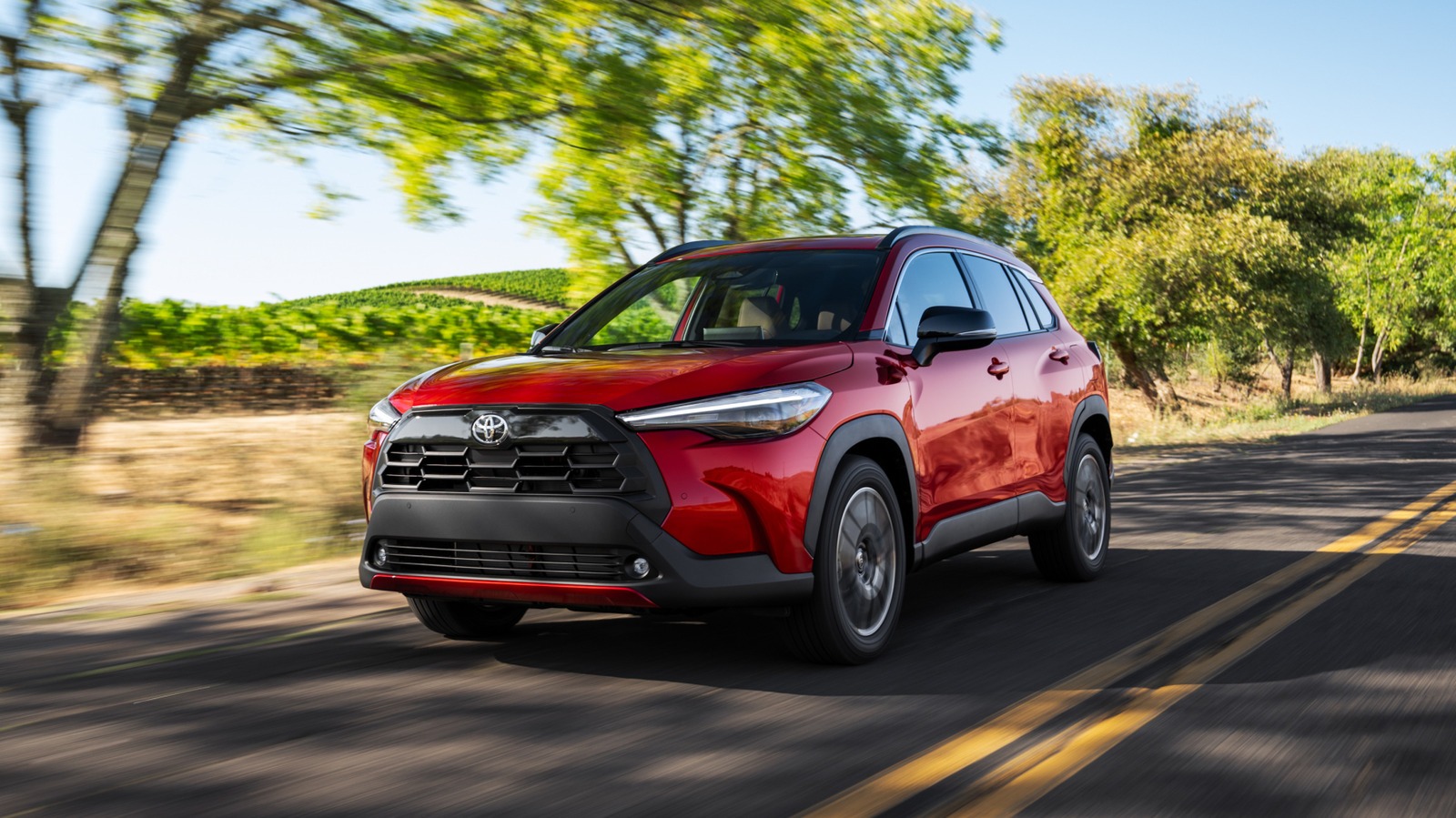
Toyota’s entry into the budget crossover segment, the 2026 Corolla Cross L AWD, carries a base sticker price of $25,810 USD plus a $1,450 USD destination fee. Powered by a 2.0-liter Dynamic Force four-cylinder engine producing 169 horsepower and 151 lb-ft of torque, the Corolla Cross delivers the highest horsepower figure among naturally aspirated engines in this price bracket. Power flows through Toyota’s Direct-Shift CVT, which incorporates a physical mechanical first gear for brisk off-the-line launch before seamlessly transferring power to the pulley system. Toyota’s Dynamic Torque Control AWD system can send up to 50 percent of engine torque to the rear wheels when front slippage is detected, decoupling the rear driveshaft during steady cruising to conserve fuel.
From an operational standpoint, the Corolla Cross delivers predictable, fuss-free commuting. EPA fuel efficiency stands at an impressive 29 MPG city, 32 MPG highway, and 30 MPG combined, making it one of the most fuel-efficient non-hybrid AWD vehicles in the class. Its 8.1 inches of ground clearance provides ample obstacle clearance, though suspension tuning is biased heavily toward compliance over sportiness, resulting in noticeable body lean during aggressive cornering. The cabin prioritizes durable materials and physical button controls for climate and audio adjustments. Cargo volume behind the second row is generous at 25.2 cubic feet, though rear seat legroom is tight at 32.0 inches, making the back seat best suited for younger children or occasional adult passengers.
Mazda CX-30 2.5 S AWD: The Premium Performance Bargain
For drivers who demand engaging steering feedback and elevated cabin refinement without breaking the $30,000 USD threshold, the 2026 Mazda CX-30 2.5 S AWD comes standard with all-wheel drive for $25,950 USD, plus a $1,420 USD destination fee. Under the hood sits a potent 2.5-liter Skyactiv-G four-cylinder engine pumping out 191 horsepower and 186 lb-ft of torque—outperforming every other vehicle in this comparison by a wide margin. Paired exclusively with a quick-shifting six-speed torque-converter automatic transmission, the CX-30 accelerates from 0 to 60 MPH in under 8.0 seconds, delivering rapid highway merging capability.
Inside, the CX-30 punches far above its price weight. Premium materials, soft-touch leatherette surfaces, quiet cabin sound insulation, and a central rotary-controlled infotainment screen create an atmosphere resembling luxury-brand vehicles costing ten thousand dollars more. Mazda’s i-Activ AWD works in conjunction with G-Vectoring Control Plus, subtly reducing engine torque upon corner entry to shift weight onto the front tires for razor-sharp steering response. EPA fuel economy ratings are 26 MPG city, 33 MPG highway, and 29 MPG combined, despite the larger displacement engine. Ground clearance is substantial at 8.0 inches, though utility is constrained by a sloping rear roofline that reduces cargo capacity to 20.2 cubic feet behind the second row and restricts rear legroom to 36.3 inches.
Honda HR-V LX AWD: The Ergonomic Space Champion
Rounding out the budget lineup is the 2026 Honda HR-V LX AWD, priced at $28,100 USD with AWD, plus a $1,550 USD destination charge. Built on the same global platform as the Civic sedan, the HR-V features a 2.0-liter naturally aspirated four-cylinder engine generating 158 horsepower and 138 lb-ft of torque, paired with a continuously variable transmission and Honda’s Real Time AWD with Intelligent Control System. While straight-line speed is modest, the HR-V excels in structural rigidity, refined steering tracking, and crash-test safety performance.
The interior architecture of the HR-V is a masterclass in spatial efficiency. The low dashboard cowl and slim A-pillars provide exceptional forward visibility, while the honeycomb mesh air vent accent adds a clean visual aesthetic across the cabin width. Rear seat legroom leads the subcompact class at 37.7 inches, providing genuine long-distance comfort for full-sized adult passengers. Folding down the 60/40 split rear seats expands cargo volume to a massive 55.1 cubic feet with a low floor loading height. EPA fuel economy ratings stand at 25 MPG city, 30 MPG highway, and 27 MPG combined. With a ground clearance of 7.0 inches, the HR-V is engineered primarily for urban navigation, wet weather stability, and smooth suburban highway cruising.
Ergonomics, Cabin Practicality, and Cargo Architecture
Selecting an entry-level crossover requires analyzing interior package metrics against daily family routines. While subcompact exterior dimensions make city parking simple, interior usable space varies dramatically between vehicle architectures. Cargo volume behind the second-row seats ranges from a restrictive 20.2 cubic feet in the Mazda CX-30 up to 25.2 cubic feet in the Toyota Corolla Cross and Chevrolet Trailblazer. However, when evaluating maximum utility with the rear seats folded flat, the Honda HR-V takes top honors by offering over 55 cubic feet of total volume, accommodated by a low loading lip that makes loading heavy crates or pet kennels effortless.
In-cabin interface design also heavily influences daily driving satisfaction. Models like the Hyundai Kona SE rely heavily on large touchscreens and digital menus, which look high-tech but require taking eyes off the road to adjust cabin temperatures or switch radio bands. Conversely, the Toyota Corolla Cross and Mazda CX-30 retain dedicated physical rotary dials and mechanical buttons for heating, ventilation, and audio volume. Seating comfort varies similarly; Subaru equips the Crosstrek with deep, supportive front seats designed to reduce lower back fatigue over long road trips, whereas the Chevy Trailblazer uses firmer, flatter seat cushions that feel somewhat rigid during multi-hour drives.
Sound isolation represents another key differentiator between base trims. Subcompact crossovers typically scrimp on sound-deadening insulation under the carpet and wheel arches to save manufacturing costs and weight. In real-world highway testing at 70 MPH, the Mazda CX-30 registers the lowest ambient cabin noise level at just 67 decibels, yielding a quiet environment comparable to entry-level luxury vehicles. The Subaru Crosstrek follow closely behind thanks to acoustic glass windshield technology. By contrast, the Chevrolet Trailblazer and Honda HR-V allow noticeable tire roar and engine buzz to enter the passenger cabin under hard throttle, reflecting their lower isolation budgets.
Total Ownership Economics, Winter Maintenance, and Buying Advice
Calculating the true financial commitment of an all-wheel drive crossover extends beyond the initial invoice price and dealer destination charges. All-wheel drive hardware introduces additional mechanical wear items, including transfer cases, rear differentials, and center clutch assemblies. These components require periodic fluid changes—typically every 30,000 to 60,000 miles under severe weather service schedules—adding to long-term routine maintenance costs compared to simple front-wheel drive platforms. Furthermore, fuel economy across all evaluated models takes a 1 to 3 MPG penalty when equipped with AWD, translating to roughly $150 USD to $300 USD in additional annual fuel expenses based on 15,000 annual driving miles.
Tire management is another critical expense factor unique to mechanical all-wheel drive ownership. Continuous all-wheel drive systems—such as Subaru’s Symmetrical AWD—require all four tires to have virtually identical rolling circumferences (typically within 2/32 inches of tread depth of one another) to prevent mechanical strain and overheating inside the center differential. If a single tire suffers unrepairable sidewall damage on an AWD vehicle, buyers often must replace all four tires simultaneously, or pay a specialized retailer to shave a new single replacement tire down to match the tread depth of the remaining three. Budget-minded buyers can mitigate this operational risk by purchasing road hazard tire protection plans or choosing systems with selectable disengagement like the Chevrolet Trailblazer.
For buyers evaluating options under a strict $30,000 USD out-the-door price ceiling, strategic trade-offs must be made. If absolute winter traction, rough-road ground clearance, and long-term resale value are your primary criteria, the Subaru Crosstrek Base AWD (totaling roughly $27,965 USD including destination) remains the undisputed gold standard for severe weather commuters. If you prioritize energetic engine power, refined transmission shifts, and upscale interior materials, the Mazda CX-30 2.5 S AWD delivers an unmatched driving experience for under $27,400 USD total. Meanwhile, urban commuters seeking maximum rear passenger legroom and flexible cargo hauling will find the Honda HR-V LX AWD and Hyundai Kona SE AWD to be the most spacious and technological everyday hatch-back alternatives available in the 2026 model year marketplace.