

Core Disclosure & Hardware Announcement
The Teenage Engineering EP-35is a battery-powered portable speaker, multi-input instrument amplifier, and class-compliant USB audio interface featuring a rear utility hatch designed specifically for cable management. Priced at $399 USD direct from Teenage Engineering and authorized audio retailers, the hardware seeks to eliminate the clutter associated with mobile music practice and field recording. The device target demographic includes multi-instrumentalists, vocalists, buskers, and home studio producers who require a single portable enclosure capable of mixing electric guitar, dynamic microphone levels, auxiliary line signals, and digital stream inputs concurrently without requiring an external mixing console or audio interface.
🛒 Where to Buy: Teenage Engineering
- Teenage Engineering: View on Amazon
Click the link above to check current pricing, availability, and customer reviews on Amazon.
Historically speaking, mobile practice amplifiers have struggled to reconcile physical convenience with functional cable management. During the micro-amp boom of the mid-2010s, manufacturers prioritized shrinking the cabinet chassis, which invariably forced musicians to transport power bricks, quarter-inch instrument cables, USB leads, and adapters in separate bags. When setting up in temporary environments—such as a desk, a park bench, or a rehearsal space—the administrative overhead of locating loose patch cables routinely undermined the immediate utility of a portable amplifier. Teenage Engineering addresses this persistent friction point not by inventing an exotic wireless protocol, but by executing an uncharacteristically pragmatic enclosure modification: building a dedicated, enclosed mechanical compartment directly into the rear panel of the amplifier body.
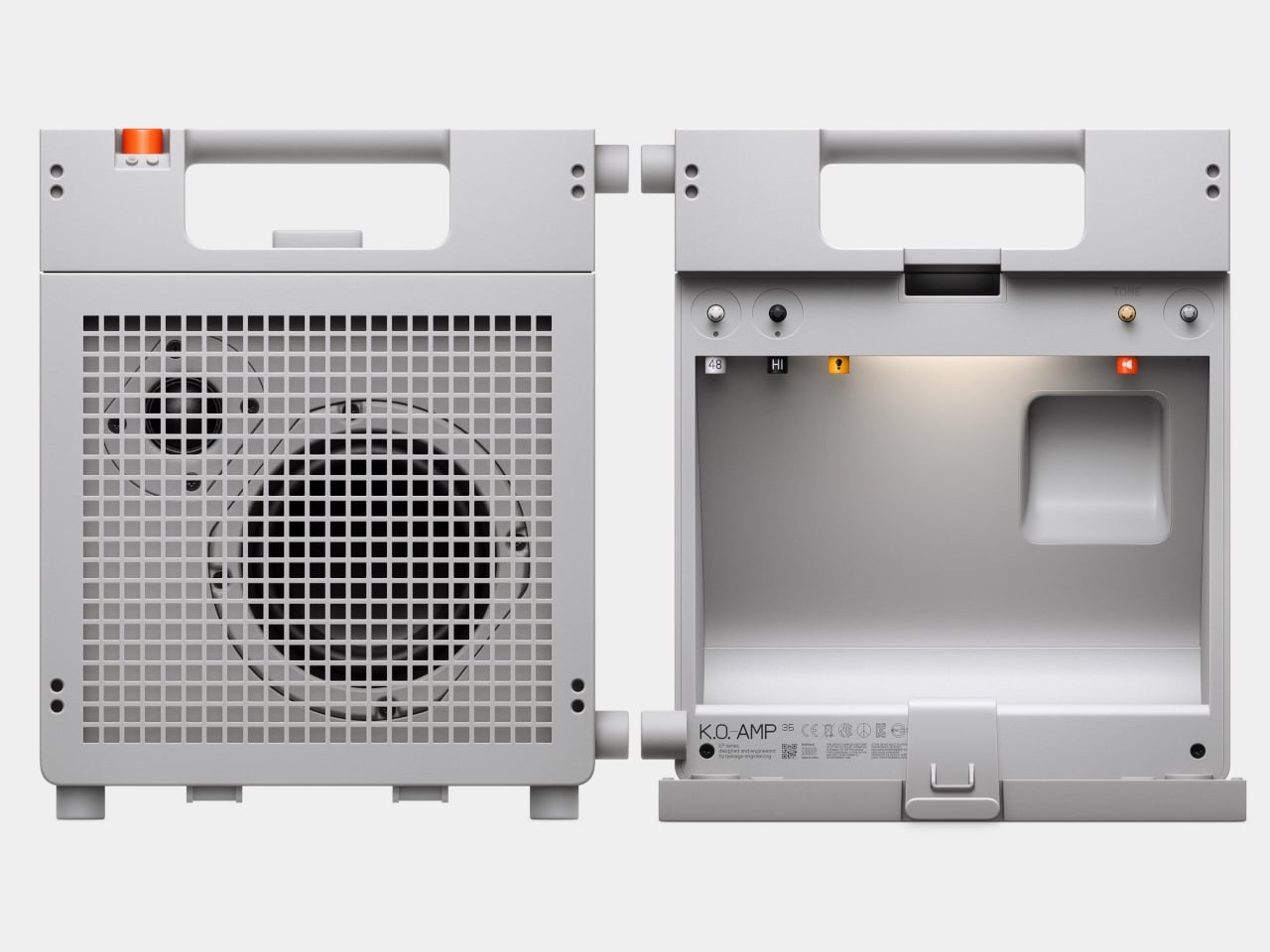
As initially detailed in a Yanko Design release dispatch, the opening rear hatch of the EP-35 acknowledges how field equipment is deployed, stored, and retrieved in practice. The mechanical integration of accessory storage inside the acoustic cabinet represents an engineering trade-off regarding internal speaker cavity volume, but it fundamentally redefines the unit as an self-contained performance ecosystem rather than a standalone speaker requiring external luggage.
Manufacturer Claims vs. Engineering Reality
In official product documentation, Teenage Engineering specifies an internal lithium-ion battery operational lifespan of up to 12 hours when playback volume is locked at a level five setting. In practice, power consumption curves in multi-input audio devices fluctuate radically based on signal routing and transducer load. Running a passive electric guitar through the onboard processing engine alongside a dynamic vocal microphone and a high-gain Bluetooth stream forces the internal amplifier topology to draw significantly higher peak current than nominal background music playback. Users operating the cabinet at higher volume thresholds or utilizing high-gain vocal FX presets should expect continuous battery longevity closer to 6 to 8 hours, which remains adequate for mobile sessions but falls short of an unconditional full-day guarantee.
The manufacturer also highlights splash-resistant weather sealing alongside an integrated, multi-mode interior illumination light. The distinction matters here regarding environmental tolerances: splash resistance protects against light moisture ingress or accidental spills during outdoor use, but it does not equate to an IPX7 waterproof rating. The inclusion of an interior camp light—capable of ambient illumination, static illumination, or audio-reactive disco pulsing—serves a genuine ergonomic purpose when accessing cables in dim ambient environments, though its disco mode operates strictly as a decorative novelty rather than a utility feature.
According to technical documentation published with this release, the unit supports multi-speaker stereo linking via a proprietary wireless broadcast mode for Bluetooth audio. However, examining the fine print of the hardware documentation reveals a critical architectural limitation regarding physical instruments. While incoming Bluetooth audio streams can be split wirelessly into discreet left and right channels by tilting each speaker enclosure prior to pairing, live instrument inputs connected via the physical 6.35mm or 3.5mm jacks do not transmit wirelessly across paired units. Amplifying a live guitar or vocal microphone across two EP-35 units requires a hardwired line-out-to-line-in cable connection. Prospective buyers envisioning a completely cable-free stereo stage for live performance must take note of this routing separation.
Under the Hood: Technical Architecture and Build Quality
The exterior chassis of the EP-35 adheres to Teenage Engineering’s established industrial design language, presenting a boxy, slate-gray geometric form factor measuring approximately 7 pounds in net weight. The front facade is dominated by a rigid square grid grille through which the speaker drivers remain partially visible, imparting an utilitarian, laboratory-equipment visual character. A reinforced top handle facilitates transport, though at over three kilograms, the cabinet represents a deliberate piece of luggable equipment rather than an item easily stowed inside a standard commuter backpack.
Tactile control surfaces on the top panel prioritize direct physical manipulation over menu-diving interface screens. The unit incorporates dedicated continuous rotary potentiometers for signal gain, volume control, and digital effect parameter adjustments. The internal Digital Signal Processor (DSP) offers 8 preset algorithms tailored for electric guitar (including overdrive, delay, and modulation settings) and 8 preset algorithms for microphone signals. The vocal processing options range from practical pitch and reverb utilities to extreme pitch-shifting presets labeled “robo choir” and “frog”. This immediate physical control layout ensures that sound adjustments can be executed instantly during live practice without requiring a smartphone application pairing sequence.
The rear access door swings open to reveal the integrated cable storage void, illuminated automatically by an internal low-draw LED array upon opening. This compartment comfortably accommodates a 3-meter instrument cable, a USB-C charging lead, and compact adapters. Notably, checking the internal battery status relies on an analog physical gesture: tilting the speaker cabinet backward triggers the interior LED strip to illuminate a series of continuous bar increments representing remaining capacity. This mechanical gesture replaces traditional low-resolution segmented LCD displays or multi-color single LEDs, reinforcing the tactile identity of the hardware.
On the desktop side, the integrated USB-C audio interface functionality operates driver-less across modern desktop and mobile operating systems. When tethered to a digital audio workstation (DAW), the EP-35 functions simultaneously as a stereo output monitor and a multi-channel digital input source, bridging the gap between field rehearsal gear and desktop studio recording equipment.
Verified Market Alternatives
To evaluate the market positioning of the EP-35 at its $399 USD price point, it is necessary to examine direct competitors within the compact practice amplifier and desktop interface category. The mobile amplification sector contains several established options that handle instrument processing, though few attempt the exact combination of internal accessory storage and retro-industrial aesthetic design seen here.
A primary rival in the compact smart amplifier category is the Positive Grid Spark MINI, available for $229 USD on Amazon. The Spark MINI offers an exceptionally lightweight 3.3-pound enclosure, deep app-based tone modeling with thousands of downloadable DSP presets, an internal rechargeable battery, and USB audio interface capabilities. However, the Spark MINI relies almost entirely on a companion mobile application for tone editing, lacks a dedicated balanced microphone input with independent hardware controls, and offers no internal cable storage. Guitarists seeking deep digital amplifier modeling in a smaller form factor may prefer the Spark MINI, but those requiring simultaneous vocal and instrument mixing with physical hardware controls will find the EP-35 more physically capable.
Another prominent competitor in the premium desktop practice space is the Yamaha THR10II Wireless, retailing for $469 USD on Amazon. The THR10II Wireless provides superior hi-fi stereo audio output via dual 3-inch full-range drivers, extensive physical knob controls, integrated Line 6 wireless receiver hardware, and an onboard rechargeable lithium battery. While the Yamaha unit delivers outstanding acoustic dispersion for home environments, it weighs roughly 7.1 pounds, lacks weather resistance, does not include vocal-specific processing chains, and offers zero internal storage for power supplies or patch cables. The THR10II Wireless remains a superior choice strictly for indoor guitar playing, whereas the EP-35 presents a broader multi-instrument utility profile for outdoor and mobile scenarios.
Final Editorial Verdict: Long-Term Reliability Outlook
The Teenage Engineering EP-35 Amp represents a thoughtful, utility-driven evolution in portable musical equipment design. By integrating a dedicated cable compartment directly into the chassis, Teenage Engineering solves an enduring real-world annoyance that has plagued portable musicians for decades. The mechanical execution of the rear door hinge, the inclusion of tactile physical effect dials, and the dual-purpose utility of an integrated USB audio interface reflect a solid understanding of modern musician workflows. Long-term reliability will largely depend on the durability of the rear hatch latches and the cycle life of the internal non-removable lithium battery, but the overall structural rigidity of the gray housing inspires confidence for routine field transport.
For instrumentalists and vocalists who regularly transport their rig to temporary locations, the $399 USD asking price represents a reasonable investment for a consolidated three-in-one amplifier, interface, and storage unit. Buyers who only require a passive Bluetooth speaker for casual audio playback or dedicated electric guitarists seeking complex app-based amp modeling can find more specialized solutions for less money. However, for creator workflows that demand simultaneous multi-input mixing, physical control immediacy, and built-in cable organization, the EP-35 earns a solid editorial recommendation as an exceptionally functional piece of field gear.