

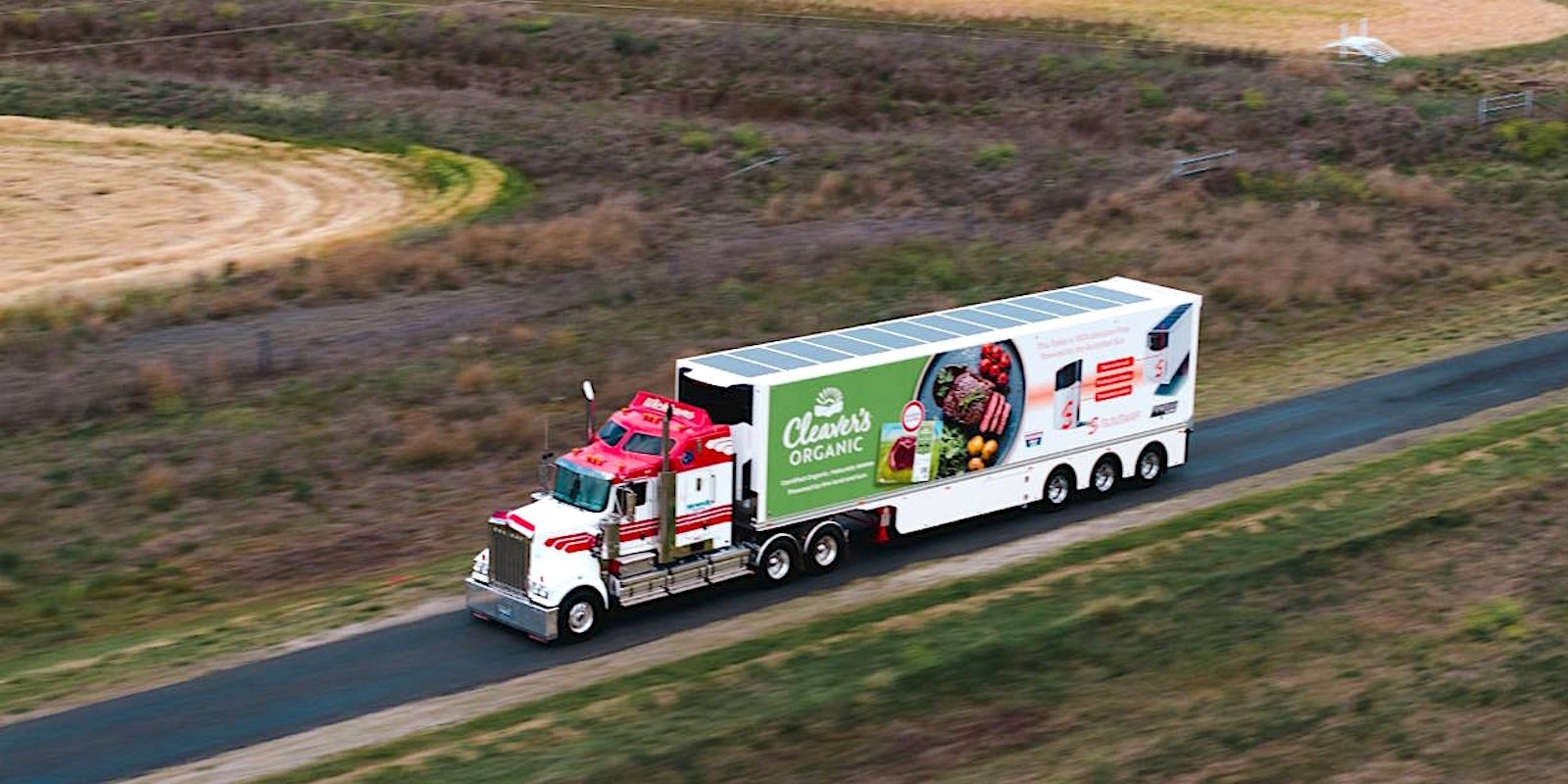
The Sunswap Endurance is a roof-integrated solar and battery-electric trailer refrigeration unit designed to cool temperature-sensitive commercial cargo without burning diesel fuel. Commercial fleet pricing sits at $85,000 USD direct from Sunswap via commercial fleet sales. The unit targets long-haul logistics operators and cold-chain fleets seeking to lower operating expenses and eliminate yard noise and tailpipe emissions.
🛒 Where to Buy: Level 2 Portable EV Charger 240V
Editorial Note & Product Verification: The Cool Great Buys editorial desk independently verifies manufacturer technical specifications, cross-checks active retail availability across authorized sellers, and evaluates verified consumer reliability data before publishing product evaluations. All featured prices and promotions reflect active market rates at the time of publication.
- Level 2 Portable EV Charger 240V: View on Amazon
Click the link above to check current pricing, availability, and customer reviews on Amazon.
Refrigerated transport trailers, commonly called reefers, move fresh produce, flowers, and medicine across highway networks. Traditionally, these trailers rely on secondary diesel engines mounted directly to the front bulkhead. These small diesel engines run continuously to power heavy-duty cooling compressors. They burn roughly 0.8 gallons to 1.2 gallons of high-sulfur diesel fuel per hour. They operate even when the primary semi-truck tractor is fully stationary or turned off. This configuration generates heavy nitrogen oxide emissions, greenhouse gases, and constant acoustic noise in distribution centers and urban delivery hubs.
Sunswap eliminates the entire internal combustion engine assembly from the trailer cooling workflow. Instead of tapping into a fuel tank, the Endurance relies on a high-capacity chassis-mounted battery pack tied directly to low-profile roof solar panels. The hardware removes localized carbon output entirely while operating. It provides a quiet cooling environment during mandatory driver rest periods and loading dock drop-offs. For fleet managers facing strict municipal noise curfews and tightening regional emissions rules, replacing diesel burners with electric cold-chain hardware is becoming an operational necessity rather than a green marketing exercise.
Engineering Architecture & How It Works
The core mechanical system of the Sunswap Endurance centers around three main hardware components: a heavy-duty Lithium Iron Phosphate (LFP) battery bank, a roof-mounted photovoltaic solar array, and a high-efficiency variable-speed hermetic scroll compressor. LFP battery chemistry was chosen over standard nickel manganese cobalt options due to superior thermal stability and long cycle life under continuous deep discharge states. The primary battery pack offers capacities ranging from 54kWh to 120kWh, depending on customer specification. The battery module mounts low on the trailer chassis to preserve a favorable center of gravity.
The solar collection system uses lightweight, durable solar panels laid flat along the aluminum roof of the trailer box. The array generates up to 3kW of peak solar energy under direct daylight conditions. This energy feeds directly through a multi-channel maximum power point tracking controller into the main LFP pack. For stationary overnight holding or pre-cooling routine operations before cargo loading, the unit features an onboard 3-phase AC shore power charger supporting 400V and 480V connections. This allows fleet depots to charge the trailer off the electrical grid while loading cargo in warehouse bays.
In official product documentation published with this release, Sunswap claims a 10-year operational lifespan with up to a 93% reduction in operational running costs compared to conventional diesel reefer units. Fact-checking these marketing figures against grid electricity pricing and practical sunlight levels reveals a more nuanced reality. While direct diesel fuel savings are immediate, overall operational savings depend heavily on regional utility power rates. In regions with expensive grid power, actual operational cost savings land closer to 60% to 75% over the unit’s lifecycle. That is still a massive drop in spending, but notably lower than the best-case press release figures.
Weight penalty is another critical engineering consideration. Traditional diesel TRUs, full fuel tanks, and mechanical linkages weigh around 800 kg (1,760 lbs). The Sunswap Endurance, complete with its 120kWh battery pack, inverter systems, solar panels, and cooling compressor, weighs approximately 1,100 kg (2,425 lbs). The net weight increase sits at roughly 300 kg (665 lbs). That extra mass reduces maximum payload capacity slightly on weight-restricted freight corridors, though for most volume-limited produce shipments, the physical weight trade-off remains negligible.
Real-World Performance Reality
Theoretical efficiency numbers mean very little until hardware hits actual highway asphalt. Commercial transport operator Wickham Freight Lines recently completed extensive commercial testing with the Sunswap Endurance unit on Australian highway routes. The evaluation covered a full round trip from Sydney to Brisbane and back, measuring a total distance of 1,670 km (1,040 miles). The run required over 30 hours of active highway driving time during summer heat conditions, placing continuous thermal load on the refrigeration system.
The trial yielded clear performance data regarding thermal retention and energy consumption. After completing the entire 1,670 km freight delivery route under real-world haulage demands, the drivers checked the battery level. The Sunswap Endurance finished the multi-day trip with over 65% of its total battery capacity remaining. The combination of passive insulation, efficient variable-speed compressor cycling, and active daylight solar harvesting generated enough energy to maintain strict temperature boundaries throughout the run without requiring grid top-ups along the highway.
Reflecting on those operational findings, fleet management committed to purchasing regular production units. As explains Graham Keogh, director at Wickham Freight Lines, the physical hardware proved its worth under standard driver treatment without requiring specialized routing or delicate driving habits. Fleet managers noted that operational savings and component reliability surpassed their initial baseline estimates during summer testing cycles, proving the viability of solar assistance on long-distance routes.
Solar input plays a distinct role during highway travel. On clear summer days, the roof panels generate between 12kWh and 18kWh of clean energy over a standard 8-hour driving window. That continuous trickle-charge offsets a large percentage of the scroll compressor’s energy drawdown while maintaining sub-zero internal trailer temperatures. However, during dark winter routes, heavy downpours, or prolonged overnight staging without sun exposure, solar input drops close to zero. In those scenarios, performance relies entirely on the pre-charged LFP battery pack and available depot shore power outlets.
Competitive Landscape: Named Rivals Compared
The market for zero-emission trailer refrigeration units is expanding as fleet operators move away from internal combustion equipment. The primary direct competitor to the Sunswap Endurance is the Carrier Transicold Vector eCool system, which retails at approximately $82,000 USD direct from Carrier authorized dealers. Carrier takes a distinctly different engineering approach to energy harvesting. Instead of relying on rooftop solar panels, the Vector eCool uses an energy-recovery axle system fitted directly to the trailer wheels. As the trailer rolls down the road or brakes downhill, a specialized generator axle converts kinetic energy into electricity to recharge an onboard lithium-ion battery array.
While Carrier’s kinetic kinetic-recovery design works effectively during stop-and-go city distribution or mountainous routes with heavy downhill braking, it introduces additional mechanical complexity. The generator axle adds rotational drag, which slightly increases the diesel or electric energy consumption of the semi-truck pulling the load. By contrast, the Sunswap Endurance collects solar energy passively without adding rolling resistance or extra mechanical wear to the trailer axle assemblies. However, Carrier holds an advantage during overcast winter operations where solar generation stalls, as rolling wheels produce energy regardless of weather conditions or sunlight levels.
Another major player in this commercial hardware space is the Thermo King Precedent E-1700 eTRU, which carries an average commercial market price of $88,000 USD direct from Thermo King commercial centers. Thermo King’s platform focuses heavily on high-voltage battery architecture tied to ultra-fast DC charging capabilities. The Precedent E-1700 uses a high-capacity pack designed to handle rapid temperature pull-downs for regional food distribution routes. It features advanced telematics that allow dispatchers to track battery status, internal box temperature, and door-opening thermal losses in real time.
Comparing the Thermo King unit against the Sunswap Endurance comes down to operational topology. Thermo King relies heavily on robust depot charging infrastructure, requiring high-kw DC fast chargers or heavy-duty 3-phase grid drops at every staging facility to keep batteries topped up during tight turnaround schedules. Sunswap’s inclusion of solar harvesting allows the trailer to top off its own battery bank during driver breaks and outdoor loading staging. This reduces absolute reliance on heavy depot charging infrastructure during daytime summer operations. However, Thermo King maintains a wider service network across North America, giving enterprise buyers established emergency repair options that younger commercial startups cannot match yet.
Final Buyer Recommendation: Practical Value Decision
The Sunswap Endurance solar-powered electric reefer unit delivers proven operational performance that directly solves the clean cold-chain puzzle. For commercial fleet operators running routes through sunny geographic corridors or regional distribution loops with high solar exposure, the hardware offers a tangible return on investment. According to reporting on the delivery launch, real-world highway runs show that solar input combined with efficient LFP storage leaves substantial energy margins even after long multi-day trips. Eliminating diesel fuel purchases and avoiding heavy engine overhauls offsets the initial $85,000 USD acquisition price over a multi-year fleet lifecycle.
Buy the Sunswap Endurance if your logistics company operates fixed long-haul or regional routes in high-sunlight environments, has depot infrastructure for pre-cooling via shore power, and needs to comply with strict urban noise and emissions laws. Skip it or wait for broader service network expansion if your fleet operates primarily in cloud-heavy northern latitudes, lacks access to 3-phase depot power outlets, or relies on low-margin routes where every pound of trailer payload capacity is strictly maximized.
For fleet managers interested in calculating localized solar economics and depot power installations before transitioning hardware, residential and commercial solar resources can help baseline regional energy costs. You can explore localized solar and battery storage evaluations to analyze potential depot energy savings; Get started here to benchmark regional commercial power rates.