

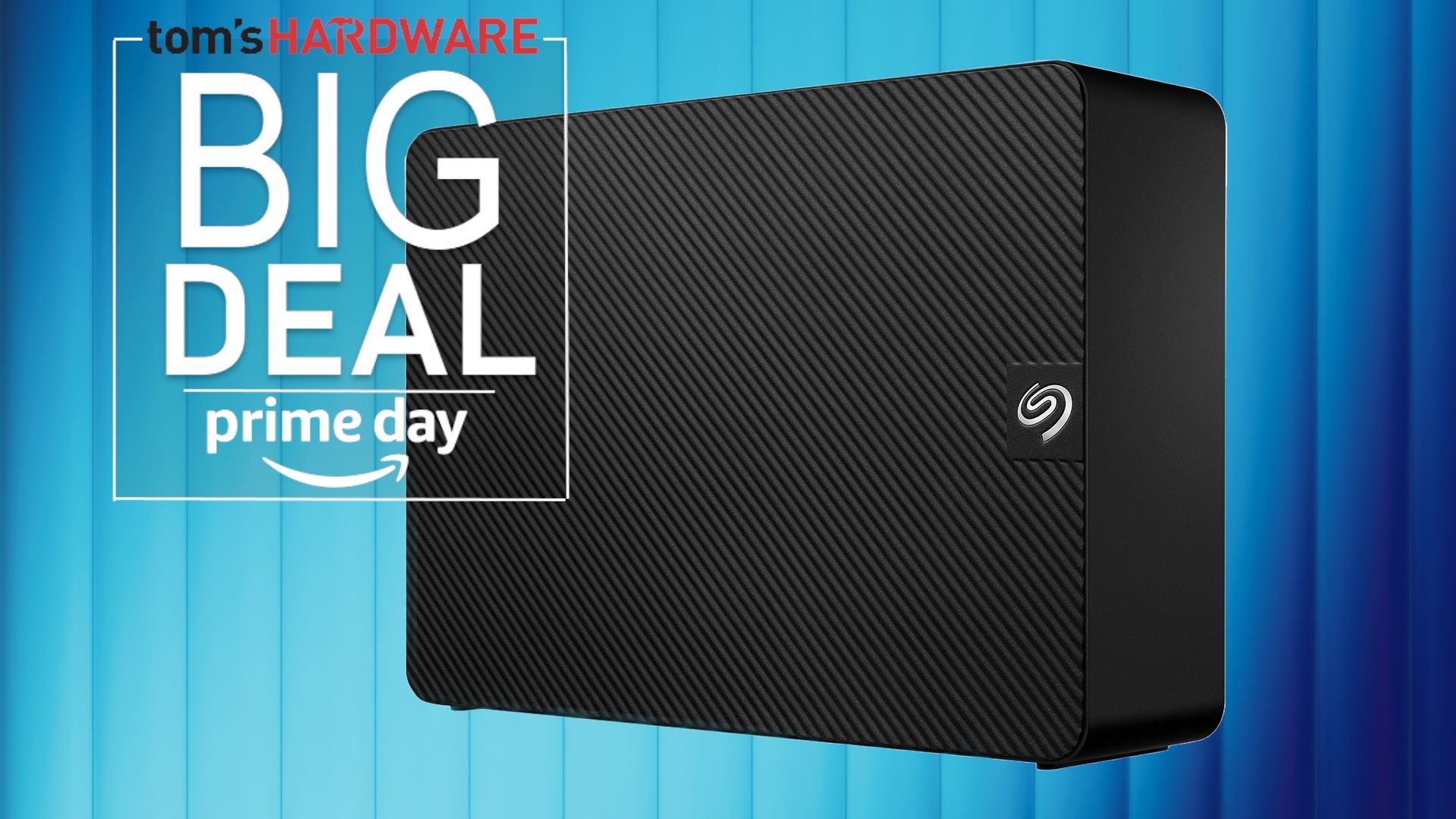
The Seagate Expansion Desktop 16TB is a high-capacity external hard disk drive designed to provide massive local storage expansion via a single USB 3.0 connection. This drive is currently available for $449.99 USD on Newegg, representing a notable price correction for creative professionals, IT administrators, and home server enthusiasts who require vast archives for cold storage, local backups, or media libraries. By offering a substantial capacity pool in a plug-and-play desktop form factor, this external unit bypasses the complex installation requirements of internal storage arrays while delivering a highly competitive cost-per-gigabyte ratio.
🛒 Where to Buy: Seagate Expansion Desktop
- Seagate Expansion Desktop: View on Amazon
Click the link above to check current pricing, availability, and customer reviews on Amazon.
The broader high-capacity hard drive market has experienced significant volatility in recent years. Historically speaking, high-capacity mechanical storage followed a predictable downward cost-per-gigabyte trajectory, allowing consumers to routinely secure massive storage pools at highly discounted rates. However, the rapid expansion of data-intensive artificial intelligence training models and enterprise cloud storage demands has consumed global high-capacity HDD manufacturing capacity. This shift has effectively ended the era of cheap, high-density consumer drives, driving retail prices for bare internal drives to unprecedented heights. In the current landscape of 2026, finding a reliable high-capacity drive that does not carry an enterprise price premium has become exceedingly difficult. Initial product disclosures and reporting were tracked via Tomshardware.
At $449.99 USD, this drive achieves a cost of $0.02 USD8 USD per gigabyte. To contextualize this value, one must look at the current retail landscape where bare internal drives of equivalent capacity, such as the Seagate IronWolf Pro 16TB, command retail prices of $599.00 USD on Amazon, even when discounted. Higher-end enterprise drives frequently exceed $700.00 USD. Thus, the consumer-grade external enclosure presents an unusual arbitrage opportunity for buyers willing to accept certain engineering trade-offs, particularly those who practice “shucking”—the process of removing the internal drive from its plastic shell to use as a standard SATA drive inside a desktop or network-attached storage (NAS) enclosure.
State of the Category & What Changed
The external desktop hard drive category has transitioned from a commodity market into a specialized niche dominated by users with massive data archiving needs. For standard productivity tasks, solid-state drives (SSDs) have entirely supplanted mechanical hard drives due to their superior speed, silent operation, and physical durability. However, when storage requirements surpass the 4TB threshold, the cost-per-gigabyte of solid-state media remains prohibitively high for average consumers and small businesses. This reality keeps high-capacity mechanical drives relevant, serving as the primary medium for local system backups, massive media servers, and cold-data archiving where immediate access speed is secondary to sheer volume.
The introduction of the Seagate Expansion Desktop 16TB at this specific price point is a direct response to the supply constraints that have plagued the storage industry. As enterprise demand for high-capacity drives continues to monopolize manufacturing lines, consumer-facing retail channels have seen a severe reduction in high-density HDD availability. This scarcity has driven the average price of 16TB drives up significantly over the past year. By packaging these high-capacity platters inside a consumer-grade external enclosure, Seagate is able to segment its pricing, offering a more palatable entry point for individual buyers while reserving its premium bare drives for enterprise clients who demand long warranties and guaranteed performance specifications.
For the target buyer—typically a creative professional managing large video assets, a system administrator overseeing local backups, or a home lab enthusiast running a Plex media server—this drive represents a highly practical acquisition. The default ExFAT formatting ensures immediate compatibility with both Windows and macOS operating systems, eliminating the initial setup friction that often accompanies enterprise-grade storage hardware. While the drive is marketed as a simple plug-and-play desktop accessory, its true appeal lies in its potential to serve as a low-cost donor drive for custom storage arrays, provided the buyer is fully aware of the technical and warranty implications of doing so.
Generational Delta: The Engineering Upgrades That Matter
To understand the engineering value of the Seagate Expansion Desktop 16TB, it is helpful to examine the history of Seagate’s external desktop line. A prior generation of Seagate external drives, specifically the Seagate Backup Plus Hub series, failed to deliver long-term reliability for power users due to a combination of restrictive plastic enclosures and the integration of Shingled Magnetic Recording (SMR) technology. SMR drives write data in overlapping tracks, which severely degrades write performance during sustained, multi-gigabyte transfers because the drive must constantly read, modify, and rewrite adjacent tracks. This engineering trade-off made those older drives highly frustrating for continuous backup tasks and RAID configurations.
The current 16TB Expansion Desktop represents a significant technological upgrade because it utilizes Conventional Magnetic Recording (CMR) technology. At the 16TB capacity threshold, Seagate must employ helium-sealed platters rather than traditional air-filled designs. Helium reduces aerodynamic drag on the spinning platters and the read/write head actuator, allowing the engineering team to pack more platters into the standard 3.5-inch form factor while reducing power consumption and operating temperatures. The transition to helium-sealed CMR platters ensures that this drive maintains consistent write speeds across its entire capacity, avoiding the severe performance cliffs associated with older SMR drives.
Furthermore, the physical construction of the enclosure has evolved to accommodate the thermal demands of a high-capacity helium drive. While older external drives relied on completely sealed passive cooling designs that frequently caused internal temperatures to exceed 50 degrees Celsius under sustained load, the current chassis features improved ventilation geometry along the top and bottom edges. However, the internal drive itself remains a variable component. Examining the fine print of the hardware documentation reveals that Seagate does not guarantee a specific internal drive model or spindle speed for the Expansion Desktop series. User reports and hardware analysis indicate that these enclosures contain either binned Barracuda Pro or enterprise-class IronWolf Pro drives, typically configured to run at 5,400 RPM or 7,200 RPM with firmware-level speed caps. This engineering trade-off allows Seagate to clear excess inventory of enterprise-grade platters by selling them in consumer-grade external enclosures at a lower price point.
Everyday Usability Trade-Offs & Adoption Barriers
While the the item 16TB offers undeniable capacity value, it carries several physical and operational compromises that prospective buyers must carefully evaluate. The most prominent usability barrier is the performance profile. Because the internal drive is optimized for capacity and thermal efficiency rather than speed, sequential read and write speeds top out at approximately 100 MB/s to 120 MB/s. While the USB 3.0 interface provides plenty of bandwidth to keep up with these speeds, the mechanical latency of a spinning disk makes this drive entirely unsuitable for modern software environments. Attempting to run contemporary operating systems, database applications, or modern AAA video games directly from this drive will result in severe performance degradation and prolonged loading times.
Another critical consideration is the physical reality of “shucking” the drive. For enthusiasts looking to extract the internal 3.5-inch SATA drive for use in a desktop PC or NAS, the process is fraught with risks. The plastic enclosure of the Seagate Expansion is held together by fragile internal clips designed to snap upon disassembly. Opening the case will void the manufacturer’s warranty immediately, leaving the buyer with zero recourse if the drive suffers a mechanical failure. Furthermore, some enterprise-class drives extracted from these enclosures utilize the SATA Power Disable (PWDIS) feature on the 3.3V power pin. When connected to a standard consumer power supply, a shucked drive with this feature may refuse to spin up entirely, requiring the user to apply non-conductive tape to the third pin of the SATA power connector or use a legacy Molex-to-SATA adapter—a workaround that introduces additional points of failure.
Finally, the physical footprint and acoustic profile of the drive limit its suitability for quiet office environments. High-capacity helium drives are inherently louder than their lower-capacity, air-filled counterparts. The drive produces an audible hum while spinning, accompanied by distinct clicking sounds during read and write operations as the actuator arm moves across the platters. Additionally, the drive requires a dedicated external 12V power adapter, adding to cable clutter on a minimalist desk. It is a stationary desktop accessory, not a portable drive, and its reliance on mechanical platters makes it highly vulnerable to physical shock. A single accidental drop while the drive is spinning can cause catastrophic head crash and permanent data loss, making a robust backup strategy essential.
Category Alternatives and Rival Solutions
When evaluating high-capacity external storage, buyers generally compare the the product against a limited number of established competitors. The most direct rival is the Western Digital 16TB Elements Desktop, which typically retails for $499.99 USD on Amazon. The Western Digital Elements series utilizes a similar plastic enclosure design and relies on white-labeled helium-filled drives, which are often down-binned enterprise Ultrastar drives. In practice,