

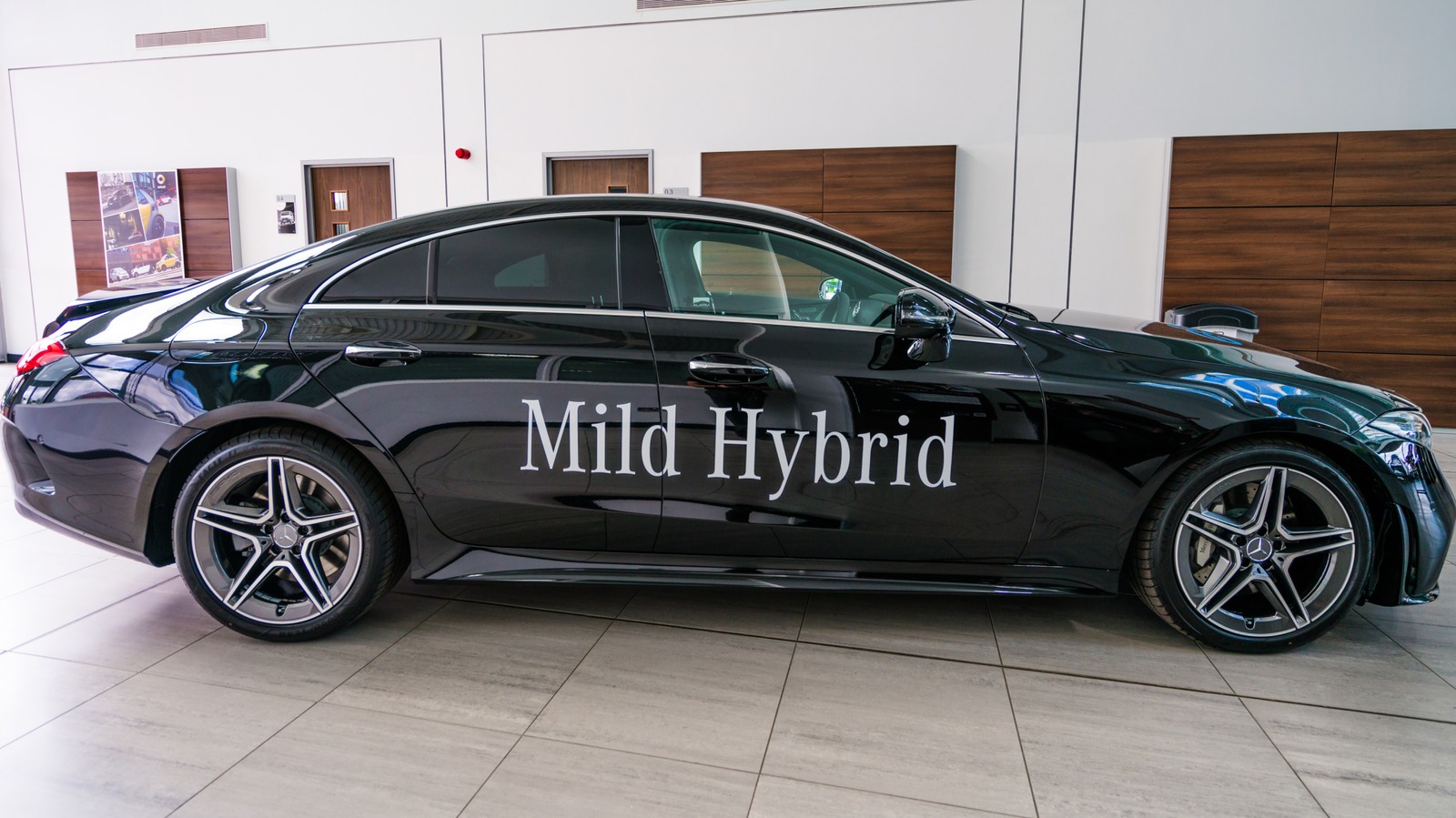
Mild hybrid electric vehicle (MHEV) architecture integrates a low-voltage electrical motor-generator alongside a primary internal combustion engine to assist with engine restarts, torque filling, and accessory operation. Vehicles equipped with standard 48-volt systems, such as the 2026 Ram 1500 Tradesman V6 eTorque starting at $40,275 USD direct from Ram, target suburban commuters and commercial fleet buyers seeking incremental fuel savings without adapting to plug-in charging routines. The technology relies on a compact lithium-ion secondary battery and a belt-driven or crank-integrated starter-generator rather than a full electric traction motor.
🛒 Where to Buy: Mild Hybrid Electric Vehicles
- Mild Hybrid Electric Vehicles: View on Amazon
Click the link above to check current pricing, availability, and customer reviews on Amazon.
Historically speaking, MHEVs represent the automotive industry’s second major attempt to transition away from pure 12-volt vehicle architectures. In the late 1990s, an industry consortium proposed a shift to 42-volt electrical systems to power heavy accessory loads, a movement that ultimately collapsed due to switchgear arcing issues, component cost spikes, and manufacturing complexity. The modern 48-volt MHEV design bypasses those legacy hurdles by isolating high-draw equipment onto a sub-grid, but it inherits similar compromises regarding return on investment. Historically, whenever automakers implement intermediate powertrain stepping stones, consumers risk paying for additional mechanical complexity that yields only modest operational gains. Initial product disclosures and reporting were tracked via Slashgear.
Understanding the distinction between true high-voltage hybrids and mild hybrids matters here, as aggressive marketing campaigns frequently obscure physical limitations. While badges reading eTorque, EQ Boost, or 48V suggest partial electrification, these vehicles remain fundamentally gasoline-powered automobiles with electric ancillary assistance. For prospective buyers evaluating long-term vehicle ownership, several distinct engineering and financial trade-offs warrant careful examination before committing to a purchase.
Real-World Context and Target Buyer Profile
The primary target buyer for a mild hybrid vehicle is typically an individual seeking refined stop-start operation and minor efficiency improvements without altering daily driving habits. Unlike battery-electric vehicles (BEVs) or plug-in hybrid electric vehicles (PHEVs), mild hybrids require no external plug-in infrastructure, specialized wall chargers, or battery thermal management oversight during winter months. Buyers in this category frequently prioritize low upfront capital expenditure over maximum tailpipe reduction, viewing 48-volt hardware as a low-impact upgrade over conventional internal combustion engines.
In practice, however, buyer expectations often diverge from hardware capabilities due to vague industry nomenclature. Automakers have deployed mild hybrid systems across broad vehicle classes, ranging from light-duty pickup trucks like the Ram 1500 to luxury crossovers from Land Rover and Mercedes-Benz. While these systems successfully eliminate the harsh starter-motor vibration associated with legacy 12-volt automatic stop-start routines, they fail to provide the extended engine-off operation or heavy electrical traction that mainstream consumers routinely associate with the “hybrid” designation.
The target demographic must also consider geographical and environmental operating parameters. Drivers whose daily routines consist primarily of steady-state highway cruising stand to gain negligible performance or efficiency improvements from a mild hybrid system. Because 48-volt starter-generators derive their energy recovery strictly from deceleration and braking events, high-speed interstate travel offers limited opportunities for kinetic energy harvesting, rendering the onboard battery and inverter secondary hardware along for the ride.
Hardware Engineering, Materials, and Core Specs
The technical architecture of a mild hybrid revolves around a 48-volt lithium-ion battery pack, a DC/DC converter to step voltage down to traditional 12-volt accessory circuits, and a dual-purpose motor-generator unit. In a typical application, such as Ram’s eTorque assembly, a belt-driven motor-generator unit replaces the conventional alternator. This unit connects directly to the engine crankshaft via a heavy-duty serpentine belt and tensioner assembly, supplying up to 12 horsepower and 90 lb-ft of torque directly to the engine’s rotating assembly during initial acceleration phases.
Examining the fine print of the hardware documentation reveals substantial engineering compromises regarding space packaging and system longevity. According to technical repair guides published by system supplier SEG Automotive, a standard 48-volt unit combines the power electronics and inverter within the alternator housing itself. Crucially, the documentation notes that these 48-volt electrical architectures often lack internal reverse-polarity protection. A routine battery jump-starting error or minor wiring mistake during routine maintenance can immediately destroy the integrated inverter module, resulting in hardware replacement costs comparable to replacing a primary alternator and control unit simultaneously.
Weight overhead and component stress represent additional engineering trade-offs. Although a 48-volt lithium-ion battery pack is significantly smaller than the 300-plus-volt traction batteries found in full hybrids, the combined assembly of the secondary battery, heavy-gauge copper wiring harnesses, liquid-cooling loops (in high-output applications), and step-down converters adds between 40 lbs and 90 lbs of mass to the front axle assembly. Furthermore, the constant load cycled through the belt drive puts elevated thermal and mechanical strain on front-end engine drive components, requiring specialized high-tensile drive belts that carry higher replacement costs than standard automotive V-belts.
From an environmental engineering standpoint, the reductions in greenhouse emissions remain modest. According to technical analysis by the International Council on Clean Transportation (ICCT), entry-level mild hybrid setups cut vehicle CO2 emissions by approximately 7% to 16% under standardized laboratory test cycles compared to equivalent gas-only vehicles with standard stop-start functionality. Real-world fleet testing conducted by Emissions Analytics confirmed an average 11% reduction in tailpipe emissions for gasoline MHEVs, whereas full hybrid powertrains achieved a 34% reduction under identical test conditions.
Everyday Usability & Design Compromises
The single largest usability trade-off of a mild hybrid vehicle is its total inability to propel itself using electric energy alone. Official guidance from the U.S. Department of Energy explicitly notes that mild hybrid systems cannot drive the wheels exclusively on battery power under any operating condition. MHEV stands for mild hybrid electric vehicle, but unlike conventional hybrids that can maneuver through parking lots or low-speed stop-and-go traffic with the internal combustion engine switched off, an MHEV must keep its internal combustion engine spinning whenever torque is required at the drive wheels.
This reality severely limits the real-world fuel economy benefits. While full hybrids deliver substantial efficiency improvements in urban congestion by operating in zero-emission electric modes, mild hybrids rely on the gasoline engine for 100% of vehicle propulsion. Data published in Case Studies in Thermal Engineering demonstrated that 48V systems yield real-world fuel economy improvements ranging from just 1.7% to 7.7%, depending heavily on driving cadence. Independent testing by the Australian Automobile Association highlighted extreme variances in real-world efficiency gains across manufacturers: while a mild-hybrid Suzuki Swift achieved an 18% reduction in fuel consumption over its gas-only counterpart, a mild-hybrid Subaru Forester actually registered a 2.8% increase in fuel usage during identical urban evaluation loops.
Day-to-day drivability also introduces subtle mechanical compromises. While the 48-volt starter-generator enables smooth engine restart transitions at traffic lights, the integration of regenerative braking creates inconsistent brake pedal feel. As the driver depresses the brake pedal, the vehicle control unit must constantly modulate friction braking pressure alongside generator resistance to harvest kinetic energy. In stop-and-go urban traffic, this transition frequently manifests as a grabby or non-linear brake pedal response, frustrating drivers accustomed to conventional hydraulic brake modulation.
Furthermore, accessory load management under extreme weather conditions reveals practical limitations. Although the 48-volt system can run electric power steering racks and air conditioning compressors for brief periods while coasting or stopped at red lights, prolonged idles in hot climates rapidly deplete the small 48V lithium-ion battery pack. Once battery state-of-charge drops below operational thresholds, the system is forced to restart the internal combustion engine to maintain cabin cooling, negating idling fuel savings during summer traffic delays.
Category Alternatives and Value Comparison
When evaluating market alternatives, full hybrid electric vehicles (HEVs) present a far more compelling value proposition for fuel-conscious buyers. Consider the 2026 Toyota RAV4 Hybrid, which starts at $31,725 USD direct from Toyota. The full hybrid RAV4 delivers an EPA-estimated 39 mpg combined rating, representing a nearly 25% cut in fuel consumption compared to standard 30-mpg gasoline compact crossovers. The full hybrid system utilizes two electric motor-generators working in tandem with a planetary gear set, allowing pure electric propulsion at low speeds and substantial energy recovery during deceleration.
For buyers seeking maximum electrification without committing to a full battery-electric vehicle, plug-in hybrids offer vastly superior operational flexibility. The 2026 Toyota RAV4 Plug-in Hybrid starts at $44,440 USD direct from Toyota and features an EPA-estimated electric-only driving range of 52 miles. Technical reviews note that the 2026 RAV4 plug-in hybrid gets great MPG ratings, achieving 94 MPGe or better when operating in hybrid mode with a charged battery pack. This allows suburban commuters to complete their daily travel entirely on grid electricity while retaining long-distance gasoline range when necessary.
The upfront cost structure of mild hybrid systems further complicates their financial justification. Historically, when manufacturers offered mild hybrid hardware as a standalone option package—such as Ram’s eTorque upgrade on the Hemi V8—it added between $1,450 USD and $1,995 USD to the vehicle sticker price. Given that fuel consumption reductions on full-size trucks typically average just 2 mpg combined (e.g., improving a Ram V8 from 17 mpg to 19 mpg), a driver covering 12,000 miles annually at $3.50 USD per gallon would save $260 USD USD per year in fuel. Payback periods for the standalone option cost can easily stretch beyond 6 years of continuous driving.
Long-term maintenance costs also weigh heavily against the mild hybrid model. While a full hybrid’s high-voltage battery replacement remains an expensive prospect—costing between $5,200 USD and $7,000 USD on premium Lexus vehicles—a replacement 48-volt MHEV battery pack still commands an average out-of-warranty price of $1,500 USD for the part alone, with standalone component costs ranging from $800 USD to $2,100 USD across major luxury brands. When combined with specialized 48V alternators and DC/DC converters, out-of-warranty ownership risks approach those of high-voltage hybrids without delivering equivalent fuel savings.
This disparity in tangible performance has prompted aggressive pushback within the automotive industry itself. Toyota Australia famously refused to adopt the term “hybrid” for its 48-volt equipped utility vehicles, publicly criticizing competing automakers for diluting consumer terminology. By classifying 48-volt systems as simple engine-assist technologies rather than true hybrids, industry analysts emphasize that consumers are often paying a brand premium for minimal hardware capability.
Final Buyer Verdict: Long-Term Ownership Value
The mild hybrid electric vehicle represents an incremental engineering compromise designed primarily to help automakers meet fleet-wide corporate average fuel economy (CAFE) standards and European tailpipe targets, rather than a breakthrough for the individual consumer. While MHEVs successfully refine the stop-start experience and provide minor torque support during initial throttle tip-in, they fail to deliver the meaningful fuel savings, pure-electric range, or long-term financial payback expected of modern electrified vehicles. The added mechanical complexity of 48-volt sub-grids, specialized starter-generators, and dedicated lithium-ion batteries introduces long-term out-of-warranty repair liabilities that outweigh the modest 1.7% to 11% real-world fuel savings.
For prospective buyers navigating the current automotive landscape, the recommendation is straightforward: if your primary purchasing objective is lower operational fuel costs or environmental impact reduction, skip the mild hybrid segment entirely. Allocate your budget toward a true full hybrid such as the Toyota RAV4 Hybrid or a dedicated plug-in hybrid model where electric-only operation yields genuine financial dividends at the pump. Conversely, if you are purchasing a vehicle where a 48-volt system comes included as standard equipment—such as select luxury sedans or light trucks—treat the technology merely as an automated engine-smoothing feature rather than a true electrified powertrain, and budget accordingly for secondary component maintenance past the factory warranty period.