

Core Disclosure & Hardware Announcement
EV Realty has announced a dedicated 27-megawatt commercial electric semi-truck charging hub located at 2151 E. Philadelphia Street in Ontario, California, engineered specifically with high-clearance pull-through bays and heavy-duty Megawatt Charging System (MCS) architecture. This infrastructure expansion is designed to service commercial Class 8 electric freight tractors, such as the Volvo VNR Electric starting from $350,000 USD direct from Volvo, where depot charging hardware integration typically requires capital outlays exceeding $150,000 USD per port through industrial equipment suppliers. The target demographic comprises short-haul drayage fleets, regional logistics operators, and intermodal transport companies navigating the heavy freight corridor between the Ports of Los Angeles and Long Beach and Southern California’s inland distribution warehouses.
🛒 Where to Buy: Level 2 Portable EV Charger 240V
- Level 2 Portable EV Charger 240V: View on Amazon
Click the link above to check current pricing, availability, and customer reviews on Amazon.
The strategic positioning of this site addresses a geographic bottleneck in West Coast freight operations. Situated three miles from Ontario International Airport—a major air cargo facility hosting primary flight hubs for UPS and FedEx—the location offers immediate egress to both the east-west State Route 60 and north-south Interstate 15 freeways. According to reporting on the site acquisition, the Inland Empire submarket represents the densest concentration of warehousing and logistics properties in North America. For drayage operations facing severe diesel price volatility and stringent zero-emission port mandates, transitioning to battery-electric heavy rigs requires localized high-power replenishment; as industry economics demonstrate, predictable fuel costs means predictable operating budgets.
Upon completion, the Ontario facility will elevate EV Realty’s total simultaneous charging capacity across the Southern California port-to-inland corridor to 27 MW. Groundbreaking for the civil engineering phase is scheduled for early 2027, with the full installation slated to become operational prior to 2028. The timing aligns with the domestic commercial rollout of third-generation Class 8 electric platforms, creating a centralized high-power fueling node where regional carriers can maintain route productivity without installing costly, space-prohibitive private charging infrastructure on leased warehouse acreage.
Manufacturer Claims vs. Engineering Reality
EV Realty’s assertion that it can reliably supply 27 MW of simultaneous power in the heart of the Inland Empire must be evaluated against the physical realities of Southern California’s electric grid. Historically speaking, commercial fleet electrification initiatives have frequently stumbled over utility interconnection delays rather than hardware failures. A notable example occurred during early municipal transit bus deployments in California during the early 2010s, where operators purchased high-rate depot chargers only to discover local sub-transmission circuits lacked necessary step-down transformer headroom, resulting in multi-year delays or severe station power derating that left buses stranded mid-shift.
The distinction matters here when scrutinizing the engineering trade-offs of Megawatt Charging Systems (MCS). While light-duty electric vehicle fast chargers utilize Combined Charging System (CCS) standards capped around 350 kW at 800V, heavy commercial rigs require sustained power delivery approaching 1.2 MW to 3.75 MW at voltages up to 1,250V and currents reaching 3,000 amperes. Operating at these extreme thermal limits creates massive ohmic resistance within station cabling and vehicle inlet contacts. In practice, supplying continuous megawatt-level power requires dedicated liquid-chilled coolant loops integrated into both the charging cable and connector assembly, consuming up to 5% of the station’s gross energy throughput solely to dissipate parasitic heat during peak summer ambient temperatures in Ontario, where ambient heat regularly exceeds 100°F (37.7°C).
Furthermore, persistent skepticism regarding fleet electrification economics has been amplified by traditional business commentary. Outlets such as the Wall Street Journal have repeatedly argued that heavy-duty battery electric vehicles suffer from uncompetitive total cost profiles due to battery weight penalties and elevated initial capital expenses. However, analyzing component physics and operational duty cycles reveals a more nuanced reality. In short-haul regional drayage routines under 200 miles per day, the superior thermal efficiency of electric powertrains combined with regenerative braking drastically reduces mechanical brake wear and maintenance costs per mile, counterbalancing high initial vehicle purchase prices provided that high-utilization charging infrastructure remains accessible without excessive downtime.
Under the Hood: Technical Architecture and Build Quality
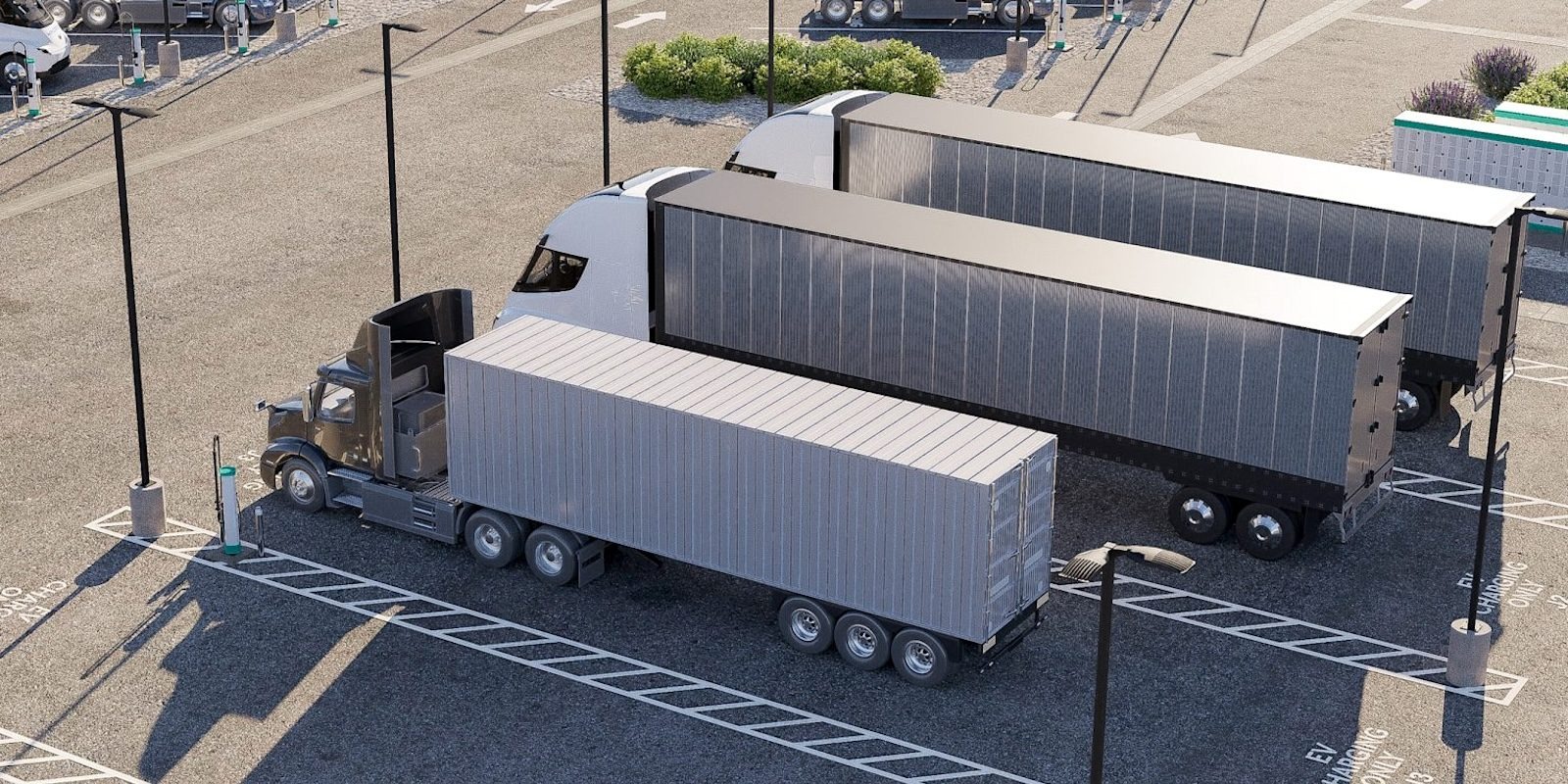
Designing an industrial truck charging hub requires civil engineering standards drastically different from conventional light-duty passenger vehicle plazas. The Ontario facility is engineered around wide, pull-through bay geometries designed to accommodate 75-foot tractor-trailer combinations without requiring dangerous or time-consuming backing maneuvers in tight logistics yards. The ground architecture relies on reinforced concrete pads exceeding 12 inches in thickness, specifically rated to withstand repeated structural stress from vehicles operating at the federal maximum 80,000-pound gross vehicle weight rating (GVWR). Heavy steel-reinforced concrete bollards are strategically positioned to shield power electronics cabinets from accidental trailer impact during high-density staging maneuvers.
Beneath the surface, the electrical distribution architecture relies on medium-voltage AC grid connections feeding high-efficiency solid-state transformer substations. According to technical documentation published with this release, the facility converts local utility distribution power from 12kV or 66kV primary feeders down to a centralized 1,000V DC bus bar network using modular power cabinets equipped with silicon carbide (SiC) semiconductors. Examining the fine print of the hardware documentation reveals that the facility incorporates localized battery energy storage systems (BESS) rated at several megawatt-hours. This localized storage acts as an energy buffer, mitigating costly utility demand charges during peak afternoon hours while preventing local grid voltage collapse during simultaneous multi-rig charging sessions.
From an operational standpoint, cable handling represents one of the most critical mechanical failure points on commercial charging sites. Liquid-cooled MCS cables capable of handling 3,000A currents weigh upwards of 12 pounds to 15 pounds per linear meter. To prevent connector head damage from being dropped onto concrete aprons—and to eliminate physical strain on truck drivers—EV Realty’s site plan integrates overhead mechanical counterbalanced gantry arms. These overhead boom systems support the physical mass of the liquid-cooled cables, allowing drivers to manipulate high-voltage connectors effortlessly while maintaining optimal cable bend radii to preserve internal coolant line integrity over thousands of insertion cycles.
Verified Market Alternatives
Fleet operators evaluating regional charging options in Southern California must consider established competitor infrastructure platforms, notably the WattEV Commercial Truck Charging Network. WattEV operates a major dedicated heavy-duty charging depot at the Port of Long Beach, tailored specifically for drayage tractors such as the BYD 8TT Electric Semi, which carries an entry price of $330,000 USD direct from BYD. WattEV provides commercial fleet access through structured kilowatt-hour pricing models starting at $0.45 USD per kWh alongside truck-as-a-service lease options. Mechanically, WattEV’s strategy relies heavily on combining large-scale direct-coupled solar canopy arrays with massive onsite battery storage at the port terminal itself. While this provides excellent localized renewable offset, it limits total simultaneous charging capacity compared to EV Realty’s high-voltage grid-direct hub strategy in the Inland Empire, which focuses on raw megawatt density adjacent to inland distribution gates.
Another primary alternative in the heavy transport sector is Tesla’s proprietary Megacharger ecosystem, designed to support the Tesla Semi, priced starting from $180,000 USD direct from Tesla for its 300-mile range configuration. Tesla has deployed private Megacharger installations delivering up to 1 MW per stall at select customer logistics facilities, such as PepsiCo hubs in Central California. However, the operational distinction matters here: Tesla’s charging hardware relies on a proprietary liquid-cooled connector interface primarily optimized for its own vehicle control architecture. In contrast, EV Realty’s open-access model utilizes universal open-standard Megawatt Charging System (MCS) and CCS Combo 1 hardware. This open architectural framework allows multi-brand commercial fleets—operating mixed compositions of Volvo, Freightliner, BYD, and Peterbilt Class 8 tractors—to utilize a single shared charging site without requiring proprietary adapter hardware or exclusive brand leasing commitments.
Final Editorial Verdict: Long-Term Reliability Outlook
The acquisition and development of the Ontario charging site by EV Realty represents a pragmatic step forward for commercial transport infrastructure in Southern California. By establishing a 27 MW regional throughput capacity across key logistics corridors, the company addresses the fundamental prerequisite for fleet electrification: accessible, high-power fuel replenishment where freight actually moves. However, prospective fleet customers should maintain a measured perspective regarding execution timelines. While site acquisition and civil designs are finalized, real-world station commissioning remains contingent upon local utility transformer delivery schedules and grid interconnect approvals, both of which historically experience schedule creep in high-demand industrial utility zones.
For logistics directors and fleet managers operating along the Port of Los Angeles to Inland Empire corridor, EV Realty’s prospective hub provides a viable roadmap to de-risk zero-emission vehicle mandates without incurring individual depot infrastructure debt. The recommendation here is analytical and clear: fleet operators should proceed with phased Class 8 electric tractor procurement, targeting initial route deployments that align with EV Realty’s 2028 full operational timeline. Ensuring that vehicle delivery schedules match verified station energization dates remains the single most critical factor in avoiding stranded capital assets during Southern California’s commercial fleet transition.