

Real-World Context and Target Buyer Profile
The Basura Bezzy Server Rack Plush is a physical, sound-emitting art toy designed to resemble an enterprise data center server cabinet that, when squeezed, plays a continuous, high-decibel recording of actual data center cooling fan noise. Priced at $99 USD direct from the design studio Basura, this limited-edition release is targeted specifically at technology industry professionals, collectors of satirical art objects, and critics of the current artificial intelligence infrastructure expansion. It does not serve as a traditional comforting plush toy, but rather as a physical manifestation of the environmental and acoustic footprint of modern cloud computing.
🛒 Where to Buy: Basura Bezzy Server Rack
Editorial Note & Product Verification: The Cool Great Buys editorial desk independently verifies manufacturer technical specifications, cross-checks active retail availability across authorized sellers, and evaluates verified consumer reliability data before publishing product evaluations. All featured prices and promotions reflect active market rates at the time of publication.
- Basura Bezzy Server Rack: View on Amazon
Click the link above to check current pricing, availability, and customer reviews on Amazon.
This release arrives in 2026, a period characterized by unprecedented data center development and rising public scrutiny over the resource consumption of large-scale language models. The toy serves as the physical centerpiece for a broader satirical campaign titled Adopt A Data Center, which parodies the classic wildlife conservation adoption portals historically operated by organizations like the World Wildlife Fund. Instead of receiving a certificate of adoption for an endangered species, buyers who interact with the portal are presented with documented journalism, municipal noise complaints, and environmental impact studies detailing the water and electrical grid demands of modern data infrastructure. The project is a collaborative effort between Rajeev Basu, founder of the New York-based creative studio Basura, and Alan Wilkis, the electronic music producer behind the project Big Data, launching alongside the album Big Data 4.0 and the single “Rabbit Hole.” Initial product disclosures and reporting were tracked via Yankodesign.
Historically speaking, physical tech satire has often struggled to balance conceptual depth with material quality. In the early 2000s, various novelty items attempted to mock the dot-com bubble, yet most ended up in landfills due to cheap manufacturing and a lack of enduring cultural relevance. The distinction matters here because Bezzy attempts to avoid this fate by positioning itself as a high-concept gallery piece rather than a mass-market novelty. With only 20 handmade units produced in the United States, the target buyer is less of a casual consumer and more of an art collector who appreciates physical commentary on the physical realities of our digital infrastructure.
Hardware Engineering, Materials, and Core Specs
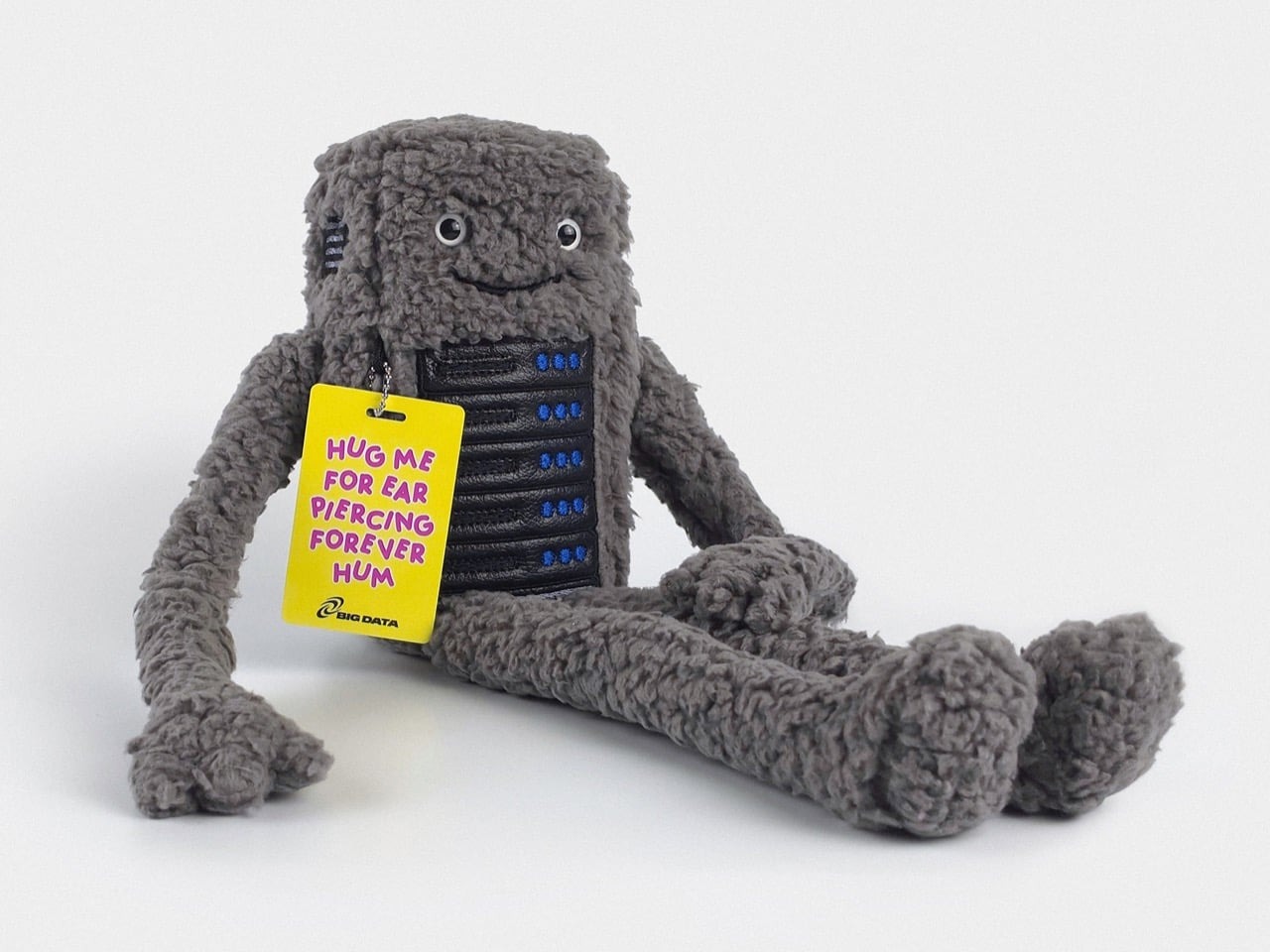
Analyzing the physical construction of Bezzy reveals a deliberate juxtaposition of soft, comforting textures and rigid, industrial iconography. The exterior chassis of the plush is constructed from a high-pile gray sherpa fleece, giving the toy a soft, lived-in texture reminiscent of thrift-store stuffed animals. This choice of material is intended to evoke the visual grammar of charity adoption plushies, complete with floppy, unweighted limbs, simple googly eyes, and a stitched-on smile. However, the front torso of the toy features a contrasting black textured fabric panel embellished with rows of blue LED dots, mimicking the status indicator lights of an active enterprise server rack. The toy measures approximately 12 inches in height, 6 inches in width, and 4 inches in depth, weighing in at approximately 12 ounces including the internal electronic components.
According to technical documentation published with this release, the internal hardware consists of a custom sound-playback module connected to a pressure-sensitive trigger switch embedded deep within the polyester fiberfill stuffing. When a user applies pressure to the torso, the switch completes the circuit, activating the sound module to play a continuous loop of industrial fan noise. The power source is an internal battery pack housed within a stitched compartment, an engineering trade-off that prioritizes the seamless aesthetic of an art toy over the ease of battery replacement. The most prominent physical accessory is a bright yellow tag attached to the upper left corner of the chassis, bearing the warning “HUG ME FOR EAR PIERCING FOREVER HUM,” which serves as both a functional instruction and a thematic statement.
The acoustic component of the hardware is notably authentic. Rather than utilizing a synthesized white noise loop or a generic studio-recorded fan sound, the engineering team utilized an actual field recording captured by a resident living adjacent to an active data center in Northern Virginia. This region hosts over 500 data centers and handles approximately 70% of the world’s internet traffic, making the source material highly representative of the real-world acoustic pollution experienced by local communities. The resulting audio profile is a low-frequency, industrial drone that replicates the exact acoustic signature of enterprise-grade cooling arrays operating under heavy computational loads.
Everyday Usability & Design Compromises
In practice, the everyday usability of Bezzy is defined by its intentional lack of user-friendly features. Unlike standard consumer electronics or interactive toys, there is no volume control dial, no headphone jack, and no external on/off switch. Squeezing the plush immediately initiates the high-decibel hum, and the sound continues until the pressure is released or the internal playback cycle completes. This design compromise is entirely deliberate, forcing the user to experience the unyielding, intrusive nature of data center noise in a domestic environment. The physical sensation of hugging the soft sherpa fleece while being subjected to an abrasive, industrial drone creates a jarring sensory dissonance that perfectly mirrors the project’s satirical intent.
From an ergonomic standpoint, the inclusion of the rigid internal sound box and battery compartment detracts from the traditional softness expected of a plush toy. A user attempting to use Bezzy as a functional pillow or a comforting companion will immediately notice the hard, rectangular edges of the internal electronics housing. Furthermore, the handmade nature of the 20 initial units means that minor variations in stitching and component placement may affect the sensitivity of the pressure trigger. In some units, a light touch may activate the sound, while others may require a firmer squeeze, representing a common limitation in low-volume, artisanal hardware production.
Another significant compromise is the lack of a user-accessible battery door. To preserve the appearance of a seamless, handmade art object, the battery compartment is sealed within the outer fleece shell. While this prevents the battery housing from detracting from the toy’s visual appeal, it means that once the internal batteries are exhausted, the user must either carefully open a seam to replace them or accept the toy as a purely passive, silent sculpture. This limitation is worth observing for collectors who intend to display the item in an active state over several years.
Category Alternatives and Value Comparison
When evaluating Bezzy within the broader landscape of physical art toys and tech-themed collectibles, it is necessary to compare it to established alternatives in the market. One notable comparison is the Kidrobot Yummy World Plushline, which retails for approximately $29.99 USD on Amazon. These plush toys also anthropomorphize inanimate objects—specifically food items—using soft materials, embroidered faces, and colorful designs. However, the distinction matters here: the Kidrobot line is mass-produced, lacks any electronic components, and is designed purely for comfort and aesthetic appeal, offering none of the political commentary or interactive acoustic feedback found in Bezzy.
Another relevant alternative is the Giant Microbes Plushseries, which retails for approximately $14.95 USD on Amazon. These toys are designed to represent scientific realities, such as cells, bacteria, and viruses, in a cute, accessible format. While they share Bezzy’s goal of translating a complex, abstract concept into a physical, tactile object, they do so for educational purposes rather than satirical critique. They also lack the high-fidelity sound modules and the extremely limited, handmade production run that defines Bezzy’s $99 USD price point.
The value proposition of Bezzy cannot be measured by traditional consumer metrics. At $99 USD, it is significantly more expensive than mass-market plush toys, yet as a limited-edition art piece of only 20 signed units, it is priced competitively with other contemporary art drops. For comparison, physical releases from art collectives like MSCHF often retail for hundreds of dollars and sell out instantly. For the target demographic of tech workers, art collectors, and environmental advocates, the value lies in the exclusivity, the hand-assembled quality, and the uncompromising nature of the political statement it makes.
Final Buyer Verdict: Long-Term Ownership Value
As a long-term collectible, the Basura Bezzy Server Rack Plush holds a unique position. Historically speaking, early attempts at interactive, data-driven plush toys—such as the original Furby or Microsoft’s ActiMates series in the late 1990s and early 2000s—promised continuous digital engagement but ultimately became obsolete due to rapid hardware shifts and fragile internal components. Bezzy avoids this technological trap by keeping its hardware simple and analog in its execution; it does not require an internet connection, an accompanying smartphone application, or firmware updates to function. It is a self-contained physical statement that will remain operational for as long as the internal battery and simple pressure switch endure.
For the collector, the primary value of Bezzy lies in its role as a historical marker of the 2026 AI infrastructure boom and the societal anxieties surrounding it. It is an uncompromising, albeit highly irritating, piece of physical journalism that refuses to let the user forget the environmental cost of digital convenience. While it is entirely unsuitable for anyone seeking a traditional, comforting stuffed animal, it is a highly effective and well-crafted piece of satirical design for those who wish to own a physical artifact of our current technological epoch. For those lucky enough to secure one of the 20 handmade units, Bezzy is a compelling, noisy addition to any modern design collection.