

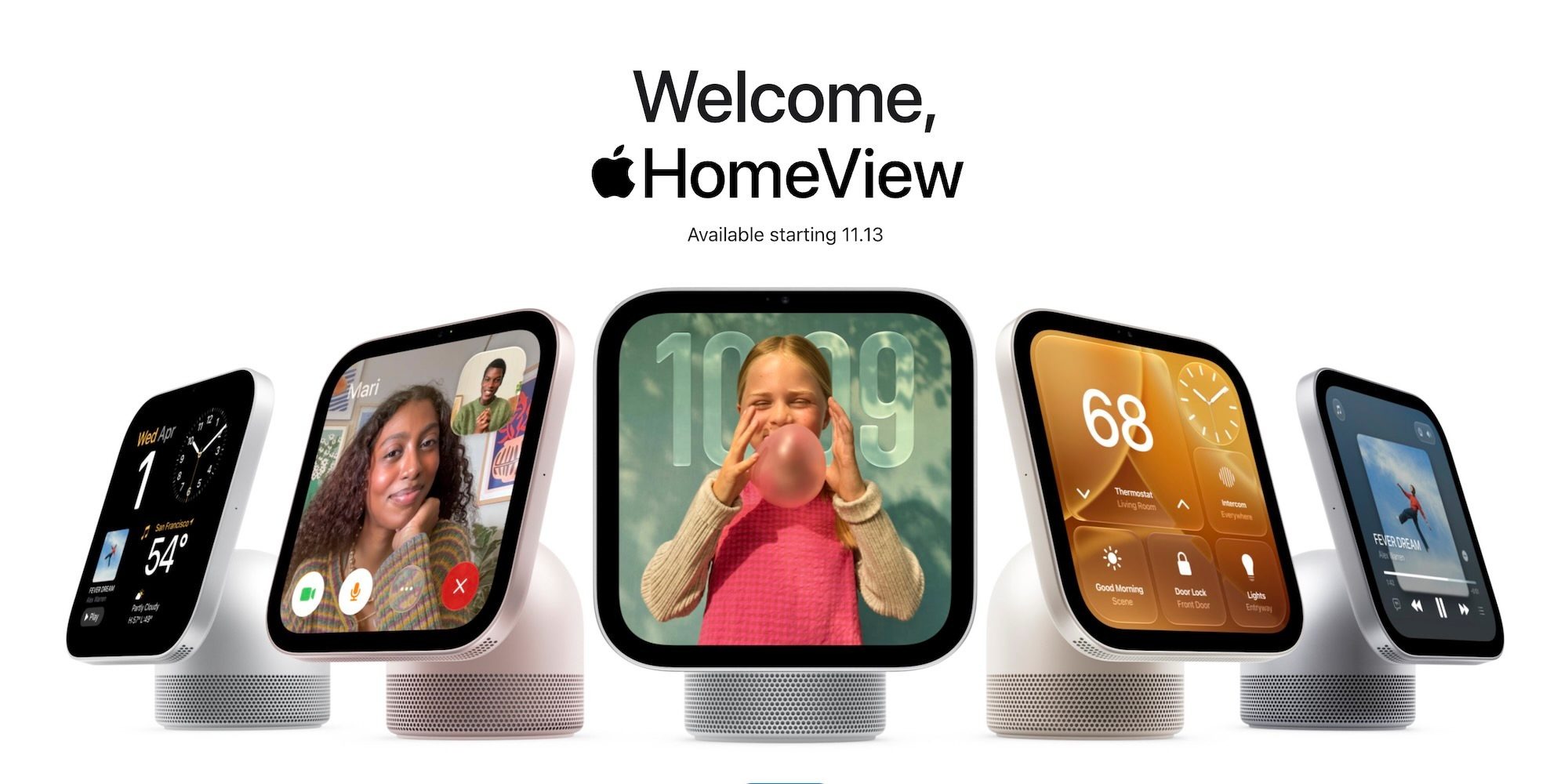
The new Apple HomeView is a dedicated smart display designed to serve as the central nervous system for your smart home, offering personalized experiences for up to six different users through advanced facial recognition and direct touchscreen control over your HomeKit and Matter-compatible devices. It also functions as a robust communication hub for FaceTime calls and inter-room intercom, alongside providing a centralized platform for all your music, podcasts, audiobooks, and streaming TV content. This brand-new device is launching with a pre-order price of $299 USD directly from Apple, but Amazon has already stepped in, dropping the price to $289.99 USD shipped for select colors. This initial discount targets families and individuals who are already deeply invested in the Apple ecosystem and are looking for a seamless, integrated control panel and communication hub to streamline their daily routines and media consumption within a shared living space.
🛒 Where to Buy: Apple HomeView Smart
Editorial Note & Product Verification: The Cool Great Buys editorial desk independently verifies manufacturer technical specifications, cross-checks active retail availability across authorized sellers, and evaluates verified consumer reliability data before publishing product evaluations. All featured prices and promotions reflect active market rates at the time of publication.
- Apple HomeView Smart: View on Amazon
Click the link above to check current pricing, availability, and customer reviews on Amazon.
For anyone considering an upgrade or a new entry into the smart display market, this early price drop is certainly noteworthy, even if it’s not a massive markdown. When you’re talking about a brand-new Apple product, any discount right out of the gate is a win, especially for those who like to be early adopters without paying full retail. My job here at Cool Great Buys is to cut through the marketing speak and figure out what this actually costs you over the long haul and if it genuinely delivers value for a normal household. We’re going to dig into the HomeView’s features, compare it to what else is out there, and ultimately, help you decide if this is the smart display your home needs, or if your hard-earned money is better spent elsewhere. Initial product disclosures and reporting were tracked via 9to5toys.
State of the Category & What Changed
The smart display category isn’t new; it’s been a battleground for Amazon’s Echo Show and Google’s Nest Hub devices for years. These devices have evolved from simple voice assistants with screens into sophisticated communication tools, media players, and smart home controllers. However, Apple’s entry with the HomeView marks a significant shift. Until now, Apple’s smart home strategy primarily revolved around the HomePod speakers for audio and Siri interactions, and the Apple TV for media, with the iPhone or iPad serving as the primary control interface for HomeKit. There hasn’t been a dedicated, always-on, visual hub from Apple that integrates all these functions into one stationary device, especially one with a focus on personalized user experiences.
The HomeView changes this by bringing Apple’s signature design and ecosystem integration to a form factor that has proven popular with other brands. It’s not just a speaker with a screen; it’s a fully-fledged interactive display designed to be a central fixture in your home. The starting price of $299 USD (or $289.99 USD on Amazon) positions it firmly in the premium segment of the smart display market, above many of its direct competitors. This pricing reflects Apple’s typical strategy: offering a polished, integrated experience at a higher price point, banking on the strength of its ecosystem and user loyalty. The target buyer here is someone who values that seamless Apple experience, already uses HomeKit, and wants a dedicated device that ties it all together without needing to pull out their phone or tablet constantly.
Generational Delta: The Engineering Upgrades That Matter
When we talk about “generational delta” for the HomeView, it’s less about comparing it to a previous Apple smart display (because there wasn’t one in this exact form factor) and more about comparing it to the existing smart home landscape and Apple’s own fragmented approach to smart home control. The HomeView’s standout engineering upgrade is its advanced facial recognition system, capable of identifying up to six different users. This isn’t just a gimmick; it’s a fundamental shift in how a shared smart display can operate. Once recognized, the HomeView seamlessly switches profiles, delivering personalized schedules, reminders, music preferences, and even specific HomeKit controls tailored to that individual. This level of personalized interaction, integrated directly into the hardware, is a significant step forward from displays that primarily rely on voice recognition or manual profile switching.
Beyond personalization, the HomeView brings a dedicated touchscreen interface for HomeKit and Matter-compatible devices, which is a big deal for practical, everyday use. While you could always control these devices from an iPhone or iPad, having a fixed, always-on display means quick access without fumbling for another gadget. It also integrates a robust FaceTime experience, turning the HomeView into a family communication hub, complete with an intercom-like setup for easy communication between rooms. The thing the product page buries in the footnotes is that while it supports Matter, ensuring broader compatibility, the core experience is still deeply rooted in the Apple ecosystem. This means that while it can talk to other smart home devices, its full potential, especially the personalized features, truly shines when paired with other Apple services and devices. It’s a powerful piece of hardware, but its true “upgrade” is in how it unifies and simplifies the Apple smart home experience into one central device.
Everyday Usability Trade-Offs & Adoption Barriers
While the Apple HomeView promises a lot, there are some practical trade-offs and potential adoption barriers that a budget-conscious dad like me needs to point out. First off, the price. At $289.99 USD, it’s a premium device in a category where you can find competent alternatives for significantly less. This isn’t just the upfront cost; Apple’s ecosystem often comes with hidden expenses. For instance, the source article mentions that the Wall Mounted edition is still at full price and, critically, “HomeView for your wall doesn’t include mount, which costs $59 minimum.” That’s a classic Apple move – a necessary accessory that adds a chunk to the total cost of ownership, pushing the price closer to $350 USD just for the hardware and a basic mount. This isn’t a giant discount or anything, but it is lower than everywhere else and you might as well keep a couple cups of coffee in your pocket.
Another potential barrier is the ecosystem lock-in. While the HomeView supports Matter, its deepest integrations and most compelling features, like personalized profiles and seamless FaceTime, are best experienced within the Apple ecosystem. If your household is a mix of Android and Apple users, or if you rely heavily on Google Assistant or Alexa for your smart home commands, the HomeView might feel restrictive or less intuitive. There’s also the question of durability and future-proofing. Apple products are generally well-built, but a fixed display in a high-traffic area like a kitchen or living room needs to withstand daily bumps and spills. The source dispatch also notes that “Apple isn’t taking trade-ins against this thing at all,” which means if you’re upgrading from an older smart display or just deciding this isn’t for you down the line, you won’t have an easy path to recoup some of your initial investment. This device is clearly not for someone who isn’t already committed to the Apple way of doing things, or for those who prioritize open-source flexibility over a tightly integrated experience.
Category Alternatives and Rival Solutions
For those who aren’t fully committed to the Apple ecosystem or are simply looking for a more budget-friendly option, the smart display market offers several compelling alternatives. The Google Nest Hub Max, for instance, is a strong contender, typically priced around $219 USD. It offers a similar large display, built-in camera for video calls (Google Duo), and facial recognition (Face Match) for personalized experiences. It integrates seamlessly with Google Assistant, YouTube, and Google Photos, making it an excellent choice for households already using Google services. While it doesn’t have the deep HomeKit integration of the HomeView, it supports a vast array of smart home devices through Google Home and offers a more open platform for third-party apps and services. Its camera can also double as a security camera with Nest Aware subscription, adding another layer of utility that the HomeView doesn’t explicitly market.
Another formidable rival is the Amazon Echo Show 10 (3rd Gen), which often retails for around $239 USD. This device stands out with its motorized base that allows the screen to automatically rotate and follow you as you move around the room during video calls or while watching content. Powered by Alexa, it offers extensive smart home control, a massive library of skills, and seamless integration with Amazon’s ecosystem, including Prime Video and Amazon Music. For families heavily invested in Amazon services, or those who prefer Alexa’s voice assistant, the Echo Show 10 provides a feature-rich experience at a lower price point than the HomeView. While it doesn’t offer the same level of multi-user facial recognition for personalized dashboards as the HomeView or Nest Hub Max, its rotating screen provides a unique hands-free interaction that Apple’s static display can’t match, making it a strong alternative for dynamic households.
Final Trajectory Verdict: Future Outlook & Buying Advice
The Apple HomeView is a significant entry into the smart display market, bringing Apple’s renowned ecosystem integration and user-centric design to a category that has long been dominated by its rivals. For families already deeply embedded in HomeKit and other Apple services, the HomeView offers an unparalleled level of personalization and seamless control that no other device can currently match. The ability for the device to recognize up to six users and tailor the experience to each individual is a genuine step forward in smart home interaction, moving beyond generic voice commands to truly intelligent, context-aware assistance. The initial pre-order discount of $289.99 USD on Amazon, while modest, makes it slightly more palatable for early adopters, but it’s crucial to factor in the additional cost of the wall mount if that’s your preferred installation method.
Ultimately, my buying advice for the Apple HomeView comes down to your existing tech ecosystem and your budget. If you’re an Apple household through and through, with multiple iPhones, iPads, and HomeKit devices, and you’ve been craving a dedicated, visual hub that ties it all together, then the HomeView is likely worth the investment. It delivers a polished, integrated experience that will feel immediately familiar and useful. However, if you’re on a tighter budget, or if your smart home setup is a mix of different platforms, or if you simply prefer the flexibility of Google Assistant or Alexa, then the Google Nest Hub Maxor Amazon Echo Show 10 (3rd Gen)offer excellent value and robust features at a lower price point. For a normal person, the HomeView is a premium product for a premium ecosystem. If that’s your world, jump on the Amazon deal. If not, there are plenty of great options that won’t break the bank.