

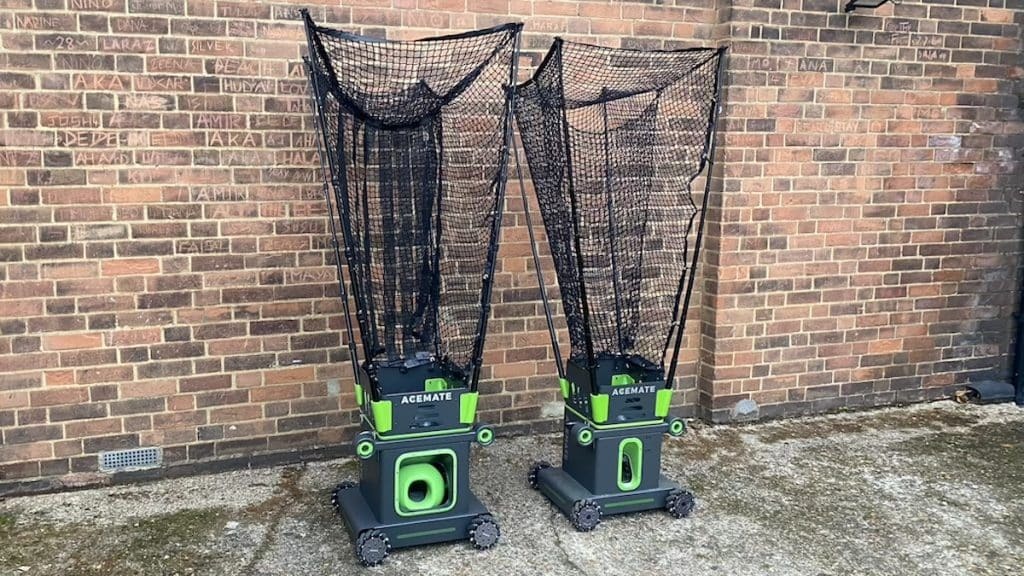
The Acemate S10 Pro sca_ref=11539908.espCPYTfX1FA3f&utm_source=uppromote&utm_medium=referral&utm_campaign=standard-affiliate-commission&utm_content=affiliate-Marko-Maslakovic” target=”_blank” rel=”noopener”>Acemate’s website, this hardware iteration targets advanced club players, coaches, and dedicated enthusiasts who require higher ball speeds and heavier durability than entry-level machines provide. Rather than redefining automated tennis practice from the ground up, the Pro model refines the core mechanics established by the original Acemate tennis robot S10 to handle intense training workloads.
🛒 Where to Buy: Acemate S10 Pro Tennis
- Acemate S10 Pro Tennis: View on Amazon
Click the link above to check current pricing, availability, and customer reviews on Amazon.
Consumer fitness tech often relies heavily on software updates to justify iterative hardware releases, but this launch takes a different route. Analyzing the manufacturer spec sheet reveals that the software platform powering both devices remains largely identical. Early hands-on reports indicate that most upgrades occur beneath the plastic chassis rather than within the accompanying smartphone application. For everyday athletes, understanding where these mechanical modifications actually alter court dynamics is essential before committing to the higher price tag.
State of the Category & What Changed
Automated tennis training equipment has traditionally fallen into two rigid categories: heavy, stationary club hoppers that require manual adjustment, or overpriced commercial units that lack modern tracking software. The introduction of wheeled, vision-enabled practice partners has bridged this gap, allowing players to practice solo with responsive ball delivery. Evaluating how these machines perform in the real world means looking past marketing buzzwords and examining the physical motors, battery capacities, and frame geometries that govern on-court reliability.
Putting the S10 and S10 Pro side by side immediately highlights their shared lineage. Both retain the distinct, mechanical-frog aesthetic characterized by dual camera optics up front, four Mecanum wheels below, and a collapsible catching net rising above the main housing. However, the Pro model is noticeably bulkier. It stands wider, rises taller, and adds 5.2 kg of dead weight to the overall assembly. That extra mass changes how the machine sits on the baseline, giving it a sturdier stance against hard ground strokes but introducing new storage considerations for trunk transport.
Examining official technical documentation confirms that the physical footprint directly impacts portability. While a heavier chassis sounds like a step backward for players walking to local asphalt courts, reality offers a surprising twist. The larger wheels and revised weight distribution on the Pro make it roll more freely when pulled by hand. The resistance felt when dragging the unit across rough court surfaces is significantly lower than on the standard S10. It is by no means lightweight, but the transport ergonomics perform better than the raw weight figures suggest.
When transitioning from a car trunk to the playing surface, the setup routine of both machines demands attention. The S10 Pro utilizes reinforced structural joints and heavier polymers that withstand the repetitive vibration of high-velocity ball feeding. During extended test sessions under direct sunlight, thermal management becomes a critical factor for autonomous court equipment. The expanded internal cavity of the Pro model allows for better heat dissipation around the primary drive motors, preventing the thermal throttling that occasionally plagues lighter units during multi-hour coaching sessions in hot weather conditions.
Generational Delta: The Engineering Upgrades That Matter
Hardware modifications on the Pro focus heavily on addressing the mechanical bottlenecks of the previous generation. On the standard S10, shifting a shot from a deep forehand corner to a sharp cross-court backhand requires the entire chassis to physically pivot on its wheels before launching the next ball. That physical rotation introduces a distinct pause between shots, altering the rhythm of a high-speed rally. The S10 Pro eliminates this delay through its internal ACE+ SHOT system, which redirects outgoing trajectories internally without rotating the main body.
This internal routing mechanism changes how drills unfold during live practice. Rallies maintain a much more natural cadence because the machine can mix up court placement instantly. Furthermore, the maximum velocity has been pushed from 97 km/h up to 120 km/h. While intermediate players might find the original top speed sufficient, the extra velocity headroom on the Pro ensures that advanced hitters will not outgrow the machine during high-intensity training sessions. Combined with a wider maximum dispersion angle, these adjustments create genuine difficulty spikes for competitive players.
Other physical refinements target durability issues identified in early user feedback. The telescopic poles supporting the front catching net on the original model felt delicate and required careful handling during setup. The Pro introduces Gen 2 twist-lock poles that use sturdier locking sections to keep the fabric net taut under heavy impacts. According to technical bulletins shared with Acemate tennis robot S10 Pro vs S10: The differences after going hands-on with both, these upgraded poles are also sold separately, allowing legacy S10 owners to retrofit their units rather than buying a new machine. The catching net itself also reaches nearly 2 meters high, offering roughly 26 cm of extra vertical clearance to trap high lobs and deep defensive returns.
Examining the spin generation capabilities reveals further divergence between the two hardware tiers. While both machines can impart heavy topspin and slice, the Pro utilizes upgraded dual-wheel brushless motors with tighter tolerance levels. This precision reduces ball-to-ball variance in spin rate and trajectory, ensuring that scripted tactical drills deliver identical rotation across hundreds of consecutive feeds. For advanced players working on footwork recovery against heavy topspin drives, this mechanical consistency eliminates unpredictable stray shots that disrupt rhythm.
Everyday Usability Trade-Offs & Adoption Barriers
Owning a robotic training partner involves managing practical trade-offs regarding power, capacity, and physical storage. Battery life represents one of the most substantial specifications separating the two models. Acemate rates the Pro for up to five hours of continuous operation in Ball Machine mode, doubling the three-hour baseline of the standard S10. However, examining the fine print of the power specifications shows that this five-hour figure applies only when the launching wheels run at moderate speeds with minimal chassis movement. Engaging high-speed Rally or Battle modes under full physical movement will drain the internal battery much faster.
Capacity upgrades extend to the ball hopper as well. The Pro holds 100 balls compared to the 80-ball limit of its predecessor. That extra twenty-ball buffer allows for slightly longer drill sequences before requiring a manual reload from scattered court debris. Yet, physical reality dictates that no net system is entirely foolproof. Wide angles, aggressive topspin returns, and mis-hits still bounce off the frame and scatter across the court surface. The larger hopper minimizes reloading frequency, but manual ball collection remains a necessary chore at the end of every session.
Software parity ensures that buyers are not paying for exclusive application features. Both devices utilize identical training modes, including Rally, Drill, Serve, Battle, and Ball Machine presets, alongside a library exceeding 100 customizable drills. The mobile app interface has received a visual polish with cleaner navigation menus and better saved-drill organization, but these software enhancements apply equally to the original S10. Therefore, the purchasing decision hinges entirely on whether an individual athlete requires the higher velocity ceiling, internal redirection speed, and extended battery endurance of the Pro hardware.
Navigating the software companion on a smartphone while standing on a windy baseline highlights usability nuances common to vision-based sports robots. The optical tracking lenses require periodic wiping to maintain calibration under dusty outdoor court environments. While the autonomous vision system handles player tracking reliably across varying lighting conditions, sudden shadows cast by surrounding fences or stadium lights can occasionally cause minor tracking latency. Users must account for court placement to ensure the dual-camera optics maintain an unobstructed line of sight to the baseline.
Category Alternatives and Rival Solutions
Evaluating the robotic tennis market requires looking at established competitors that approach automated hitting practice from different engineering angles. The Spinfire Pro 2, priced $2 USD,299 USD on authorized tennis equipment supplier channels, remains a benchmark for heavy-duty club training. It delivers exceptional ball elevation, robust spin generation, and an internal battery system designed for multi-hour coaching sessions. However, the Spinfire lacks the vision-based autonomous tracking and robotic chassis movement found on modern units like the S10 series, relying instead on a fixed baseline position and remote-control programming.
Another prominent alternative is the Slinger Bag Grand Slam Pack, retailing near $999 USD on Slinger Bag Grand Slam Pack. The Slinger offers a much more portable, lightweight design that doubles as a standard tennis bag and ball carrier. It prioritizes simplicity and budget-friendly accessibility over automated court tracking. While it lacks the smart camera vision and dynamic repositioning of the Acemate lineup, its straightforward mechanical oscillator appeals to club players who want reliable baseline feeds without managing heavy robotic hardware or complex software calibration routines.
When contrasted against traditional pneumatic or wheel-based launchers, the Acemate hardware environment commands a distinct premium due to its autonomous vision tracking. Competitors like the Lobster Elite series offer robust build quality and impressive elevation ranges, but they remain tethered to manual remote controls or pre-programmed oscillation patterns that do not react dynamically to player movement. For solo athletes seeking a sparring partner that mimics live-ball rally dynamics rather than a static ball machine, autonomous vision-enabled platforms represent a generational leap forward, albeit with a steeper financial investment and higher physical maintenance footprint.
Final Trajectory Verdict: Future Outlook & Buying Advice
Choosing between these two training machines depends heavily on player classification and session intensity. Recreational and intermediate players will find that the standard S10 delivers more than enough velocity, tracking intelligence, and drill variety for weekly workouts without stretching household budgets. The core automated hitting experience remains largely identical across both models, meaning budget-conscious buyers sacrifice very little in terms of software capability by choosing the lighter, more affordable base unit.
The S10 Pro justifies its higher cost for high-level competitors, tennis coaches, and heavy users who run extended daily training blocks. The combination of internal directional shifting, a 120 km/h top speed, a 100-ball hopper, and a five-hour battery profile provides the necessary headroom for rigorous, uninterrupted practice. Anyone running multi-hour coaching sessions or demanding rapid directional changes will benefit directly from the engineering upgrades built into this heavier, more durable chassis.
Looking at the broader trajectory of smart tennis automation, hardware iterations like the S10 Pro signal a shift toward commercial-grade durability in consumer-accessible packages. As brushless motor technology and optical tracking algorithms continue to mature, future updates will likely narrow the gap between stationary club hoppers and mobile robotic partners. For serious competitors seeking an immediate upgrade to their solo training regimen, understanding these hardware realities ensures that the investment aligns perfectly with daily on-court demands.