

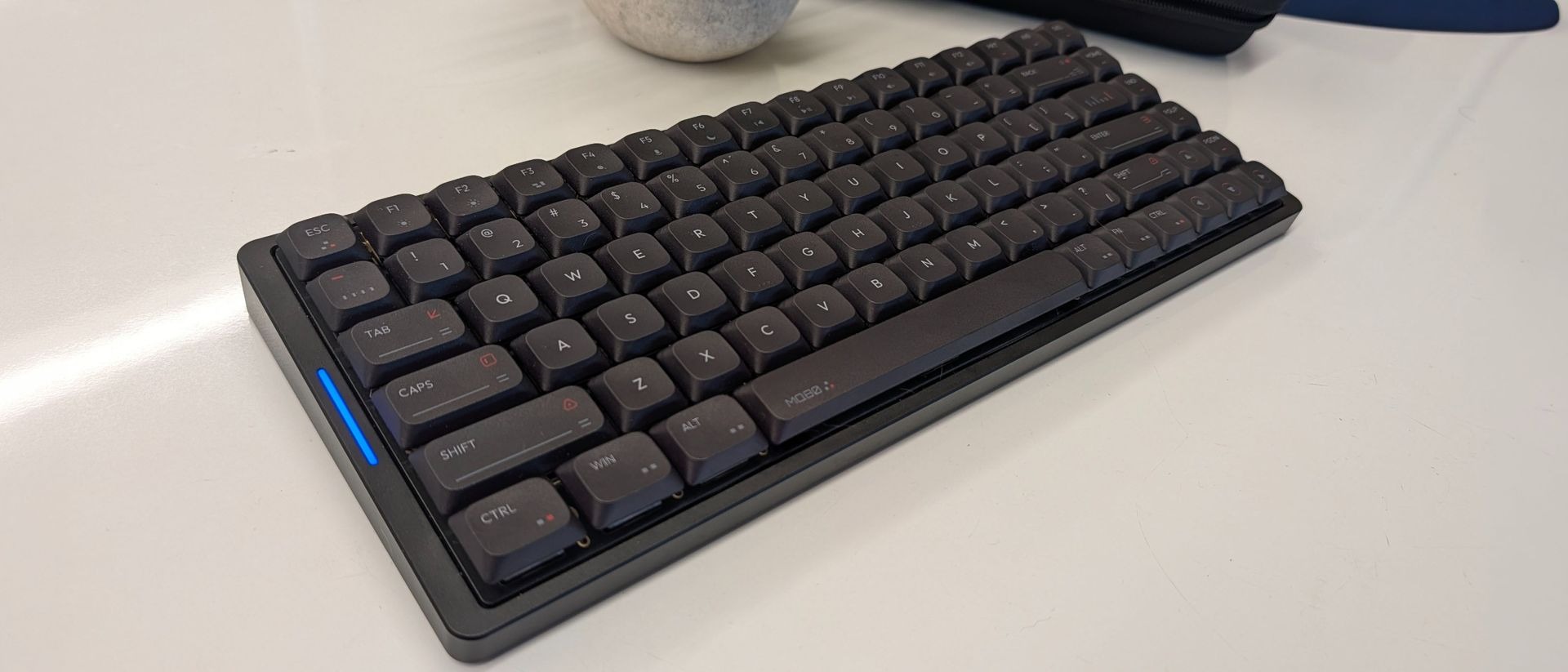
The IQUNIX MQ80 Low Profile Mechanical Keyboardis a compact 75-percent wireless typing deck housed in a heavy CNC-milled aluminum chassis, built for home office professionals who demand custom-keyboard acoustic dampening in a low-profile form factor. Retailing for $189 USD on Amazon and direct from the manufacturer, it targets productivity enthusiasts, heavy typists, and minimalist desk strategists who want the shallow wrist strain of a laptop keyboard combined with the premium tactile engineering of custom enthusiast gear. According to Tom’s Hardware initial hardware review, IQUNIX has squeezed high-end sound isolation into a slim profile, though its heavy weight and restricted switch selection keep it firmly anchored to a single desk rather than floating in a travel bag.
🛒 Where to Buy: IQUNIX MQ80 Low Profile
Editorial Note & Product Verification: The Cool Great Buys editorial desk independently verifies manufacturer technical specifications, cross-checks active retail availability across authorized sellers, and evaluates verified consumer reliability data before publishing product evaluations. All featured prices and promotions reflect active market rates at the time of publication.
- IQUNIX MQ80 Low Profile: View on Amazon
Click the link above to check current pricing, availability, and customer reviews on Amazon.
For years, IQUNIX built its reputation by supplying the mechanical keyboard market with heavy-duty aluminum frames, thick keycaps, and distinct visual designs long before mainstream brands caught on. The company helped popularize standard PBT keycaps and acoustic case foam across community hubs like r/mechanicalkeyboards. As more office workers transition to low-profile keyboards to reduce wrist extensions and maintain ergonomic comfort without bulky palm rests, manufacturers are racing to shrink component heights without making keystrokes sound hollow or feel metallic. The MQ80 represents IQUNIX taking its custom keyboard expertise and flattening it down to desktop size.
State of the Category & What Changed
The low-profile mechanical keyboard category has undergone a massive structural shift over the last few product cycles. Historically, choosing a low-profile keyboard meant accepting major functional compromises: cheap plastic frames, scratchy short-throw switches, minimal sound dampening, and thin keycaps that rattled with every keystroke. Most buyers view low-profile keyboards as glorified laptop alternatives meant solely for travel. However, recent design trends demonstrate a clear shift toward desktop-grade low-profile setups that combine heavy metal construction, hot-swappable circuit boards, and sophisticated sound-dampening foam layers to rival standard-height custom builds.
In response to this demand, IQUNIX launched the MQ80 to bridge the gap between boutique custom enthusiast engineering and low-profile ergonomics. Retailing at $189 USD, the keyboard introduces a 75-percent “Compact TKL” layout that retains dedicated arrow keys, a full function row, and key navigation buttons while eliminating unnecessary empty spacing across the case. Instead of relying on a flimsy plastic tray, the MQ80 utilizes a thick block of CNC-machined aluminum that sets a new structural baseline for desk stability. This transition toward heavy, acoustics-first low-profile hardware changes how home office users evaluate peripheral purchases, turning low-profile gear from a travel compromise into a permanent workspace upgrade.
Generational Delta: The Engineering Upgrades That Matter
Comparing the MQ80 against older low-profile standards reveals significant internal engineering enhancements designed to refine keystroke sound and feel. The single biggest innovation lies in the internal mounting system. Traditional low-profile decks screw the circuit board directly into the bottom case, transmitting harsh vibrations straight through the plastic frame and creating high-pitched click sounds. The MQ80 incorporates a modified “Le-Tray Gasket Mount” assembly, floating the internal switch plate on six extended arms fitted with silicone rubber buffers. This floating structural suspension allows the typing deck to yield subtly under finger pressure, softening impact forces when keys hit the bottom of their stroke.
Beneath the keycaps, IQUNIX implemented a five-tier acoustic dampening stack that mirrors high-end custom mechanical keyboards. Moving from top to bottom, switches plug into an FR4 fiberglass plate, which offers a flex pattern far superior to stiff aluminum or cheap bent steel. Below the plate lies a thick layer of high-density PORON foam to absorb empty air space, followed by a thin sheet of IXPE switch foam and a protective PET plastic film. The printed circuit board sits on yet another PORON cushion, while the lower aluminum case holds a final IXPE foam layer to reflect mid-range sound frequencies. In plain English, this multi-layered sandwich eliminates hollow case echoes, resulting in a deep, satisfying sound profile that stands far above typical off-the-shelf office keyboards.
What caught my eye reading the full spec sheet is how the engineering team packed a massive 4,000mAh rechargeable battery into a frame that measures just 0.4 inches (10.8mm) tall at the front lip and 1.08 inches (27.5mm) at the rear slope. The keyboard utilizes pre-lubricated Kailh Rose Red linear switches, engineered with a light 40g actuation force, a short 1.2mm pre-travel distance, and a total movement distance of 2.8mm. That offers approximately 70% of the physical travel distance found on full-sized mechanical switches. Topped with thick, dye-sublimated PBT keycaps featuring subtle finger scoops, the MQ80 gives users modern tri-mode connectivity (2.4GHz wireless with a 1,000Hz polling rate, Bluetooth 5.1, and USB-C wired) alongside full per-key RGB backlight control through open-source VIA web configuration software.
Everyday Usability Trade-Offs & Adoption Barriers
Despite the high-end engineering, the MQ80 presents very real physical trade-offs that buyers need to evaluate before pulling out a credit card. The most jarring reality is weight. Coming in at 2.6 pounds (1.18 kg), this keyboard weighs as much as many full-sized desktop keyboards and even some modern ultraportable laptops. While the low height profile looks sleek, carrying a heavy block of aluminum in a backpack during a daily commute gets tiring fast. That’s the catch. IQUNIX includes a hardshell carrying case in the box, but this device is clearly built to live on a home office desk rather than travel between coffee shops.
Typing accuracy presents another distinct learning curve. Because low-profile keycaps sit flat across every row without the sculptured height differences of traditional keycaps, fingers rely heavily on visual cues and edge boundaries. The Kailh Rose Red linear switches actuate under just 40g of force with a rapid 1.2mm trigger point. For a heavy-handed typist who rests fingers firmly on keys, this hyper-sensitivity can trigger accidental double letters or accidental spacebar presses during long typing sessions. In typing speed tests conducted on benchmark tools like MonkeyType, raw typing speed often increases due to short key travel, but overall net accuracy can dip initially due to extra backspacing corrections.
The third major barrier involves hardware customization and backlighting limitations. The PCB features hot-swappable switch sockets, but they are strictly compatible with Kailh Choc V2 switch footprints. Unlike standard mechanical keyboards that support hundreds of aftermarket switch options, the Choc V2 market remains fairly limited, leaving buyers with few replacement switch choices if they dislike light linears. Furthermore, while the keyboard features vibrant per-key RGB backlighting, the thick PBT keycaps feature solid, non-shine-through legends. In dark room environments, the RGB light glows around the base of the keycaps rather than illuminating the letters themselves, making night-time typing difficult for non-touch typists.
According to technical documentation published with this release, battery longevity depends heavily on operational settings. IQUNIX rates the battery for up to 350 hours of uptime, but the fine print reveals that figure is calculated strictly over Bluetooth with all RGB lighting completely powered off. In real-world office conditions using the low-latency 2.4GHz wireless dongle with RGB lighting set to medium brightness, realistic battery performance hovers around 45 hours of continuous typing. For a standard eight-hour workday, you can expect to plug in a charging cable every week to ten days. That’s actually fair for a lighted wireless board, but buyers expecting months of maintenance-free wireless use without plugging in will need to turn off backlighting entirely.
Category Alternatives and Rival Solutions
When evaluating what this board costs over a multi-year lifespan, smart buyers must examine competing models in the low-profile productivity space. The most direct alternative is the Nuphy Air75 V3, available for $119 USD direct from the manufacturer or on Amazon. NuPhy has refined its low-profile architecture over three hardware generations, offering custom Gateron low-profile switches available in linear, tactile, and silent tactile options right at checkout. The Air75 V3 features a lighter plastic-and-aluminum composite frame that makes daily travel far more practical, full web-based VIA software remapping, and superior switch customization options at a retail price point roughly $70 USD lower than the MQ80.
For buyers who prioritize software integration and multi-device workstation productivity over custom mechanical typing sound, the Logitech MX Mechanical Ministands as a dominant category standard for $149.99 USD on Amazon. Logitech’s offering features low-profile tactile switches, smart proximity-sensing backlit keycaps with clear pass-through legends, and seamless multi-device pairing via Logi Options+ software. With Logitech’s software suite, users can execute complex multi-monitor workflow switching and custom macro actions across multiple computers simultaneously. While the MX Mechanical Mini lacks gasket mounting and thick acoustic dampening foam—resulting in a clackier sound profile—its robust multi-year battery efficiency and established customer support network offer strong competition for mainstream office workers.
Comparing these three models highlights the clear trade-offs across the low-profile hardware market:
- IQUNIX MQ80 ($189 USD): Premium full-aluminum construction, superior multi-layer acoustic dampening, Le-Tray gasket mounting, heavy 2.6 lb desk anchor, limited Kailh Choc V2 switch variety.
- NuPhy Air75 V3 ($119 USD): Composite aluminum/plastic body, lightweight travel ergonomics, broad Gateron low-profile switch options (linear, tactile, silent), lower entry price.
- Logitech MX Mechanical Mini ($149.99 USD): Commercial software support, smart backlit illumination, cross-computer control options, plastic housing construction, firmer tactile switch profile.
Final Trajectory Verdict: Future Outlook & Buying Advice
The IQUNIX MQ80 proves that low-profile mechanical keyboards no longer need to sound like thin plastic toys or feel harsh on the fingers. By combining a heavy CNC aluminum enclosure with a floating gasket plate and multi-layer acoustic foam, IQUNIX created one of the best-sounding typing surfaces in its class. Examining authorized retailer listings confirms initial launch stock is shipping direct ahead of broader retail distribution, positioning this board as a niche flagship for design-focused desk setups. However, at $189 USD, it demands a significant cash outlay for a keyboard that lacks keycap legend backlighting and restricts switch choice to light linear switches out of the box.
Is this worth it for a normal person? For a typical household budget or a standard office worker who needs a versatile daily keyboard, the total cost of ownership is difficult to justify at full retail price when highly capable alternatives like the NuPhy Air75 V3 deliver comparable typing speed and wider switch customization for $119 USD. The MQ80 shines specifically for desk-bound professionals who want a heavy, ultra-stable aluminum desk centerpiece that delivers custom enthusiast sound dampening in a low-profile footprint. If you prefer light linear switches and heavy metal design, keep an eye out for promotional discounts. Otherwise, waiting for a seasonal sale makes this premium typing deck a much sweeter deal for your home workstation.