

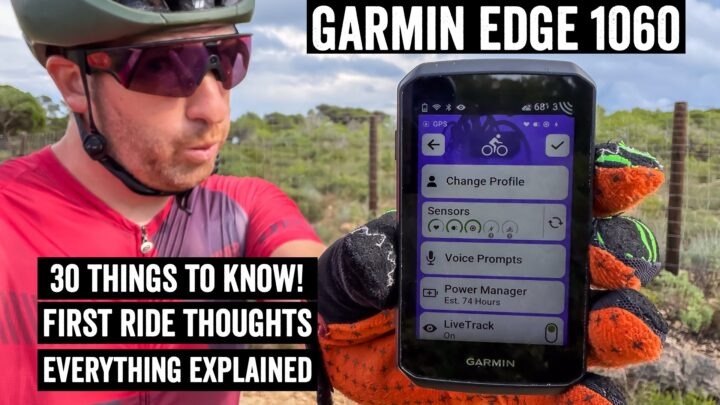
The Garmin Edge 1060 cycling GPS is a premium touchscreen head unit featuring a slimmed-down 3.5-inch 1,000-nit display, built-in microphone for voice commands, and expanded navigation tools packaged in a 142g chassis. Retailing for $799 USD direct from Garmin and through authorized cycling specialists, this flagship tracking computer is engineered for serious endurance riders, gravel racers, and data-driven cyclists who demand absolute route autonomy and seamless hands-free messaging on long outdoor training blocks.
🛒 Where to Buy: Garmin Edge 1060
Editorial Note & Product Verification: The Cool Great Buys editorial desk independently verifies manufacturer technical specifications, cross-checks active retail availability across authorized sellers, and evaluates verified consumer reliability data before publishing product evaluations. All featured prices and promotions reflect active market rates at the time of publication.
- Garmin Edge 1060: View on Amazon
Click the link above to check current pricing, availability, and customer reviews on Amazon.
As the cycling technology market matures, hardware developers face mounting pressure to deliver meaningful mechanical refinements rather than superficial yearly feature additions. Examining the trajectory of high-end cycling computers reveals a distinct shift toward ecosystem integration, where hardware manufacturers borrow features from adjacent wearable lines to keep pace with modern smartphone expectations. For years, the endurance community has watched flagship head units balloon in physical size while remaining stubbornly tethered to touchscreens that struggle under heavy rain or sweat. The arrival of the Garmin Edge 1060 signals a calculated pivot toward tactile redundancy, physical weight reduction, and deeper voice-controlled utility. Analyzing the manufacturer spec sheet and initial hands-on technical disclosures, this release represents an architectural evolution of the established core guts of the Edge 1050, refining the physical footprint while addressing longstanding user grievances regarding button controls and on-the-fly route modifications. Initial product disclosures and reporting were tracked via Dcrainmaker.
When unpacking the physical unit for the first time, the visual impression is immediately striking compared to its predecessor. Engineers have successfully trimmed the external bezels without sacrificing screen real estate, yielding a brilliant 3.5-inch panel that remains exceptionally legible under blazing midday sunlight thanks to its robust 1,000-nit maximum backlight output. For cyclists who regularly transition from bright open roads to deeply shaded forest canopy, the ambient light sensor reacts with near-instantaneous adjustment speeds, modulating brightness smoothly without blinding the rider or leaving the map obscured. The physical dimensions measure 58.5 x 107 x 16.3 mm, a noticeable retraction from the bulkier geometry of older generations that used to make the device look oversized on standard 31.8mm handlebars. By shaving off crucial millimeters of depth and width, this iteration fits much more harmoniously into aggressive aero cockpit configurations used by time-trialists and elite road racers alike.
Beyond dimensions, structural improvements extend directly into how the housing handles moisture, dirt, and mechanical stress. The IPX7 water-resistance rating ensures that torrential downpours, muddy gravel pursuits, and pressure washing after a filthy winter ride pose zero operational threat to the internal computing stack. Furthermore, the redesigned chassis incorporates a tougher polymer compound that resists scuffing when clumsy hands drop the unit onto asphalt during pre-ride cafe stops. The mounting tab on the rear of the unit remains fully compatible with quarter-turn locking mechanisms, ensuring that millions of existing out-front mounts, TT bars, and integrated carbon cockpits will accept the device without requiring costly hardware replacements.
State of the Category & What Changed
The premium cycling GPS segment has long been defined by a constant tension between screen brightness, battery preservation, and structural weight. When Garmin introduced its previous high-end iteration, the market welcomed the brilliant display panel and built-in speaker, yet many endurance athletes pointed out that the chassis remained bulky and heavy for dedicated climbing setups. The Garmin Edge 1060 addresses this exact critique by slimming down the outer casing dimensions to 58.5 x 107 x 16.3 mm and dropping the total unit weight from 161g down to 142g. This engineering reduction is achieved without sacrificing the vibrant 480x800px display resolution or the dependable 20-hour battery life that long-distance riders require for multi-day bikepacking trips.
Beyond the physical reduction in shell volume, the structural layout of external controls has undergone a significant overhaul. Garmin has added four physical buttons to the housing, bringing the total to seven tactile clickers that mirror the configuration found on the Garmin Edge 550series. This layout decision directly impacts real-world ride utility, allowing cyclists to execute complete system navigation through either touch or physical buttons when wearing thick winter gloves or riding through torrential downpours. Furthermore, the USB-C charging port has been relocated from the rear end to the underside of the device, making it substantially easier to maintain external battery connections while locked into an out-front mount. For riders examining top-tier head units, the $799 USD pricing tier establishes a new high watermark for cycling peripherals, placing the onus squarely on these hardware adjustments to justify the investment.
Diving deeper into the everyday operational experience, the inclusion of tactile buttons fundamentally transforms how riders interact with menus while operating at high power outputs. When performing maximal efforts during a local town-line sprint or navigating technical gravel descents, attempting to swipe a capacitive glass touchscreen can introduce dangerous moments of distraction. The tactile click of physical buttons provides immediate confirmation without requiring visual verification, meaning riders can flip through data screens, dismiss navigation prompts, or lap their intervals purely by feel. This mechanical redundancy acknowledges that cycling is an active, physically demanding sport where touch-only interfaces frequently fall short of ergonomic necessity.
The strategic relocation of the USB-C charging port to the bottom lip of the housing also resolves a persistent grievance among endurance athletes who rely on external battery packs during multi-hour gravel epics or ultra-distance bikepacking tours. Previously, cable clearance issues often interfered with out-front mount arms, forcing riders to employ awkward right-angle adapters or loose cable routings that could snag on handlebar bags. The lowered port position allows for clean, straight-line cable routing directly from a stem-mounted power bank, maintaining weatherproof integrity and structural stability even over washboard gravel roads that test every bolt on the bicycle.
Generational Delta: The Engineering Upgrades That Matter
A granular look at the internal component architecture reveals that the software ecosystem is where the most consequential shifts have occurred. The integration of an internal microphone, positioned directly to the left of the relocated bottom speaker, unlocks hands-free voice control and voice messaging capabilities. By uttering the wake phrase “OK Garmin”, riders can initiate routing commands or dispatch hands-free voice notes via the Garmin Messenger appwithout taking their hands off the handlebars or staring down at a miniature QWERTY keyboard. During high-intensity efforts or group pacing scenarios, this capability transforms how athletes communicate mid-ride, routing audio transcriptions automatically to paired contacts who also utilize the messaging platform.
Navigation and route calculation engines have likewise received substantial algorithmic improvements. The introduction of Free Flow Routing utilizes billions of historical Garmin Connect activity records to evaluate actual cyclist speeds relative to posted road limits, dynamically routing riders around chronic stop-and-go intersections, traffic lights, and congested junctions. Furthermore, Strava Live Segments are no longer restricted to dedicated Strava-generated routes; athletes can now load custom GPX files from platforms like Komoot and still trigger live segment challenges against KOM benchmarks. These software enhancements, combined with a redesigned workout player featuring collapsible structural blocks and real-time POI hazard overlays, demonstrate a clear focus on reducing rider friction.
Evaluating the practical utility of the voice control engine uncovers a powerful tool for modern training sessions. When riding solo on remote country roads, quickly searching for a nearby cafe, gas station, or alternate shelter point can be safely achieved by voicing the destination while keeping eyes locked firmly on the road ahead. The speech-to-text conversion engine operates locally and via paired smartphone data streams, parsing commands with impressive accuracy provided wind noise is kept to a moderate level. Similarly, the updated workout player provides a massive quality-of-life leap for structured training devotees, allowing interval blocks to be collapsed or expanded instantly on the fly without forcing the user to swipe through cumbersome sub-menus.
Hazard detection and real-time point-of-interest overlays further elevate the safety profile of the tracking computer. Utilizing crowd-sourced incident data alongside mapping metadata, the hardware warns approaching riders of upcoming road hazards, steep grade changes, sharp switchbacks, and localized construction zones. When integrated with rear-facing radar units, these visual and auditory alerts combine into an exhaustive situational awareness ecosystem. The dual speakers emit distinct, high-priority acoustic chimes that cut through roaring highway traffic, ensuring that audio warnings are perceived instantly even when wearing windproof ear bands or riding in windy weather.
Everyday Usability Trade-Offs & Adoption Barriers
Despite the impressive array of software additions, real-world deployment reveals distinct operational trade-offs that prospective buyers must weigh. While the newly added microphone excels at capturing voice commands in moderate wind conditions, ambient acoustic interference during high-speed descents or heavy downpours occasionally requires users to repeat voice prompts. Additionally, because voice messages record in fixed 30-second blocks with a mandatory ten-second cancellation window, quick corrections can feel protracted if a sudden radar alert or navigation chime interrupts the recording sequence. Cyclists who prefer minimalist gear setups may also find the $799 USD price tag a difficult pill to swallow, particularly when core display specifications and storage capacity remain identical to the previous generation.
Durability and mounting compatibility remain strong points, retaining IPX7 water resistance and backward compatibility with established power-charging mounts, but the physical price increase marks a departure from Garmin’s recent pricing stability. Riders who frequently switch between multiple bicycles will appreciate the new alternate data field feature—which automatically swaps power meter metrics for secondary data streams when mounting the unit to a non-power-equipped training bike—yet this remains a niche convenience rather than a transformative training breakthrough. Anyone currently running an older mid-tier unit should carefully evaluate whether hands-free messaging and slightly better routing algorithms justify moving into Garmin’s highest pricing tier.
Battery performance under maximum operational load is another factor requiring close examination. While the advertised 20-hour battery life easily handles standard weekend training blocks, engaging maximum screen brightness alongside dual-frequency GPS tracking, live tracking broadcasts, and continuous music or audio prompt streaming will degrade endurance more rapidly, dropping total runtime closer to 12 or 14 hours. For multi-day bikepacking excursions, riders will still need to manage power consumption settings intelligently or pack supplementary USB-C battery banks. Furthermore, the sheer density of software features and data pages can introduce a steeper learning curve for athletes migrating from simpler, stripped-down cycling computers, requiring dedicated time spent configuring custom profiles before heading out on critical training rides.
Storage capacity, while ample for thousands of miles of map tiles and historical activity logs, mirrors the previous generation without offering expanded internal flash memory upgrades. For globetrotting cyclists who need to download massive regional topographical maps for North America, Europe, and Asia simultaneously, strategic file management remains necessary to prevent storage warnings. Nevertheless, the automated map download manager handles Wi-Fi synchronization smoothly when connected to home networks, keeping cartography updated overnight without requiring manual desktop computer file transfers.
Category Alternatives and Rival Solutions
Evaluating the device requires looking closely at competing flagship head units that dominate the endurance training market. The most direct alternative is the Hammerhead Karat 3, which retails for $499 USD on Amazon and offers an Android-based operating system renowned for its fluid smartphone-like navigation and seamless cellular routing integration. While the Karat 3 provides a deeply customizable dashboard and excellent map rendering, it lacks the specialized ecosystem synergies found in Garmin’s broader athletic tracking environment, such as native integration with the Garmin Fenix 8multisport watch and unified training load metrics.
Another primary contender in the ultra-endurance space is the Wahoo ELEMNT ROAM V3, available for $399 USD on Amazon. Wahoo focuses heavily on physical button durability, simplified companion app configuration, and a streamlined user interface that eschews complex touch menus in favor of reliable outdoor visibility and stellar battery conservation. While the ELEMNT ROAM V3 cannot match the high-resolution display clarity, built-in speaker audio alerts, or advanced voice-messaging capabilities of the Garmin flagship, its lower price point and rugged simplicity make it a compelling choice for bikepackers who prioritize hardware longevity over smart-connectivity features.
Comparing these competitive offerings highlights distinct philosophical approaches to modern cycling navigation. Devices built on open Android frameworks prioritize third-party application flexibility and rapid software iteration, appealing to tech-savvy riders who want sideloaded mapping layers and real-time weather overlays. Conversely, streamlined hardware competitors champion absolute operational reliability, ditching power-hungry touchscreens entirely in favor of physical button arrays designed to function flawlessly under extreme sub-zero winter conditions. The Garmin hardware occupies a middle ground, attempting to merge smartphone-grade display technology and voice utility with robust physical controls, though this ambitious balancing act commands a premium financial investment that sits well above rival pricing structures.
When factoring in broader ecosystem considerations, athletes already embedded within specific software training platforms will find their purchasing decisions heavily influenced by data synchronization friction. Riders tracking recovery metrics, sleep scores, and daily training readiness via smartwatch ecosystems will extract maximum value from keeping their cycling computer within the same brand family. Switching to an alternative brand ecosystem often results in fragmented recovery metrics, requiring third-party bridge applications to harmonize training load analytics—a minor annoyance, but one that dedicated data enthusiasts prefer to avoid.
Final Trajectory Verdict: Future Outlook & Buying Advice
The product represents a calculated refinement of an already potent hardware platform, successfully shedding excess weight while introducing practical tactile controls and voice integration. For current owners of the previous-generation flagship, the minor architectural shifts and software updates do not necessitate an immediate upgrade, especially given the $799 USD price point. However, for endurance athletes transitioning from older x30 or x40 series devices, this unit delivers a comprehensive suite of navigation tools, hazard warnings, and hands-free communication options that streamline long training blocks.
Looking at the broader trajectory of cycling technology, this release signals that voice control and predictive routing algorithms are becoming standard expectations for premium fitness electronics. If this hardware generation successfully establishes reliable voice-command workflows in adverse weather, future iterations will likely expand these capabilities into automated safety reporting and dynamic group pacing adjustments. Prospective buyers should weigh their need for advanced routing and voice messaging against the substantial financial investment required, making current-generation discounted stock an attractive alternative for budget-conscious cyclists.
Ultimately, choosing this high-end tracking computer comes down to a clear-eyed assessment of individual riding priorities and financial thresholds. Cyclists who demand absolute navigation autonomy, crisp graphical map rendering, voice-activated messaging capabilities, and versatile dual-input control schemes will find that the engineering refinements successfully justify the flagship status. For recreational weekend warriors or riders content with basic GPS tracking and simple telemetry fields, lower-priced market alternatives offer robust performance at a fraction of the cost. As the cycling tech landscape continues its rapid evolution, this flagship model establishes a formidable benchmark for what riders can expect from their handlebar-mounted companions on every ride ahead.