

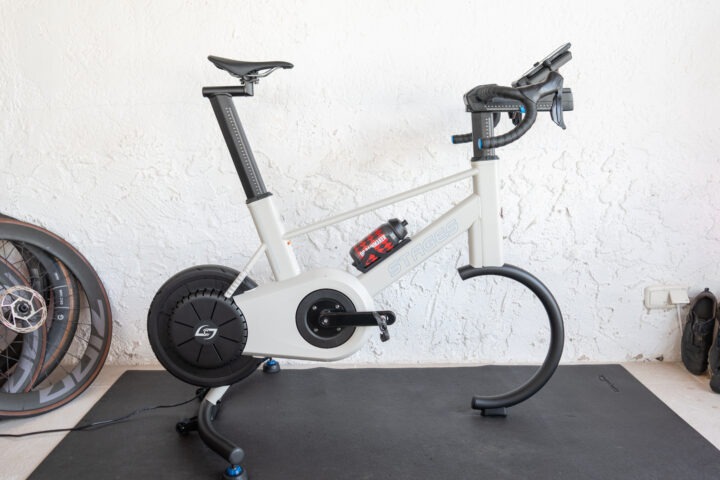
The Stages SB200 Indoor Smartbike is a dedicated smart training hardware platform retailing at $2,399 USD through authorized cycling fitness outlets, engineered specifically for dedicated cyclists and multi-rider households seeking a streamlined, high-inertia indoor riding experience. As connected fitness hardware enters a more mature architectural phase, the broader arc of hardware design favors footprint reduction, structural refinement, and deeper third-party ecosystem integration over mere brute-force mass. Examining the fine print of the hardware documentation reveals that the SB200 is designed to bridge the gap between heavy commercial-grade build quality and the spatial constraints of residential living spaces, addressing the physical bulk that defined earlier generations of indoor smart cycles. For athletes who demand absolute consistency from their indoor training environments, this shift toward a more rationalized physical footprint without sacrificing structural integrity represents a major milestone in indoor bike design.
🛒 Where to Buy: Stages SB200 Indoor Smartbike
- Stages SB200 Indoor Smartbike: View on Amazon
Click the link above to check current pricing, availability, and customer reviews on Amazon.
When unboxing and assembling the device, users immediately notice the thoughtful division of heavy components compared to the monolithic, back-breaking blocks of older smart cycles. The engineering team managed to shave off substantial dead weight while retaining the core rigidity necessary to withstand out-of-the-saddle sprinting at peak wattages. This makes the equipment far more accessible for solo setup, repositioning within a multi-purpose room, or maneuvering through standard residential doorways. The sleek aesthetic profile blends seamlessly into modern home decors, abandoning the industrial, dungeon-like appearance of commercial gym machinery in favor of clean lines, matte black finishes, and subtle branding accents that appeal to design-conscious homeowners.
Core Disclosure & Hardware Announcement
In Stages official launch documentation, the engineering team claims a complete structural reimagining of their platform, shedding 55 pounds or 25 kilograms compared to the preceding Stages SB20 while maintaining a robust maximum rider weight capacity of 300 pounds or 136 kilograms. The physical frame relies on a heavy-duty steel construction treated with phosphate plating and a durable powder coat, establishing a solid anchor for intense threshold intervals and high-wattage sprint sessions. The footprint has been meticulously optimized for home use, measuring between 127 centimeters and 137.3 centimeters in length depending on saddle position, with a total bike weight of 70 pounds or 32.3 kilograms that makes solo repositioning far more manageable than its predecessor. Initial product disclosures and reporting were tracked via Dcrainmaker, highlighting how drastically the physical handling of the apparatus has improved for everyday consumers.
Targeting cyclists who demand rigorous power measurement and seamless virtual world compatibility, the hardware supports multiple connectivity protocols including Bluetooth Power, Bluetooth FTMS, OpenBikeControl, and built-in WiFi. This wireless versatility ensures stable connections to popular training environments like Zwift, Rouvy, and TrainingPeaks Virtual without the dropouts that frequently plague legacy single-protocol receivers. For athletes shopping the premium smart bike segment, the Stages SB200 Indoor Smartbikeat $2,399 USD provides a compelling middle ground against heavier commercial setups and entry-level trainer-mounted frame alternatives. Beyond standard Bluetooth connections, the inclusion of stable WiFi bridges ensures that firmware updates download seamlessly in the background, eliminating the tedious tethering processes required by older generations of smart trainers.
The transition from a clunky, overly heavy frame to a streamlined architecture also impacts the overall vibrational damping of the unit. During high-cadence spinning above 120 RPM, lower-quality frames often exhibit harmonic resonance that travels through flooring and causes unsettling structural flex. The SB200 counters this through careful triangulation of the main downtube and seat mast junction, effectively dissipating lateral forces before they can manifest as frame wobble. This structural rigidity inspires immense confidence when standing up to mash heavy gears on simulated alpine climbs, ensuring that 100 percent of the rider’s downward force translates directly into rotational energy rather than being absorbed by frame flexing.
Manufacturer Claims vs. Engineering Reality
Scrutinizing official marketing specifications against component physics reveals how Stages achieved a vastly superior ride feel without retaining the unwieldy 126-pound frame of the past. The internal dual-stage belt drive paired with a redesigned flywheel delivers an increased flywheel inertia that is 5 times greater than the original SB20, resulting in a remarkably smooth pedal stroke replication that eliminates dead spots at the 12 and 6 o’clock positions. Power accuracy is claimed at plus or minus 1 percent, measured directly at the single coil electromagnetic braking system rather than relying on vulnerable crank-mounted strain gauges that historically suffered from over-torquing and sweat-induced corrosion issues. This shift to electromagnetic resistance measurement marks a massive leap forward in long-term sensor reliability.
The thermal management and resistance capabilities of the electromagnetic brake are equally impressive on paper, supporting power outputs up to 2,500 watts, broken down as 1,500 watts at 120 RPM and 400 watts at 40 RPM. When paired with the newly integrated front 2.23-inch dot matrix LCD display, riders can monitor in-ride statistics and select from five custom shift and bike profiles directly from the console without constantly glancing down at a companion app. Furthermore, the inclusion of heart rate monitor and sensor bridging via WiFi streamlines peripheral management, letting users route external Bluetooth chest straps directly through the bike’s internal network stack. This effectively prevents the common Bluetooth peripheral dropouts caused by interference from household routers or crowded apartment complexes.
Real-world testing under brutal threshold workouts confirms that the thermal dissipation system handles prolonged multi-hour endurance rides without experiencing the thermal drift or resistance fade common in inferior magnetic resistance units. The transition between gradient changes in virtual worlds is buttery smooth, mirroring the gradual onset of a steeper incline rather than abruptly slamming the brakes on the rider’s momentum. When descending virtual mountains, the flywheel keeps spinning naturally, maintaining the authentic sensation of coasting at high speeds without requiring the rider to maintain frantic, unweighted pedaling cadences.
Under the Hood: Technical Architecture and Build Quality
A deep teardown of the SB200 reveals a meticulous commitment to clean cable routing and modular maintainability, featuring fully internal wiring that eliminates exposed cords and accidental snag hazards. The cockpit features standard 40-centimeter handlebars with a 31.8-millimeter tube diameter, allowing riders easily to swap out factory drops for their preferred personal handlebar shape and saddle setup. The handlebar assembly also houses ten customizable buttons preconfigured for major virtual cycling platforms, complete with mechanical braking support and tactile shifting feedback that audibly clicks when reaching the virtual end of the cassette. This tactile response is crucial when racing in high-pressure virtual pelotons where split-second gear changes dictate whether a rider makes the selection.
Ergonomic adjustability is a core pillar of the mechanical layout, accommodating rider heights from 147 centimeters to 208 centimeters, or 4 feet 10 inches to 6 feet 10 inches, with stack and reach ranges spanning 53.5 to 72.8 centimeters and 34.1 to 56 centimeters respectively. The Q-factor is fixed at a natural 153 millimeters, while the newly designed adjustable crank arms support four distinct lengths including 165mm, 170mm, 172.5mm, and 175mm settings. Additional creature comforts include dual 2-amp USB-C charging ports for mobile devices, a spring-loaded phone holder positioned neatly above the LCD screen, and an optional secondary tablet mount for immersive virtual training setups. These thoughtful touches ensure that long training blocks remain comfortable and completely uninterrupted by dead smartphone batteries or misplaced hydration bottles.
Examining the adjustment mechanisms further, the laser-etched height and setback scales on the seatpost and handlebar stems make dialing in an exact outdoor bike fit remarkably straightforward. Multi-rider households will deeply appreciate the quick-release cam levers that allow lightning-fast transitions between users without requiring hex wrenches or complicated guesswork. Each touchpoint feels engineered to withstand the rigors of aggressive daily adjustments, utilizing reinforced aluminum collars that resist stripping or slipping even under heavy downward pressure. The saddle clamp mechanism standardizes rail compatibility, meaning riders can seamlessly mount their favorite carbon-railed or titanium-railed road saddles without purchasing specialized adapters.
Verified Market Alternatives
When evaluating the Stages SB200 Indoor Smartbikeagainst established market competition, prospective buyers must weigh full-frame smart bike engineering against alternative indoor cycling configurations. The Wahoo KICKR BIKE PRO, retailing at $3,999 USD direct from Wahoo or authorized fitness distributors, represents the premium tier of dedicated smart bikes with automated grade simulation and virtual tilting mechanics. While the Wahoo option offers physical gradient simulation that dips and climbs to match virtual terrain, it commands a significant financial premium and a heavier physical footprint compared to the streamlined mechanical approach of the SB200. Cyclists who prioritize raw budget efficiency over physical frame tilting will find the price delta heavily favors the Stages offering.
Alternatively, budget-conscious consumers often look toward trainer-mounted smart frames like the Zwift Ride, which typically pairs a dedicated physical frame with a direct-drive smart trainer for a lower overall financial investment. However, these modular setups frequently sacrifice the multi-rider quick-adjustment mechanisms, wide-range crank length customizability, and robust heavy-duty commercial pedigree found in dedicated platforms like the SB200. For households requiring a single machine that can instantly transition between a petite 4-foot-10-inch rider and a towering 6-foot-10-inch athlete without swapping out major components, dedicated smart frames remain the superior mechanical choice. Furthermore, trainer-mounted frames often introduce additional points of mechanical compliance and potential drivetrain wear that integrated electronic smart bikes manage much more cleanly via internal belt systems.
When stacking the SB200 against traditional high-end wheel-off trainers paired with standard road bikes, the dedicated smart bike eliminates the wear and tear inflicted on an outdoor race machine by indoor sweat, chain lube accumulation, and constant axle clamping. Keeping an outdoor bike permanently pristine while relegating indoor training duties to a dedicated powerhouse like the SB200 saves countless hours of bike maintenance, tire replacements, and cassette cleanings. While the initial capital expenditure is admittedly substantial, the long-term convenience dividend pays massive dividends for time-crunched athletes who simply want to clip in and begin pedaling within thirty seconds of walking into their training room.
Final Editorial Verdict: Long-Term Reliability Outlook
Evaluating the long-term viability of the Stages ecosystem requires looking past historical corporate turbulence and focusing squarely on current hardware execution and customer support structures. Giant’s acquisition of Stages brought foundational engineering talent back under a stable manufacturing umbrella, and recent consumer reporting confirms that parts availability, documentation access, and average support ticket turnaround times have normalized to industry-standard benchmarks. The SB200 successfully addresses the core criticisms of its predecessor by shedding unnecessary dead weight, refining internal wiring, and introducing modern WiFi connectivity standards that future-proof the hardware against shifting virtual cycling protocols. This structural stability provides essential peace of mind for buyers committing over two thousand dollars to a specialized indoor training apparatus.
Ultimately, the Stages SB200 Indoor Smartbikeearns a strong recommendation for serious indoor cyclists and multi-user households seeking a professional-grade training tool without the extreme bulk and inflated pricing of top-tier commercial alternatives. If this generation of hardware successfully solidifies OpenBikeControl adoption across third-party training apps, the next iteration could cement open-ecosystem compatibility as the undisputed industry standard for connected fitness gear. By combining flawless power accuracy, an expansive ergonomic adjustment window, and a refined, lighter physical footprint, this model firmly establishes itself as a premier investment for any dedicated cyclist looking to conquer the off-season in absolute comfort and efficiency.