

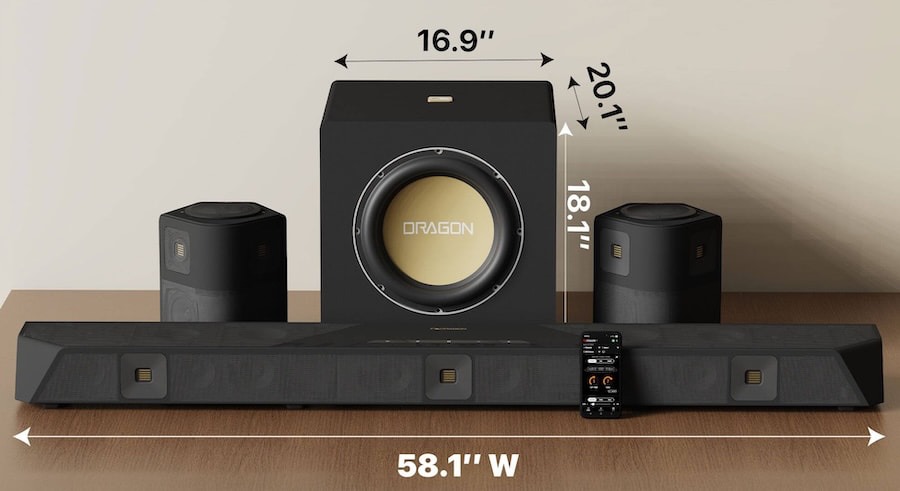
The Nakamichi 11.1.6 Dragon soundbar delivers an absolute powerhouse home theater audio system featuring 28 total speakers, a massive 12-inch subwoofer, and up-firing surround modules. Retailing for $2,588 USD at Amazon and Best Buy, this high-end audio setup targets dedicated home theater enthusiasts and movie lovers who demand massive physical scale and uncompromised cinematic immersion without installing a traditional multi-component A/V receiver. When unboxing a system of this magnitude, the immediate realization sets in that home entertainment audio engineering has reached a distinct hardware crossroads where standard single-bar solutions no longer suffice for large residential spaces.
🛒 Where to Buy: Nakamichi
- Nakamichi: View on Amazon
Click the link above to check current pricing, availability, and customer reviews on Amazon.
Analyzing the manufacturer spec sheet reveals a system built entirely around extreme performance metrics. Nakamichi rates the total power output at a staggering 3,000 watts. This massive wattage feeds a sprawling physical footprint that includes a 58-inch wide main soundbar housing 17 discrete drivers. According to technical documentation published with this release, the hardware array incorporates four dedicated up-firing drivers for height effects alongside three 1.5-inch air motion transformer tweeters. In the real world, hardware of this magnitude requires careful spatial planning before unboxing, forcing users to measure their entertainment centers twice over. Initial product disclosures and hardware reporting were tracked via Ecoustics, setting off a wave of anticipation across enthusiast forums.
Core Disclosure & Hardware Announcement
The Nakamichi 11.1.6 Dragon soundbar represents a massive shift in all-in-one home theater design. Retailing for $2,588 USD at Best Buy, the system is engineered specifically for consumers with large living spaces and equally large television displays. The core package consists of the main 58-inch soundbar, a colossal 12-inch subwoofer, and two dedicated wireless surround speakers. This setup bypasses traditional multi-channel separate amplifiers while attempting to deliver equivalent spatial scale for high-end movie soundtracks, DTS:X Pro mixing environments, and Dolby Atmos cinematic content.
Hardware reality sets in the moment the delivery boxes arrive at your doorstep. The main soundbar alone weighs more than 32 pounds and spans 58 inches across, demanding a substantial media console just to sit safely without sagging. Meanwhile, the heavy-duty subwoofer tips the scales at roughly 80 pounds and extends nearly 18 inches deep, requiring absolute floor stability and rubber isolation pads to prevent structural resonance throughout the home. This is not a plug-and-play soundbar designed to disappear beneath a modest bedroom television. It is a heavyweight consumer electronics installation that requires two people to position correctly, hook up safely, and calibrate over several hours of intensive testing.
Examining the physical layout of the main soundbar reveals an intricate alignment of acoustic chambers. Nakamichi has split the 17 drivers inside the primary enclosure to manage left, center, right, and wide channels efficiently. The inclusion of dual symmetrically spaced up-firing drivers on the top deck of the soundbar aims to bounce audio waves off flat ceilings, creating an overhead canopy of sound. However, unlike modular systems that rely on smart calibration apps to map room anomalies automatically, the Dragon demands a hands-on approach. Users must manually determine ceiling heights, listening distances, and surround angles using the physical remote and the legacy-style on-screen display interface connected via HDMI.
Manufacturer Claims vs. Engineering Reality
Nakamichi markets the Dragon as a 3,000-watt sonic behemoth capable of filling any residential room with concussive audio. On paper, the sheer driver count supports this ambitious power claim. In practice, however, raw wattage requires strict calibration to prevent domestic chaos. Examining the fine print of the hardware documentation reveals that the low-end frequency response is tuned heavily out of the box. In a standard medium-sized room, the default subwoofer volume setting is overwhelmingly aggressive and easily rattles window glass, wall art, and light fixtures during action sequences. Dialing down the gain is mandatory for sensible daily viewing.
The engineering trade-offs extend past the low-end punch into the midrange and high frequencies. While the three 1.5-inch air motion transformer tweeters deliver exceptional dialogue clarity even during chaotic cinematic battles, the overall sound signature leans thin and tightly wound. Official marketing emphasizes cinematic immersion, but the hardware lacks the full-bodied warmth found in traditional separate bookshelf speakers or even rival premium soundbar packages. Audio purists listening to complex musical tracks will immediately notice this clinical, forward presentation. String sections and acoustic guitars lack rich harmonic resonance, sounding somewhat analytical rather than emotionally engaging.
When testing dynamic range with blockbuster test scenes featuring heavy explosions and whispered dialogue simultaneously, the unit maintains admirable composure. The center channel separation prevents dialogue from getting drowned out by the thunderous LFE track generated by the 12-inch subwoofer. Yet, pushing the master volume past 75 percent introduces slight harmonic distortion in the upper mids, suggesting that while 3,000 watts of peak power is available on tap, continuous sustained playback at reference levels pushes the internal amplification close to its thermal limits.
Under the Hood: Technical Architecture and Build Quality
The acoustic architecture relies on an 11.1.6-channel configuration utilizing 28 individual speaker drivers across the entire kit. The main bar contains 17 drivers, while each wireless surround speaker packs two additional 1.5-inch AMT drivers, two 3.5-inch drivers for side and rear surround duties, and a 3-inch up-firing driver. Nakamichi even provides a physical top-mounted dial on the surrounds that lets users manually adjust the angle of the up-firing height drivers to match unusual seating arrangements. Despite this clever mechanical feature, the plastic build quality of the surround speakers feels a bit underwhelming given the steep price point, lacking the brushed aluminum or heavy-duty grilles found on competing flagship setups.
Connectivity options are extensive, featuring three HDMI 2.1 inputs, one HDMI eARC port, optical connections, and Bluetooth 5.0 with aptX HD support. Surprisingly, the engineering team omitted onboard Wi-Fi entirely. This means popular streaming protocols like Spotify Connect and Apple AirPlay are missing out of the box, forcing users to route music streaming through an external streamer, Apple TV, or connected gaming console. System configuration relies heavily on an old-school infrared remote control paired with an on-screen display interface that looks pulled straight from a legacy A/V receiver. There is no companion smartphone app for fine-tuning, and the system lacks automatic room calibration, meaning users must manually input room measurements or select preset dimensions to optimize the soundstage.
Delving deeper into the rear panel layout, the inclusion of three full-bandwidth HDMI 2.1 ports ensures that high-refresh-rate gaming consoles and 4K media players pass through video signals up to 120Hz without lag or compression artifacts. This makes the unit a formidable companion for PlayStation 5 and Xbox Series X owners who want uncompromised video passthrough alongside immersive spatial audio. Nevertheless, the lack of an Ethernet port or wireless networking stack represents a glaring omission for a device commanding nearly $2,600, limiting firmware updates to USB thumb drives rather than reliable over-the-air downloads.
Verified Market Alternatives
For buyers weighing the high cost and physical bulk of the Nakamichi Dragon, several established market alternatives offer different balances of simplicity and acoustic warmth. Shoppers prioritizing a clean, app-driven hardware environment can look toward the Sonos Arc Ultra soundbar priced at $1,099 USD on Amazon, paired with a Sonos subat $899 USD and individual Sonos Era 300surround speakers at $499 USD each. While this modular Sonos configuration approaches a comparable total investment, it provides reliable Wi-Fi streaming, automated Trueplay room tuning, and a much warmer, more refined musical presentation for daily listening without requiring a master’s degree in acoustic measurement.
Alternatively, home theater enthusiasts seeking traditional component flexibility can bypass soundbars entirely. Building a separates rig using an A/V receiveralongside bookshelf and floorstanding speakers from specialized acoustic brands like Klipsch+Speakers” target=”_blank” rel=”noopener”>Klipsch, Polk, or SVSoffers superior midrange warmth and upgradability for a similar budget. Component setups allow owners to replace failing amplifiers or upgrade individual speakers over time, a luxury that an all-in-one soundbar hardware environment simply cannot match once technology standards shift.
Another strong all-in-one competitor is the Samsung HW-Q990Dsoundbar system, which delivers robust Dolby Atmos immersion, a more balanced musical sound signature, and complete app integration at a significantly lower price point than Nakamichi’s flagship entry. The Samsung system includes rear wireless speakers and a capable subwoofer while offering automated space-fitting sound calibration that analyzes room reflections in seconds. For most households, the Samsung package hits the sweet spot between plug-and-play convenience and cinematic power, leaving the Nakamichi Dragon as an ultra-niche option reserved strictly for enthusiasts with large dedicated media rooms.
Final Editorial Verdict: Long-Term Reliability Outlook
The Nakamichi 11.1.6 Dragon soundbar succeeds brilliantly at what it sets out to do: delivering unearthly bass, pinpoint overhead height effects, and visceral cinematic immersion for large-screen home theaters. If your primary goal is recreating a commercial movie theater experience with maximum physical impact, this hardware delivers in a very big way. However, the lack of modern Wi-Fi connectivity, the absence of automatic room calibration, and a thin, forward sound signature make it a tough recommendation for general music listening or casual everyday use.
Long-term reliability for heavy-duty amplification and massive subwoofer drivers is generally solid, but setting up this system requires patience and manual calibration expertise. Audiophiles and music lovers will find a better return on investment by assembling a traditional component system or opting for a more versatile, app-enabled soundbar hardware environment. Skip it if you value streaming convenience and midrange warmth. Buy it only if you have a massive room, a giant television, and an unyielding appetite for window-shaking bass that tests the structural integrity of your home.