

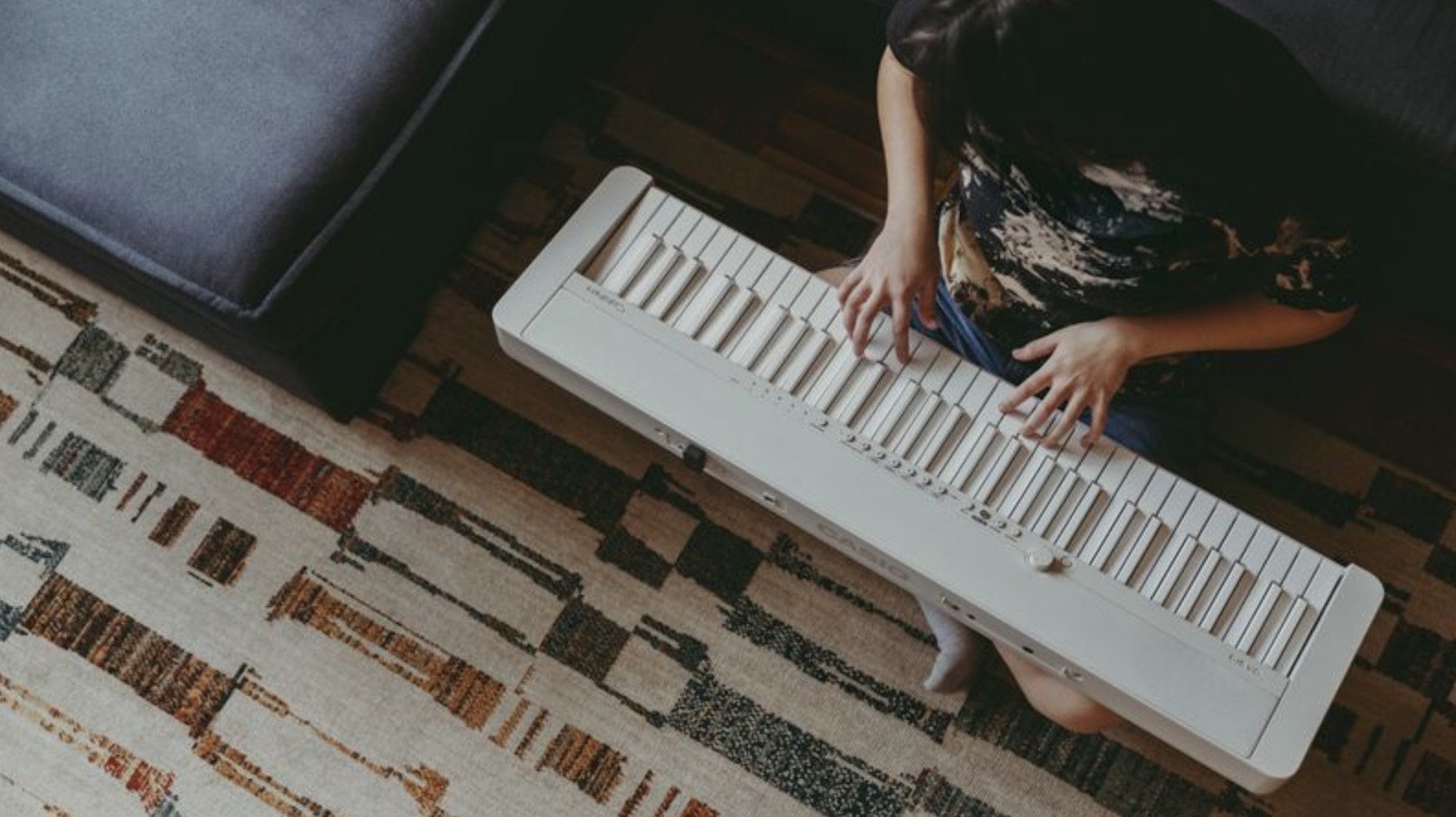
The Casio CT-FS1is a 61-key portable electronic keyboard featuring real-time hardware pitch quantization powered by Casio’s proprietary Feel Sync technology. Retailing for $400.00 USD directly from Casio and through major retailers like Amazon, this compact instrument is designed specifically for novice recreational players, content creators seeking an approachable desktop melody tool, and home office professionals wanting an accessible musical break between work tasks. By pairing physical keyboard hardware with algorithmic song analysis, the device restricts active pitch outputs to key-appropriate intervals regardless of which physical key the user depresses.
🛒 Where to Buy: Casio CT-FS1 Keyboard
- Casio CT-FS1 Keyboard: View on Amazon
Click the link above to check current pricing, availability, and customer reviews on Amazon.
Historically speaking, electronic instrument manufacturers have struggled to bridge the gap between absolute beginners and fluid musical expression. Where conventional keyboards demand months of tedious scale memorization before a user can play along with commercial audio tracks, the CT-FS1 offloads harmonic constraints entirely to software. The distinction matters here: rather than functioning purely as an automated playback device, the keyboard forces the player to govern rhythm, velocity, and expression while hardware logic handles pitch correction. In practice, this architectural shift redefines the entry-level keyboard experience from rigid academic instruction to immediate rhythmic engagement.
Upfront Investment & 2-Year Total Cost of Ownership
At an entry price of $400.00 USD, the CT-FS1 occupies a distinct mid-tier positioning within the compact keyboard market. The base purchase includes the 61-key monochrome hardware unit, an AC power adapter, and access to the dedicated Feel Sync companion software application. Unlike software-subscription-heavy digital audio workstations or app-tied learning eco-systems, Casio has avoided lock-in monthly recurring software fees for the core pitch-filtering engine. However, calculating the true 2-year total cost of ownership requires factoring in auxiliary accessories and power management choices necessary for daily desktop deployment.
For users prioritizing mobile operation, the keyboard runs on 6 AA batteries. Under typical daily operating conditions of one hour of playback at moderate volume, a standard set of alkaline cells lasts approximately 16 hours. Over a 2-year lifecycle, reliance on disposable batteries adds roughly $80.00 USD to $120.00 USD in operational costs, making the purchase of a rechargeable NiMH battery kit (approximately $30.00 USD) or consistent use of the included 9.5V DC power supply an economic necessity. Furthermore, because the Feel Sync app requires a connected smartphone or tablet to perform real-time harmonic extraction, users will likely need a dedicated tablet stand or USB-C cable adapter, adding approximately $25.00 USD to $40.00 USD to the initial setup expense. Consequently, the realistic 2-year total cost of ownership settles at approximately $455.00 USD.
What You Actually Get: Core Features & Build Specs
Unboxing the CT-FS1 reveals a striking, minimalist physical design that deviates sharply from traditional portable keyboards. The chassis weighs under ten pounds at precisely 9.9 lbs (4.5 kg) and measures roughly 36 inches in width, making it exceptionally easy to stow beside an office desk or transport between rooms. Casio offers the unit in two strict monochrome finishes: an entirely matte black version with blacked-out keytops, and an entirely matte white version with stark white keytops. While visually distinctive, this design choice represents a calculated engineering trade-off; the lack of color contrast between traditional natural keys and accidental keys requires muscle memory or reliance on touch feedback rather than immediate visual orientation.
Under the hood, the CT-FS1 houses a 61-key touch-responsive keybed with full-size synth-action keys. Sound reproduction is handled by an internal stereo speaker system paired with an integrated spatial surround effect algorithm. Physical connectivity includes a 3.5mm headphone output for private practice, a 3.5mm auxiliary audio input, a USB micro-B or USB-C host port for MIDI transmission, and integrated Bluetooth connectivity for wireless audio streaming and data sync with external devices. According to reporting on the product dispatch, the keyboard’s internal engine carries a wide assortment of PCM instrument tones ranging from classic acoustic grand pianos to vintage electric pianos and modern synthesizer pads.
The core technological innovation lies within the Feel Sync architecture. When a user loads an audio track into the proprietary Feel Sync application on a paired mobile device, the software’s algorithm analyzes the track’s tonal center, chord progressions, key changes, and structural bridges. The application then communicates in real time with the keyboard’s internal sound generator, remapping physical key strikes to the mathematically correct scale notes of the song currently playing. Notably, the keyboard also supports a dual-zone split mode. This configuration allows a beginner to trigger quantized, error-free rhythmic fills on one half of the keybed while a instructor or more experienced musician plays uncorrected, literal pitch values on the other.
From an educational perspective, this approach marks a notable evolution over early consumer keyboard learning aids. This is not the industry’s first attempt at lowering the barrier to entry for novice keyboardists; historically speaking, Casio’s own LK-series key-lighting keyboards from the late 1990s and early 2000s, such as the Casio LK-40, attempted to guide beginners by illuminating red LEDs underneath individual keycaps. That prior generation largely failed to foster real musical proficiency because students developed a visual latency habit—waiting for lights to flash rather than internalizing temporal rhythm and musical phrasing. The CT-FS1 corrects this pedagogical flaw by eliminating pitch penalties entirely, forcing the user’s brain to concentrate strictly on cadence, dynamics, and timing.
Hidden Costs, Ecosystem Dependencies & Fine Print
While the hardware proposition is straightforward, examining the fine print of the official technical documentation published with this release reveals several operational dependencies that prospective buyers must consider. Primary among these is the complete reliance on an external smart device running the Feel Sync mobile app for full functionality. The physical keyboard instrument panel lacks a multi-line graphic LCD display, offering only minimal tactile controls for volume and core power. Consequently, deep parameters—such as custom tone editing, detailed key-split points, and track analysis management—require an active wireless or wired link to an iOS or Android device. Should a user’s mobile device lack sufficient processing power, real-time track analysis may suffer from latency delays during complex musical passages with rapid key modulations.
Another practical consideration involves audio routing latency over wireless connections. Although the CT-FS1 features integrated Bluetooth connectivity, playing real-time pitch-quantized notes over Bluetooth Audio introduces inherent wireless latency that can disrupt rhythmic accuracy. To achieve imperceptible latency during fast playback, users must connect their mobile device via a direct wired USB cable, which may necessitate buying specialized OTG host adapters not included in the retail box. Furthermore, while the monochrome keybed creates a clean aesthetic suitable for modern minimalist office setups, low-light environments render the key boundaries difficult to discern, particularly on the all-black model.
Smarter Alternatives at This Price
Prospective buyers evaluating the $400.00 USD CT-FS1 should examine rival instruments in the portable keyboard market, as alternative products offer different trade-offs between automated guidance, sonic flexibility, and physical key action.
The Yamaha EZ-300retails for $299.99 USD on Amazon and represents the modern continuation of light-guided keyboard instruction. Featuring 61 touch-sensitive light-up keys, 622 high-quality instrument voices utilizing Yamaha’s AWM Stereo Sampling, and an onboard lesson system, the EZ-300 provides a structured, traditional path toward reading sheet music and finger placement. Unlike the CT-FS1, which dynamically alters pitch outputs to ensure zero wrong notes, the EZ-300 requires the student to press the correct illuminated key to advance the song. For buyers who prioritize conventional music literacy and standard keybed aesthetics over real-time pitch quantization, the Yamaha EZ-300 delivers superior built-in sound quality and a lower upfront investment, though it lacks the CT-FS1’s sleek monochrome form factor and custom song analysis capabilities.
Alternatively, the Roland GO:KEYS 3is available for $349.99 USD on Amazon and targets creative players focused on sound design and modern music production. Powered by Roland’s flagship ZEN-Core synthesis engine, the GO:KEYS 3 offers over 1,000 professional-grade sounds, built-in chord loopers, dynamic auto-accompaniment, and comprehensive Bluetooth audio/MIDI integration. While it does not include a pitch-correcting safety net like Casio’s Feel Sync technology, Roland’s offering provides significantly richer synthesizer tones, robust audio editing parameters, and dual stereo speakers that easily outperform the speaker output of the CT-FS1. Beginners intent on learning traditional keyboard technique alongside electronic music production will find the Roland GO:KEYS 3 to be a more versatile, long-term instrument, whereas absolute novices seeking immediate jam satisfaction without technical frustration will prefer the Casio engine.
Final Buyer Verdict: Is the Investment Worth It?
The Casio CT-FS1succeeds as a specialized, low-friction entry point into musical execution. By leveraging algorithm-driven pitch quantization via the Feel Sync app, Casio effectively removes the primary psychological barrier to instrument practice: the fear of sounding dissonant. The lightweight 9.9 lb frame, battery power flexibility, and clean monochrome aesthetic make it an attractive addition to a home office or creative workspace where traditional music hardware might look out of place. For adults who want to play along with their favorite streaming playlists, practice rhythmic timing without formal music theory, or engage in casual stress-relief sessions between work tasks, the CT-FS1 justifies its $400.00 USD asking price through sheer accessibility.
However, serious students aiming to develop traditional piano technique, sight-reading skills, or unassisted live performance capabilities should look elsewhere. The hardware pitch correction, while effective for casual play, can act as a crutch that delays the development of proper scale muscle memory. Furthermore, users who demand high-fidelity piano sampling or deep physical parameter controls without relying on an external smartphone screen will be better served by traditional alternatives like the Yamaha EZ-300or Roland GO:KEYS 3. The CT-FS1 is ultimately a niche product—a well-engineered, aesthetically bold tool designed for casual expression rather than classical mastery.