

Real-World Context and Target Buyer Profile
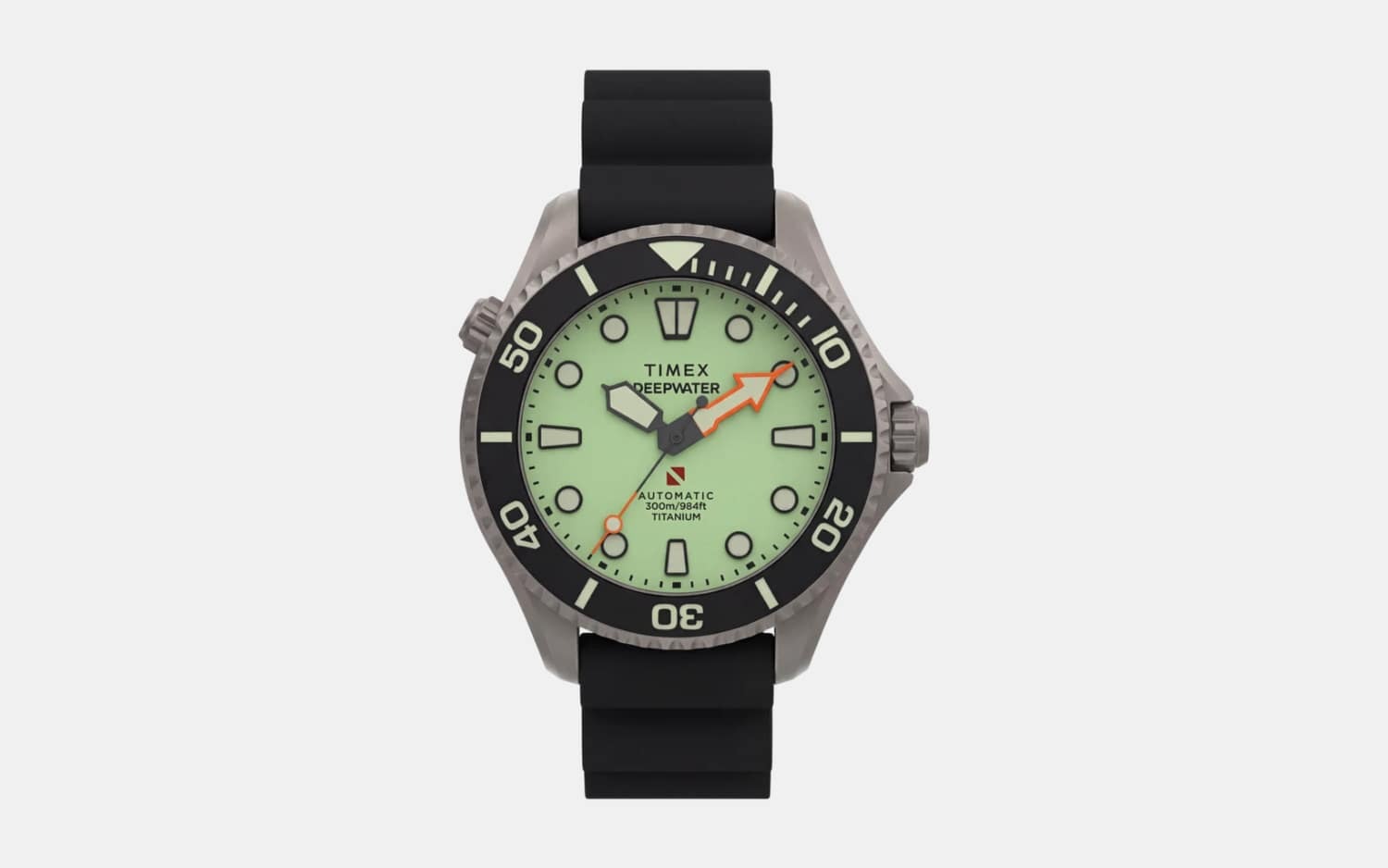
The Timex Deepwater Meridian 300 Titanium HEV Automatic is a robust mechanical dive watch built around a 44mm titanium chassis, retailing for $999 USD via GearMoose and authorized retail channels. It is engineered explicitly for recreational and technical saturation divers, maritime professionals, and mechanical watch collectors seeking professional-grade specifications from an unexpected heritage brand without entering luxury-tier pricing. Historically speaking, Timex has spent the past several years aggressively pushing past its quartz-driven mass-market origins into serious mechanical territory, and this piece represents the firm’s most ambitious hardware undertaking in the professional sub-aquatic category to date. Beyond the baseline specs, the device targets an audience that evaluates wristwatches strictly through a lens of pragmatic utility, scrutinizing weight distribution, bezel grip, and dial legibility under adverse conditions rather than relying purely on historical brand prestige.
🛒 Where to Buy: Timex Deepwater Meridian
- Timex Deepwater Meridian: View on Amazon
Click the link above to check current pricing, availability, and customer reviews on Amazon.
Positioned squarely in the sub-thousand-dollar tool watch category, this model addresses a demanding demographic that typically demands high-end metallurgy, reliable automatic movements, and credible depth ratings. The distinction matters here because mechanical divers at this price point are frequently compromised by excessive weight, sub-par illumination, or decorative components that fail under pressure. By outfitting the Deepwater Meridian with specialized pressure-management hardware and high-grade materials, Timex is directly courting enthusiasts who value utility over brand prestige, presenting a compelling option for those who require a dependable instrument for maritime exploration or heavy-duty field use. When taking the hardware into aquatic environments, users quickly notice how the brand has shifted away from lifestyle accessories toward genuine functional gear. The structural integrity of the case, the choice of dial treatments, and the robust assembly of the internal components all point toward an intentional design philosophy that prioritizes longevity and survival in unforgiving environments over mere aesthetic conformity.
To further understand the appeal of this timepiece, one must analyze how modern buyers approach the thousand-dollar threshold for mechanical watches. Historically, consumers entering this bracket expect Swiss or Japanese provenance with impeccable finishing. Timex leverages its immense heritage while throwing down a bold challenge to traditional microbrands. The watch does not try to be a subtle dress diver that slips under a tight cuff; instead, it proudly displays its industrial lineage. The matte titanium surfaces absorb light rather than reflecting it, signaling to anyone familiar with technical gear that this instrument is built for operational duty rather than cocktail parties. This calculated focus on raw, unfiltered capability forms the cornerstone of the target buyer profile, attracting individuals who appreciate over-engineered solutions to everyday mechanical challenges.
Hardware Engineering, Materials, and Core Specs
Examining the fine print of the hardware documentation reveals a remarkably stout specification sheet. The defining structural element is the 44mm case fabricated entirely from lightweight titanium, a material choice that successfully mitigates the heavy wrist fatigue commonly associated with stainless steel divers of comparable physical dimensions. Integrated into the case architecture is a functional helium escape valve (HEV), an essential engineering inclusion for saturation diving that allows trapped helium gas to safely equalize during decompression phases. Furthermore, the watch boasts an impressive 300 meters of water resistance, ensuring it can handle demanding recreational and professional underwater environments with ease. The machining of the titanium case exhibits crisp lines, sharp chamfers on the lugs, and an overall execution that punches well above previous efforts from the brand.
Propelling the timepiece is a Japanese Miyota 8215 automatic movement, a reliable mechanical workhorse providing a 40-hour power reserve. Surrounding the dial is a unidirectional ceramic-inlay bezel that offers crisp, tactile feedback and scratch resistance during timing tasks. The dial itself is protected by an anti-reflective sapphire crystal, paired with a screw-down crown to maintain hermetic integrity. Notably, this iteration features a fully luminous green dial treated with Nemoto LumiNova SG2200 compound, delivering exceptional legibility in dark environments. A perforated HNBR synthetic rubber strap completes the ensemble, providing inherent resistance to water, heat, and ultraviolet degradation. Every element of the hardware architecture has been meticulously chosen to withstand corrosive saltwater exposure, heavy impact, and the continuous thermal shocks experienced during professional diving operations.
A deeper dive into the technical specifications reveals the thoughtful engineering behind the structural layout. The 44mm diameter is complemented by a substantial lug-to-lug distance, which ensures the device sits securely across the wrist without excessive lateral sliding during dynamic movements. The titanium alloy utilized for the outer shell provides an exceptional strength-to-weight ratio, ensuring that the watch resists scratching and denting far better than standard grades of stainless steel while keeping overall ounces to a minimum. The screw-down crown features deep knurling, allowing for effortless manipulation even when wearing thick neoprene gloves. Inside this secure housing, the Miyota caliber operates at a standard 21,600 vibrations per hour, offering a field-serviceable architecture that any competent watchmaker can maintain anywhere in the world without requiring proprietary factory servicing tools.
Everyday Usability & Design Compromises
In practice, the 44mm titanium chassis strikes an effective balance between wrist presence and daily wearability, though its sheer footprint demands a wrist of moderate-to-large proportions. The lightweight nature of titanium prevents the watch from feeling overly burdensome during extended wear, distinguishing it favorably from heavier steel alternatives. However, the inclusion of a helium escape valve introduces a specialized protrusion that serves little purpose for desk divers or casual weekend wearers, acting as a visual reminder of the watch’s hyper-specific design brief. While the HNBR synthetic rubber strap is flexible and waterproof, its perforated aesthetic leans heavily into aggressive tool-watch territory, which may limit its versatility when paired with formal attire. Users who prefer a seamless transition from the boardroom to the ocean will find that the unapologetically industrial aesthetic requires a casual or technical wardrobe.
The Miyota 8215 movement is a proven, easily serviceable mechanical caliber, though enthusiasts should note its unidirectional winding rotor and lack of a hacking seconds function, which can exact a toll on precise time-setting procedures. When the rotor spins freely in its unweighted direction, wearers will occasionally feel a slight wobble on the wrist, a well-documented characteristic of this specific movement family that some collectors find charmingly utilitarian while others view as a minor refinement compromise. On the other hand, the ceramic bezel clicks with reassuring precision across its 120-click track, and the Nemoto LumiNova SG2200 treatment ensures that low-light readability is never an issue. The engineering trade-off here is clear: Timex has prioritized raw mechanical utility and rugged field durability over delicate refinement, meaning everyday users must accept a few industrial compromises in exchange for genuine diving credentials.
Analyzing the daily tactile experience further highlights the pragmatic nature of this instrument. The sapphire crystal is treated with internal anti-reflective coating, successfully cutting down on harsh glare under direct midday sunlight, ensuring the time can be checked at a glance. The fully luminous green dial charges rapidly under natural or artificial light sources, emitting a vivid, long-lasting glow that easily persists through the dark hours of the night. Despite the large case dimensions, the ergonomic contouring of the case back allows the unit to rest comfortably against the skin, avoiding any sharp digging points around the wrist bones. While the absence of a hacking mechanism means setting the exact second requires minor dexterity tricks with the crown, the sheer reliability of the movement ensures that once calibrated, it maintains exceptionally stable daily rates across varying temperature ranges.
Category Alternatives and Value Comparison
When evaluating the Deepwater Meridian 300 within the broader landscape of mechanical dive watches, it faces stiff competition from established microbrands and traditional Swiss heritage houses. For instance, the Seiko Prospex Turtle— typically retailing around $525 USD on Amazon — offers legendary in-house automatic reliability and a comfortable cushion case, though it relies on standard stainless steel and lacks specialized features like a helium escape valve. Buyers evaluating Japanese mechanical movements will find Seiko’s automatic calibers comparable in day-to-day performance, even if the metallurgy and saturation-diving hardware lean heavily in Timex’s favor. The Seiko alternative represents a softer, more traditionally styled vintage approach, whereas the Timex embraces a modern, high-tech industrial aesthetic that appeals directly to fans of contemporary tool watches.
Stepping up in price introduces options such as the Christopher Ward C60 Trident Pro 300, which commands roughly $1,095 USD direct from the manufacturer. The Trident counters with superior finishing, a Swiss Sellita automatic movement, and a more versatile everyday aesthetic, but it misses out on the featherlight titanium construction and industrial HEV hardware found on the Timex. This pricing dichotomy illustrates the strategic positioning of the Deepwater Meridian; it asks buyers to invest nearly a thousand dollars in a brand historically known for inexpensive quartz pieces, relying entirely on its superior titanium build and specialized specifications to justify the cost. Additional competitors in this bracket include offerings from brands like Certina and Mido, which provide Swiss mechanical calibers and ISO-compliant dive ratings, yet they often stick to heavier stainless steel construction rather than the advanced grade of titanium utilized here.
Weighing these alternatives side-by-side demonstrates that the choice ultimately boils down to specific feature priorities. If a buyer values Swiss pedigree and ultra-refined case polishing above all else, alternatives from Christopher Ward or Mido present strong arguments. However, for enthusiasts specifically hunting for a full titanium build, an integrated helium escape valve, a high-performance ceramic bezel, and a striking fully-luminous dial layout under the thousand-dollar mark, the Timex carves out a unique niche that very few competing brands can successfully replicate. The value proposition here is not rooted in brand snobbery or luxury status markers; rather, it is anchored entirely in raw hardware density, specialized engineering features, and the tangible comfort of lightweight titanium construction.
Final Buyer Verdict: Long-Term Ownership Value
Ultimately, the Timex Deepwater Meridian 300 Titanium HEV Automatic demonstrates how far the brand’s manufacturing capabilities have evolved in recent years. At $999 USD, it represents a significant financial commitment for a timepiece bearing the Timex logo, yet the underlying hardware — spanning lightweight titanium metallurgy, a ceramic bezel, 300 meters of water resistance, and robust Nemoto luminescence — delivers legitimate value for serious enthusiasts. It bridges the gap between affordable field watches and professional saturation equipment without cutting corners on essential sub-aquatic functionality. Over extended periods of ownership, the scratch-resistant properties of the ceramic insert and the corrosion-resistant nature of the titanium case ensure that the hardware maintains its rugged appearance even after sustained exposure to harsh elements.
For collectors and maritime enthusiasts willing to look past traditional brand perception, this titanium diver offers a durable, highly capable mechanical package that punches well above its weight class. While the 44mm footprint and tool-centric design language will not suit every wrist or wardrobe, those who prioritize honest engineering and specialized dive specifications will find a remarkably capable daily companion. It is a confident, well-executed statement piece that firmly establishes Timex as a serious contender in the modern mechanical dive watch category. Long-term durability is further supported by the easily serviceable nature of the Miyota movement, ensuring that future maintenance remains straightforward and cost-effective, cementing the timepiece as a dependable tool for decades of adventurous use.