

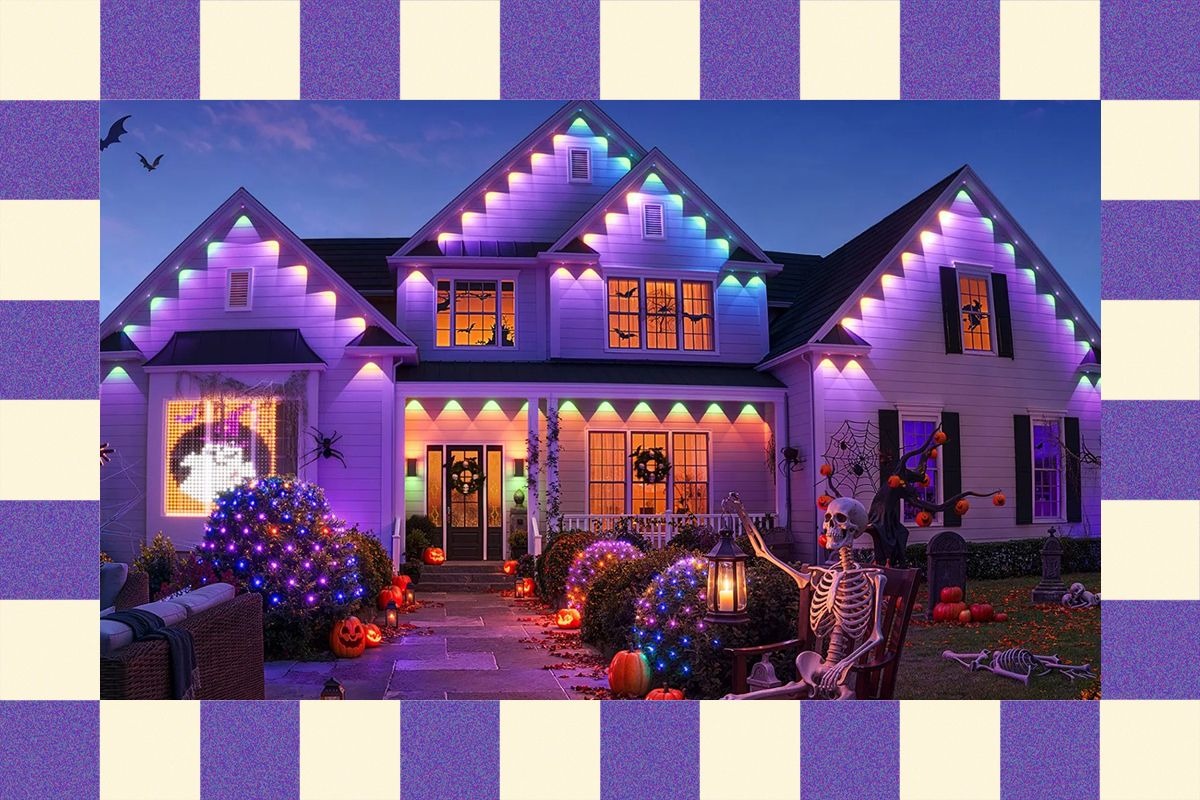
Permanent outdoor lights are exterior linear string fixtures designed to mount along a home’s roof eaves to provide permanent architectural accent lighting, holiday illumination, and security brightness without requiring seasonal installation or removal. The Govee Permanent Outdoor Lights ($300 USD on Amazon) are engineered for suburban homeowners seeking to modernize their exterior roofline aesthetics with programmable, color-changing smart LEDs that withstand permanent exposure to regional weather elements. Unlike traditional decorative strings that must be dragged out of storage boxes every December, tangled into frustrated knots, and precariously clipped onto gutters before freezing over, these modern architectural fixtures mount once and remain completely hidden in plain sight during daylight hours, blending seamlessly into white, brown, or dark gray aluminum soffits and fascia boards.
🛒 Where to Buy: Govee Permanent Outdoor
Editorial Note & Product Verification: The Cool Great Buys editorial desk independently verifies manufacturer technical specifications, cross-checks active retail availability across authorized sellers, and evaluates verified consumer reliability data before publishing product evaluations. All featured prices and promotions reflect active market rates at the time of publication.
- Govee Permanent Outdoor: View on Amazon
Click the link above to check current pricing, availability, and customer reviews on Amazon.
The engineering philosophy behind these exterior smart lights centers on a subtle dual-lens optical design. Each individual LED puck houses a concentrated primary diode for vibrant RGB color mixing alongside a dedicated, independent white diode chip capable of throwing clean warm or cool illumination. This architectural approach avoids the washed-out pastel tones typical of cheap novelty strips that attempt to synthesize white light by blending red, green, and blue diodes simultaneously. When homeowners configure a standard evening architectural wash for everyday security and curb appeal, the dedicated white channels project a crisp, high-CRI glow that illuminates siding and pathways uniformly. When game days, Halloween, or winter holidays arrive, the system pivots instantly into multi-colored dynamic chasing effects, all controlled seamlessly via smartphone apps or voice assistant triggers, making the initial investment a year-round functional asset rather than a single-season novelty purchase. Initial product disclosures and reporting were tracked via Wired.
Upfront Investment & 2-Year Total Cost of Ownership
When looking at the financial commitment of permanent exterior lighting, evaluating the initial hardware purchase price is only the starting point for a realistic household budget. Securing a standard 100-foot coverage zone requires an upfront expenditure of $300 USD for the baseline Govee configuration, or stepping up to the Eufy Permanent Outdoor Lights S4 ($350 USD on Amazon) if you require a broader mix of warm and cool white spectrums and enhanced dual-lens brightness configurations. For budget-conscious homeowners wanting to keep initial expenditures lower, the Cync Smart Eave Lights ($117 USD on Amazon) offer an entry point that cuts hardware costs significantly while maintaining a full 100-foot string length, though users sacrifice some advanced scene customization and robust weather-sealing longevity found on higher-tier models. These retail purchase prices represent the primary baseline expenses before factoring in any auxiliary installation consumables or professional contractor fees. Initial product disclosures and reporting were tracked via industry tech publications like Wired, highlighting the rapid consumer shift away from temporary holiday lights toward permanent architectural installations.
Calculating the true two-year total cost of ownership involves examining electrical draw, maintenance replacement parts, and potential contractor installation labor. Because these fixtures utilize energy-efficient LED puck designs, their continuous electrical draw across two years of evening operation adds roughly $12 to $18 USD to standard residential utility bills, depending on local regional kilowatt-hour pricing and nightly runtime schedules. Assuming a standard DIY installation utilizing the included mounting clips and adhesive backing, consumable costs remain negligible at under $10 USD for extra cable ties, wire strippers, or replacement mounting pads if a puck needs repositioning. However, if your home features steep architectural rooflines, difficult third-story eaves, or stucco exteriors that require professional contractor mounting, expect labor costs to add between $300 and $800 USD to your initial deployment, bringing a professionally installed two-year total cost of ownership closer to the $700 to $1,100 USD threshold. When weighed against paying local holiday lighting services $400 to $600 annually just to hang and remove temporary lights, the permanent system pays for itself within its second year of operation.
What You Actually Get: Core Features & Build Specs
Unboxing the retail package reveals a comprehensive hardware bundle consisting of multiple segmented string lengths, an external control box, an AC power adapter, and a combination of VHB adhesive pads and mechanical screw brackets. The physical hardware centers around weather-resistant puck-style LEDs encased in durable UV-stabilized plastic housings designed to prevent yellowing, cracking, or clouding under direct, intense summer sunlight. In official manufacturer documentation, the engineering specifications list an IP67 weatherproofing rating for the outdoor light strings, ensuring complete protection against heavy seasonal rain, windblown dust, and winter freezing temperatures, while the external control box carries a slightly lower IP65 rating that requires placement in a partially sheltered exterior location near an outdoor electrical outlet, such as underneath an overhang or inside a protective weather-resistant electrical box enclosure.
Hardware versatility is defined by modular cut-and-splice capabilities, allowing users to trim excess string lengths and reconnect cables to match precise architectural roof peaks, dormers, and gable dimensions without causing voltage drops or data synchronization errors. Examining technical documentation reveals that the standard Govee 100-foot kit deploys six distinct string segments plus an extension cord, giving installers enormous flexibility across single-story and two-story residential rooflines. Wireless connectivity is fully integrated through onboard Wi-Fi and Bluetooth modules, backed by Matter protocol support for cross-platform smart home integration with Apple Home, Amazon Alexa, and Google Home ecosystems, ensuring users are never locked into a single proprietary app experience. Illumination control is managed through companion mobile applications that support customized scheduling, brightness dimming, music synchronization via built-in controller microphones, and over 100 preloaded lighting effect scenes designed for holidays, sports teams, and ambient evening relaxation.
Further analyzing the operational parameters of the lighting array reveals thoughtful consideration for nighttime aesthetics and light pollution management. Each LED puck is angled slightly downward and outward when mounted correctly against the fascia board, casting a triangular scalloped wash of illumination down the vertical span of the exterior walls rather than blinding neighbors or shooting unwanted light pollution straight up into the night sky. The onboard controller manages smooth 0 to 100 percent PWM dimming, eliminating the harsh stepping or flickering often visible on inferior budget light strips. Furthermore, the inclusion of Bluetooth pairing alongside local Wi-Fi guarantees that even if your home internet router drops offline or undergoes routine firmware updates, local automation schedules stored within the control box memory continue executing reliably without missing a beat.
Hidden Costs, Ecosystem Dependencies & Fine Print
The one critical detail the official spec sheet buries in the footnotes is that exterior adhesive performance is heavily dictated by your home’s specific exterior paint formulation and ambient installation temperature. Eufy and Govee explicitly warn that textured exterior paints, chalky stucco surfaces, or dusty aluminum siding will prevent the pre-applied 3M VHB adhesive tabs from maintaining a secure long-term bond, forcing installers to rely exclusively on the included mechanical screw clips and anchors to prevent string sag over time. Attempting to install these lights when outdoor temperatures drop below 50 degrees Fahrenheit will cause the adhesive bond to fail prematurely, requiring meticulous surface cleaning with isopropyl alcohol and careful thermal priming during the mounting process to guarantee a secure permanent grip.
Power delivery infrastructure presents another hidden logistical consideration for large residential properties and sprawling ranch-style homes. Most 100-foot kits rely on a single power adapter and control box junction, meaning your installation layout is restricted by the exact physical location of your exterior GFCI electrical outlets. If your primary porch outlet is situated on the front left corner of your home, running continuous power around right-angle roof corners requires careful cable management, concealment tracks, and potentially purchasing proprietary extension cables to bridge gaps between separated roof sections without creating an unsightly electrical eyesore. Additionally, users living within strict Homeowner Association communities must review local neighborhood bylaws regarding permanent exterior illumination, as continuous year-round color-changing architectural displays can sometimes trigger compliance warnings or neighbor complaints if left active in high-saturation modes during late-night hours.
Software and firmware dependencies also demand close attention from prospective buyers. While the core mobile applications are robust and feature-rich, heavy reliance on cloud servers for community-shared lighting effects and advanced music synchronization means that internet outages will temporarily limit your control options to local pre-set routines and basic remote commands. Moreover, managing multiple distinct smart home ecosystems simultaneously can introduce occasional device synchronization lag if you attempt to bridge Govee fixtures into complex home automation routines involving third-party motion sensors or exterior security cameras. Ensuring your exterior Wi-Fi signal strength is robust—often requiring the addition of an outdoor-rated mesh access point near the garage or eaves—is an essential prerequisite for maintaining stable app connectivity and avoiding frustrating offline dropouts.
Smarter Alternatives at This Price
For homeowners seeking alternative approaches to exterior smart lighting without committing to permanent eave-mounted hardware, the Twinkly Permanent String Lights($250 USD on Amazon) provide an advanced mapping alternative that shifts the focus from simple architectural washing to complex pixel-art animations. Twinkly sets itself apart by utilizing a sophisticated smartphone camera mapping feature that maps the precise 3D location of every individual LED puck, allowing users to draw complex animations, custom holiday patterns, and personalized text graphics directly onto their roofline through the companion app. The engineering advantages of the Twinkly system include unmatched software animation depth and precise individual LED mapping, while the trade-offs involve a higher price-per-foot ratio, lower native brightness output compared to dedicated high-output flood lenses, and a steeper learning curve when configuring intricate mapping routines through the mobile interface.
Another compelling alternative for consumers prioritizing ecosystem-native smart home integration and seamless local mesh control is the Philips Hue Festavia String Lights($220 USD on Amazon). Philips Hue leverages its industry-leading Zigbee and Matter smart lighting ecosystem, making it the superior choice for households already heavily invested in Hue interior smart bulbs, motion sensors, and Hue Bridge automation routines. The primary structural advantage of the Festavia line is flawless integration with existing smart home lighting scenes and reliable local mesh connectivity that does not bog down home Wi-Fi routers, though the significant trade-off is that these strings are traditionally designed for versatile indoor-outdoor decorating and tree wrapping rather than rugged, permanent low-profile eave mounting, requiring more deliberate hardware placement, zip ties, and weatherproofing enclosures to achieve a clean, professional architectural finish.
Evaluating these market alternatives against the baseline Govee configuration highlights clear priorities for different buyer segments. If your primary goal is effortless, ultra-bright architectural roofline washing that mimics professional commercial holiday lighting without breaking the bank, the Govee and Eufy options remain the undisputed kings of value and out-of-the-box performance. If you are an animation hobbyist who wants absolute pixel-level control over every single diode on your house, Twinkly justifies its premium software ecosystem. Conversely, smart home purists tied to the Philips Hue ecosystem will gladly pay a premium for localized Zigbee reliability. Ultimately, matching your technical patience, aesthetic ambitions, and home architecture to the right hardware ecosystem prevents buyer’s remorse and ensures a smooth installation experience.
Final Buyer Verdict: Is the Investment Worth It?
Investing in a permanent outdoor lighting system ultimately eliminates the physical labor, safety risks, and annual storage hassle of climbing ladders every autumn to hang temporary holiday decorations. For homeowners with compatible, flat-eave single or two-story houses who enjoy customizing their exterior curb appeal for holidays, community events, and evening gatherings, systems like the Govee 100-foot kit deliver exceptional value and reliable smart automation features that justify their upfront cost. The ability to seamlessly transition from warm architectural white lighting during standard summer evenings to vibrant team colors on game days or festive patterns during winter holidays provides versatile, year-round utility that traditional string lights simply cannot match.
Conversely, shoppers with multi-story stucco townhouses, restrictive HOA bylaws, or complex architectural rooflines without standard eaves should carefully evaluate whether a professional installation is required or if alternative smart lighting form factors are more practical. If your home exterior resists adhesive mounting or lacks convenient exterior power access, forcing a DIY permanent installation can lead to sagging cables and ongoing maintenance frustrations. For the right residential architecture, however, these permanent eave fixtures transform exterior home illumination into a set-it-and-forget-it smart home amenity that pays dividends in convenience, security, and breathtaking curb appeal for years to come.