

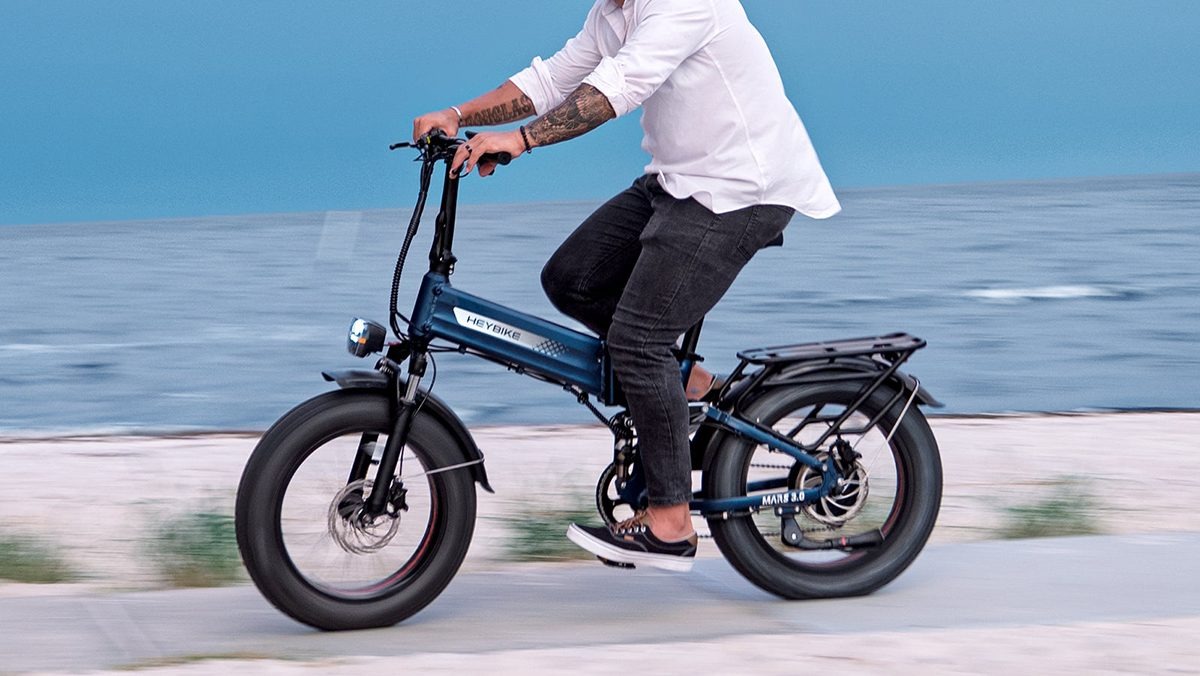
The Heybike Mars 3.0 Folding Full Suspension Fat Tire e-bike is currently on sale for $1,099 USD shipped directly from Heybike during its ongoing Fall Riding Sale. Built for urban commuters and off-road riders alike, this heavy-duty folding frame electric bike delivers high-torque hill climbing power paired with advanced security features for riders demanding utility and portability.
🛒 Where to Buy: Heybike Mars
Editorial Note & Product Verification: The Cool Great Buys editorial desk independently verifies manufacturer technical specifications, cross-checks active retail availability across authorized sellers, and evaluates verified consumer reliability data before publishing product evaluations. All featured prices and promotions reflect active market rates at the time of publication.
- Heybike Mars: View on Amazon
Click the link above to check current pricing, availability, and customer reviews on Amazon.
State of the Category & What Changed
The commuter electric bike landscape is shifting away from bare-bones rear hub setups toward sophisticated sensor-driven drivetrains. Manufacturers are upgrading entry-level platforms to include torque sensors, hydraulic braking, and integrated theft-deterrent hardware. Against this backdrop, Heybike restructured its pricing strategy for its flagship compact fat tire platform. Originally carrying a $1,799 USD MSRP, the brand instituted a permanent price cut down to a $1,199 USD MSRP. The current Fall Riding Sale shaves an additional $100 USD off that new baseline, landing the hardware at a new all-time low of $1,099 USD for buyers looking to secure heavy-duty personal electric transit. Initial product disclosures and reporting were tracked via 9to5toys.
This pricing adjustment repositions the Mars series firmly against mid-tier commuter offerings that lack full suspension or torque-sensing capability. Historical promotions for the preceding generation fluctuated between $1,499 USD and $1,199 USD, meaning the current markdown undercuts previous promotional ceilings by a wide margin. For daily commuters and weekend trail riders, the hardware now sits at an aggressive cost-to-performance ratio. Competing brands frequently charge upwards of $1,500 USD for similar multi-link suspension designs and high-capacity battery packs, making this direct-to-consumer reduction a significant market correction.
When analyzing how the personal electric vehicle market has matured over the past several years, buyers are no longer willing to tolerate crude, jerky throttle responses or basic mechanical disc brakes on machines crossing the thousand-dollar threshold. The mainstreaming of torque sensors has completely revolutionized the riding experience, replacing artificial cadence sensing with an intuitive proportional power delivery system that feels remarkably natural. Brands that fail to keep pace with these mechanical and electrical refinements find their legacy inventory sitting unsold on digital warehouse shelves. Heybike clearly recognized this shift, ensuring that their latest revision did not merely tinker with cosmetics, but rather overhauled the underlying drivetrain intelligence to compete directly with boutique urban commuters costing significantly more.
Furthermore, the broader economic climate has forced direct-to-consumer manufacturers to re-evaluate their profit margins in order to sustain volume sales in a competitive climate. By permanently lowering the retail anchor to $1,199 USD and layering on seasonal promotional incentives that pull the price down to $1,099 USD, the company effectively democratizes advanced utility features that were once locked behind premium paywalls. This pricing strategy impacts rival entry-level startups that rely on outdated, clearance-style marketing tactics without offering genuine technological upgrades. For consumers who have tracked the ebbs and flows of micromobility pricing over multiple product cycles, this represents one of the most compelling value propositions ever introduced for a full-suspension, high-payload folding utility platform.
Generational Delta: The Engineering Upgrades That Matter
Examining technical documentation published with this release reveals that the latest generation of Heybike’s popular Mars lineup brings substantial internal and structural revisions over its predecessor. The most notable architectural shift lies in the integration of the brand’s proprietary Galaxy Perform eDrive system. On paper, this system pairs a rear hub motor rated at 750W nominal output with a staggering 1,400W peak power rating. In the real world, that electrical capacity translates to an explosive 95 N·m of torque, fundamentally altering how the frame accelerates from a dead stop on steep urban inclines.
Beyond raw motor output, the inclusion of a responsive torque sensor replaces the jerky cadence-based pedal assist found on older budget models. Power delivery scales linearly with rider input rather than acting as an on-off switch. Energy is supplied by a robust 624Wh internal battery pack. According to manufacturer engineering claims, this pack supports a maximum assisted range of up to 65 miles under optimal conditions, while top-end speed reaches 28 MPH in unlocked settings. Structural capacity also expands significantly, yielding a maximum payload rating of 440 pounds to accommodate heavy cargo loads and diverse rider profiles.
Delving deeper into the physical construction of the chassis reveals a heavily reinforced aluminum frame designed to withstand the rigors of heavy daily usage and rough trail abuse. The dual-suspension layout utilizes a custom-tuned front hydraulic suspension fork paired with an adjustable rear shock absorber, effectively isolating the rider’s spine from bone-jarring potholes and jagged rocks. Braking performance has similarly received a major overhaul, trading traditional mechanical stoppers for responsive hydraulic disc brakes equipped with large rotors that shed heat efficiently during extended descents. These mechanical enhancements ensure that the vehicle handles predictably even when loaded down with groceries, camping gear, or heavy courier backpacks.
The cockpit electronics have also received thoughtful modernizations, highlighted by a crisp, high-visibility TFT color display that remains legible under direct sunlight. Integrated near-field communication (NFC) technology allows riders to tap a designated card or key fob to unlock the electronics, providing a layer of deterrent security against opportunistic thieves who might otherwise hop on and ride away. Ergonomic adjustments are plentiful, featuring a quick-adjust telescoping seatpost and handlebars that accommodate a wide spectrum of rider heights, ranging from shorter urban dwellers to tall off-road enthusiasts. Every contact point—from the ergonomic rubber grips to the plush, supportive saddle—has been optimized for long-distance comfort, ensuring that multi-hour weekend excursions do not result in physical fatigue or lower back strain.
Everyday Usability Trade-Offs & Adoption Barriers
Hardware reality dictates that packing a 750W motor, dual suspension linkages, and a heavy-duty folding mechanism into a single frame carries physical consequences. The bike is undeniably heavy, which complicates carrying it up apartment stairwells or hoisting it onto standard automotive hitch racks. While the folding frame design effectively reduces the unit’s overall footprint for trunk storage or garage organization, lifting a machine of this scale requires genuine upper body strength. Riders living in walk-up apartments without elevators should carefully weigh the physical burden of daily transit.
The integration of modern tech features also introduces potential points of failure over long-term outdoor use. The inclusion of a TFT display featuring near-field communication (NFC) startup security prevents unauthorized driveaways, but losing the physical key fob leaves the rider stranded unless a backup authentication method is programmed. Furthermore, while the 4-inch puncture-protected fat tires excel at smoothing out gravel paths and cracked pavement, they introduce noticeable rolling resistance and road hum on clean asphalt. Commuters prioritizing silent, effortless top-speed cruising on smooth bike lanes may find the heavy knobby treads excessive for daily pavement pounding.
Managing a machine of this mass in tight interior spaces demands careful spatial awareness. Navigating narrow elevators, tight apartment hallways, or office cubicle farms with a wide-handlebar, heavy-frame utility vehicle requires practice. The dual-hinge folding mechanism is robust, utilizing a secure locking lever with a secondary safety latch to prevent accidental mid-ride folding, but operating the hinge smoothly takes physical leverage. Users must ensure the hinges are kept clean and periodically lubricated to prevent grit accumulation from making the folding process stiff or sticky over months of dusty trail riding and wet-weather commuting.
Battery management is another practical consideration for daily riders. While the 624Wh power source provides ample juice for typical commutes, heavy throttle usage, aggressive hill climbing, and high-speed Class 3 riding will rapidly deplete the reserve capacity. Recharging from empty takes several hours using the included charger, meaning commuters who forget to plug the pack in overnight may face a strenuous pedal-powered journey home given the vehicle’s substantial weight. Additionally, while the integrated lighting system enhances nighttime visibility, the auxiliary illumination is primarily designed for being seen rather than illuminating unlit rural pathways at high speeds, prompting serious night riders to invest in supplemental handlebar-mounted headlamps.
Category Alternatives and Rival Solutions
For buyers evaluating the folding fat tire segment, the market offers several compelling alternatives with distinct engineering trade-offs. The Lectric XPeak2off-road e-bike represents a primary competitor, often bundled during seasonal promotions near the $1,299 USD mark. While Lectric relies on a stout frame geometry optimized for rugged terrain, it typically lacks the compact folding hinge mechanism found on the Mars platform, making the Heybike a superior choice for apartment dwellers with limited storage space.
Alternatively, riders willing to explore mid-drive configurations can look toward the Heybike ALPHA Mid-Drive All-Terrain e-bike, which offers superior weight distribution by centering the motor down at the bottom bracket. Shoppers purchasing alternative hardware through authorized channels can frequently leverage promotional codes such as 9TO5TOYS200 to offset initial acquisition costs. While mid-drive systems deliver natural hill-climbing dynamics, they generally command a higher price premium than rear hub alternatives like the Mars 3.0, illustrating the unique value proposition of the current $1,099 USD discount.
Expanding the competitive matrix further, several other direct-to-consumer brands offer comparable folding fat tire configurations, though they often compromise on critical sub-components to hit similar price points. Many entry-level rivals utilize mechanical cable-pulled brakes rather than the robust hydraulic systems found here, resulting in softer lever feel and frequent adjustment requirements. Others cut corners by retaining crude cadence sensors that deliver an abrupt, unnatural power surge the moment the pedals begin turning, creating a jarring experience for inexperienced riders navigating crowded city streets. By maintaining a torque-sensing drivetrain and hydraulic stoppers at an introductory price of $1,099 USD, the Mars 3.0 forces competing manufacturers to re-evaluate their own feature sets and profit margins.
Choosing between a folding hub-motor platform like this and a dedicated rigid-frame commuter ultimately hinges on individual lifestyle constraints. Riders who possess spacious suburban garages with ground-floor access might benefit from larger, non-folding cargo bikes featuring extended rear racks and dual battery capacities. Conversely, city dwellers, RV owners, and frequent travelers who need to stash their personal transit solution inside a compact car trunk, closet, or tiny apartment entryway will find that the space-saving utility of a rugged folding full-suspension design completely outweighs the minor logistical penalty of its heavier frame construction.
Final Trajectory Verdict: Future Outlook & Buying Advice
The Heybike Mars 3.0 successfully bridges the gap between utilitarian cargo capability and recreational all-terrain performance. By dropping the baseline price to $1,199 USD and discounting further to $1,099 USD during the Fall Riding Sale, the manufacturer addresses historical criticisms regarding pricing parity within the competitive fat tire sector. The addition of a responsive torque sensor, NFC security, and robust 95 N·m torque output provides tangible quality-of-life improvements that justify the hardware investment for daily commuters.
Buy it if you need a high-capacity, full-suspension folding e-bike capable of hauling heavy loads and tackling steep hills without breaking the bank. Skip it if your daily commute involves frequent stair climbing or tight indoor storage spaces where a heavy frame becomes a logistical hurdle. For the vast majority of suburban and urban riders seeking an all-weather utility vehicle at an all-time low price point, this current promotional window offers an ideal entry point into high-powered electric transit.
Looking ahead, the long-term trajectory of this product category points toward deeper software integration, standardized smart security features, and even more refined torque-sensing algorithms that seamlessly adapt to changing terrain without requiring manual mode switching. As direct-to-consumer brands continue to refine their supply chains and manufacturing tolerances, consumers reap the direct rewards through unprecedented performance-per-dollar ratios. Whether navigating congested metropolitan thoroughfares during morning rush hour or exploring remote dirt fire roads on a lazy weekend afternoon, having access to heavy-duty motor power, multi-link comfort, and reliable stopping hardware for just over a thousand dollars marks a major milestone in personal electric mobility evolution.