

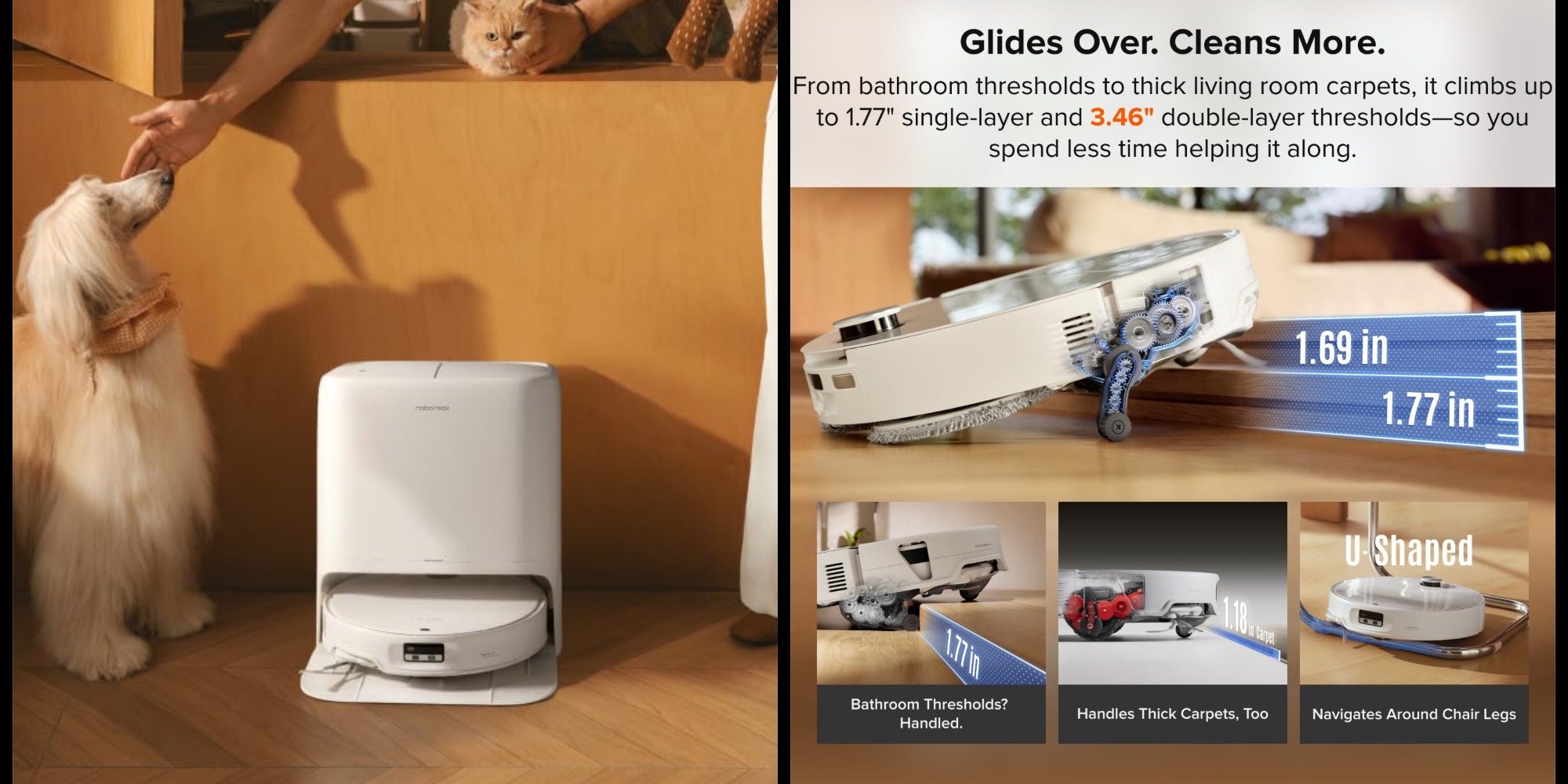
The Roborock Qrevo Edge 3 Pro Robot Vacuum and Mop has dropped to a significant all-time low price of $1,099.99 USD on Amazonas part of promotional Amazon early fall Prime Day deals, matching the current pricing from the brand’s direct website. This premium hardware package is built specifically for homeowners with mixed flooring who demand automated, hands-off maintenance for pet hair, dried spills, and heavy foot traffic.
🛒 Where to Buy: Roborock Qrevo Edge
Editorial Note & Product Verification: The Cool Great Buys editorial desk independently verifies manufacturer technical specifications, cross-checks active retail availability across authorized sellers, and evaluates verified consumer reliability data before publishing product evaluations. All featured prices and promotions reflect active market rates at the time of publication.
- Roborock Qrevo Edge: View on Amazon
Click the link above to check current pricing, availability, and customer reviews on Amazon.
When investing four figures into household cleaning automation, buyers naturally scrutinize every engineering decision to ensure the financial layout translates into genuine domestic convenience. Over the past several hardware generations, robotic cleaning appliances have evolved from novelty gadgets that bounce randomly off baseboards into sophisticated spatial computing units. Yet, despite these software advancements, the physical limitations of mechanical cleaning systems have remained stubbornly difficult to solve. Floors are inherently uncooperative landscapes featuring high-pile carpets, slippery hardwood planks, rigid stone grout lines, and irregular furniture layouts that challenge even the most advanced autonomous navigation systems available on the market today.
The Problem and Hardware Purpose
Automating household floor maintenance requires managing two fundamentally contradictory physical tasks: pulling dry particulate debris out of deep carpet fibers and scrubbing stubborn liquid residue off hard floors. Traditional hybrid robots often compromise on suction power or rely on static mop plates that merely drag moisture across tile and hardwood. The Roborock Qrevo Edge 3 Pro Robot Vacuum and Mopaddresses this core engineering challenge by combining a high-pressure suction motor with dynamically extending mechanical arms and dual spinning mop pads. Priced at $1,099.99 USD following a $400 reduction from its standard $1,500 MSRP, the unit targets households looking to eliminate manual sweeping and mopping cycles entirely. Initial product disclosures and reporting were tracked via 9to5toys.
The physical footprint of the cleaning unit is anchored by a massive 10-in-1 docking station that handles the dirty work once the robot finishes a run. This dock automatically empties dry dustbins, fills the internal water reservoir, dispenses cleaning solution, washes the mop pads with heated water, and dries them with warm air to prevent mildew. For busy professionals and pet owners, the hardware workflow shifts floor cleaning from a daily manual chore into a periodic maintenance task that only requires emptying the external waste water tank every few days.
Beyond the fundamental mechanics of sweeping and washing, the sheer volume of dust, dander, and biological contaminants found in modern homes demands a closed-loop containment strategy. Without automated emptying and sanitization, the traditional vacuum dock quickly becomes a foul-smelling incubator for bacteria and mold. The Qrevo Edge 3 Pro mitigates these hygiene concerns through high-temperature thermal washing cycles that break down oily residues on the microfiber pads, followed by continuous warm air circulation that leaves the textiles completely desiccated. This ensures that every subsequent cleaning cycle begins with sanitary, odor-free equipment rather than dragging yesterday’s liquefied kitchen grime across pristine dining room floors.
Engineering Architecture & How It Works
Under the hood, the internal mechanics represent a significant leap over previous generation devices. According to technical documentation published with this release, the suction system delivers a monstrous 36,000Pa of suction power. In the real world, this extreme static pressure pulls embedded pet hair and grit from deep inside woven rugs where lesser 20,000Pa machines leave debris behind. This high-output airflow works alongside dual zero-tangle roller brushes designed to channel hair toward the center collection port without wrapping around the axle.
Edge cleaning performance relies on mechanical articulation rather than software tricks alone. The unit utilizes FlexiArm technology to swing both the side vacuum brush and the spinning mop pads outward when approaching baseboards, table legs, and toe-kick areas. Roborock’s official launch documentation claims this mechanical extension achieves complete edge and corner coverage. To navigate complex room layouts, the AdaptiLift chassis 3.0 physically raises the entire robot body to climb over single-layer thresholds up to 1.77 inches high and double-layer thresholds up to 3.46 inches high.
The acoustic profile of this high-pressure motor system has also been meticulously tuned to balance raw performance against domestic tranquility. While operating at maximum 36,000Pa output, the device produces a focused white-noise hum that avoids the high-pitched mechanical whines common in older high-suction models. Users can schedule deep-cleaning runs during work hours or configure quiet modes that throttle the impeller down when family members are relaxing in adjacent rooms. Furthermore, the dual roller brush architecture employs counter-rotating elastomeric fins that actively shear apart long human hairs before they can spool around the bearings, dramatically reducing the frequency with which owners must manually slice away tangled tresses with maintenance scissors.
Spatial navigation relies on a robust combination of solid-state LiDAR towers, structured light projectors, and onboard neural processing units that categorize objects in real time. When the machine encounters stray charging cables, children’s building blocks, or unexpected pet waste, it classifies the hazard and sketches a virtual exclusion zone around it. This reactive agility prevents catastrophic smear incidents that have historically plagued lesser autonomous cleaners. The integration of advanced mapping algorithms also allows the appliance to store multi-level floor plans with astonishing precision, adapting seamlessly to split-level living spaces and automatically switching cleaning profiles as it transitions from dense wool area rugs to smooth polished concrete.
Real-World Performance Reality
On paper, extreme suction and lifting chassis specs look impressive, but practical day-to-day outcomes depend on navigation reliability and obstacle avoidance. The SmartPlan 3.0 processing suite analyzes real-time sensor data to map room layouts, identify carpet boundaries, and adjust cleaning intensity based on historical habits. When the machine encounters closed doors or low furniture, it logs the obstruction and routes around it, returning later if the path clears. The integrated Pet Care Hub adds specific routines for homes with shedding animals, prioritizing high-traffic feeding zones without requiring manual zone drawing.
Maintenance overhead for the user is remarkably low, thanks to the self-servicing dock architecture. The station washes the dual spinning mops automatically, though users must periodically clean out the debris filter in the base and wipe down the dock tray to prevent slime buildup from dirty water runoff. While the chassis can clear thick door thresholds, highly uneven stone tile transitions can occasionally trigger a stuck error if the lift mechanism engages at an awkward angle. Overall day-to-day operation requires minimal human intervention beyond occasional tank refills and emptying the sealed dust bag.
Observing the appliance tackle heavily soiled kitchen tiles reveals the true efficacy of the heated mop-washing mechanism. Dried coffee spills and sticky fruit juice residues that typically require rigorous manual scrubbing are systematically softened and lifted within two passes of the rotating pads. The downward pressure exerted by the motorized mop heads provides enough mechanical friction to buff out light surface smudges without stalling the drive wheels. Meanwhile, on deep-pile living room carpets, the automatic carpet-boost feature senses the change in floor density instantly, throttling the suction motor to maximum output while lifting the damp pads entirely to prevent moisture transfer onto sensitive woven textiles.
Battery longevity and charging efficiency round out the day-to-day user experience. The high-capacity internal battery pack easily sustains continuous cleaning runs spanning upwards of two and a half hours under standard operating parameters. Should the battery dip below critical thresholds before a cleaning map is fully executed, the machine independently navigates back to its docking station, initiates a rapid-charge sequence, and resumes its cleaning path precisely where it left off once sufficient power has been restored. This intelligent energy management ensures that sprawling single-level estates and multi-room apartments receive thorough, uninterrupted coverage regardless of total square footage.
Competitive Landscape: Named Rivals Compared
The high-end robotic cleaning market features fierce competition among brands pushing dock automation and extreme suction ratings. A direct alternative in the current lineup is the Roborock Qrevo CurvX Robot Vacuum and Mop, which retails at $799.99 USD on Amazon, marked down from its $1,500 MSRP. The CurvX offers a respectable 22,000Pa of suction power and features similar dual spinning mops and dock self-cleaning capabilities. However, it lacks the extreme 36,000Pa motor and the advanced AdaptiLift chassis 3.0 found on the flagship model, making it slightly less capable when tackling ultra-thick carpets or towering door sills.
Stepping down further in price reveals options like the Roborock S8 Max Ultra Robot Vacuum and Mop, priced at $649.99 USD on Amazon down from $850. While the S8 Max Ultra remains a capable flagship from previous release cycles, its raw suction and threshold-climbing capabilities fall short of the engineering standards established by the 2026 Qrevo Edge 3 Pro. Buyers weighing these alternatives must decide whether maximum suction power and advanced obstacle clearance justify the price premium over mid-tier cleaning solutions.
Evaluating these competing hardware packages highlights the rapid pace of iteration within the smart home appliance sector. Machines released just two years prior now occupy the mid-tier price brackets, offering foundational automation features that were once considered bleeding-edge luxuries. Yet, the gap between standard suction ratings and ultra-high-pressure impellers like the 36,000Pa motor becomes glaringly apparent in households with thick, high-density carpeting that traps fine silica grit beneath the primary wear surface. For owners living in older homes with sagging floors and pronounced wooden thresholds, the physical limitations of lesser chassis designs make the advanced mechanical lifting systems on top-tier units a necessity rather than an unnecessary indulgence.
At the same time, budget-conscious consumers must weigh the diminishing returns of absolute flagship performance. For those living in compact urban apartments featuring continuous hardwood surfaces and minimal architectural barriers, spending over one thousand dollars on a massive multi-function docking station and specialized carpet-lifting actuators may represent an inefficient allocation of financial resources. In those specific living environments, simpler single-surface machines provide more than adequate daily maintenance while leaving substantial capital unspent. The key to making a sound purchasing decision lies in matching the physical realities of the domestic space against the specialized engineering capabilities engineered into each tier of cleaning hardware.
Final Buyer Recommendation: Practical Value Decision
The Roborock Qrevo Edge 3 Pro Robot Vacuum and Mopis worth the money for homeowners with large multi-surface floor plans, heavy pet shedding, and complex architectural transitions like thick door thresholds. At the current all-time low price of $1,099.99 USD on Amazon, the $400 discount softens the blow of investing in top-tier home automation hardware. Buyers with straightforward hardwood apartments or strict budget limits should look toward more affordable alternatives like the Roborock Qrevo S Pro Robot Vacuum and Mopat $429.99 USD on Amazon, which handles basic daily sweeping without the expensive multi-tier dock and extreme suction motor.
For those committed to the absolute pinnacle of automated floor care, this discount represents the best window to buy since the hardware launched. The combination of 36,000Pa suction, intelligent chassis lifting, and a fully automated maintenance dock delivers on its engineering promises. Buy it if you want zero-effort floor cleaning across challenging surfaces and have the budget for a flagship machine. Skip it if your home consists mostly of bare floors where standard mid-tier robots already achieve acceptable daily results.
Ultimately, transitioning to an advanced robotic cleaning hardware environment transforms how households manage interior cleanliness, replacing sporadic weekend deep-cleans with continuous, background maintenance. By removing the friction points of manual machine upkeep—such as hand-washing filthy mop pads, untangling wound pet hair from roller axles, and manually clearing stuck threshold wheels—the hardware delivers genuine autonomy. While the financial commitment remains substantial even at promotional discount levels, the long-term preservation of flooring materials and the reclamation of countless hours of domestic labor validate the investment for qualifying households.