

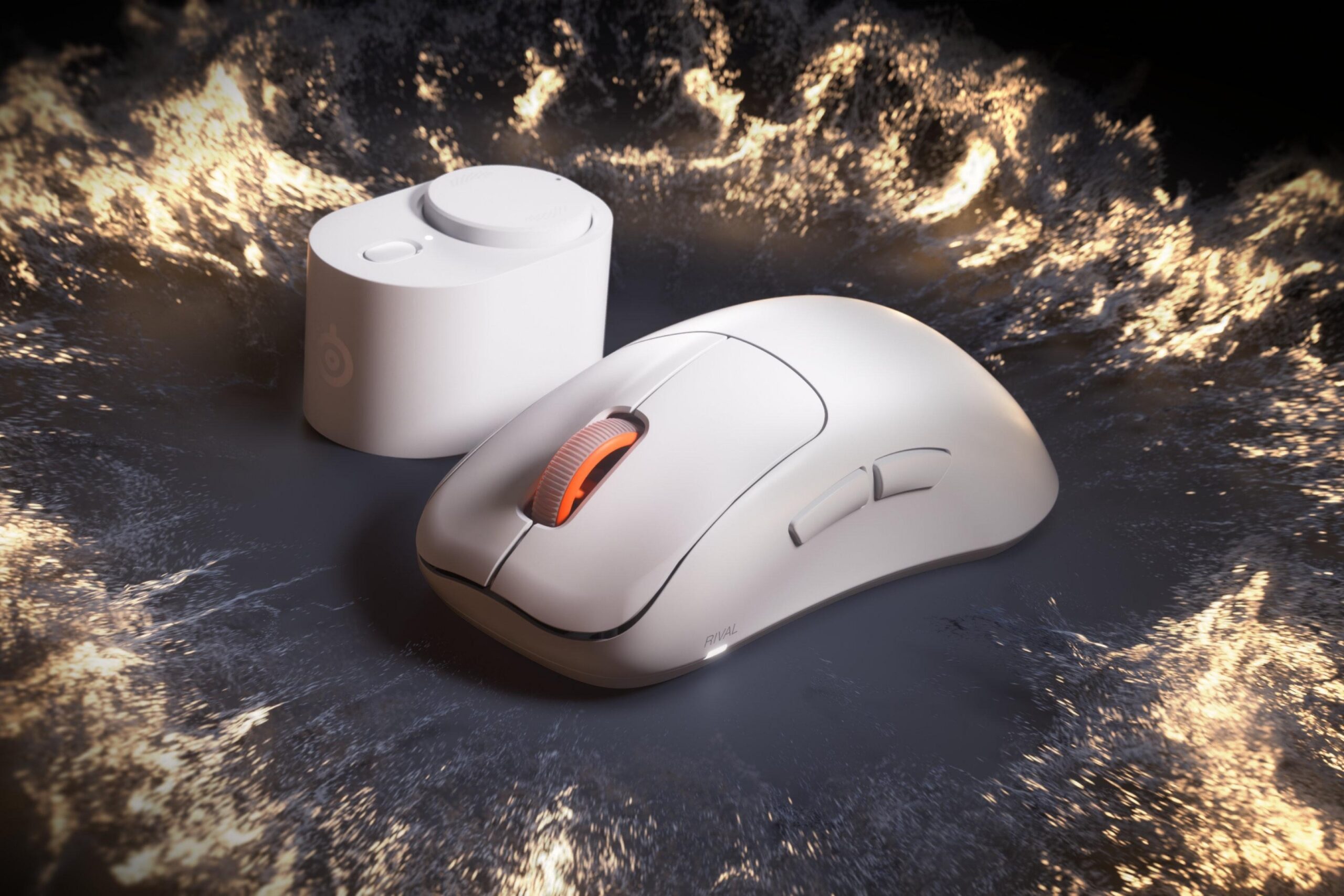
SteelSeries Rival Pro and Sensei Pro wireless gaming mice bring 53-gram chassis designs, swappable round batteries, and ultra-wideband base stations to the high-performance peripheral market for $179.99 USD direct from SteelSeries and major retailers. Engineered for competitive desktop players who demand consistent polling rates without traditional cable drag, these professional-tier mice prioritize sustained high-frequency data transmission and field serviceability over built-in lithium-ion longevity.
🛒 Where to Buy: SteelSeries Rival Pro
Editorial Note & Product Verification: The Cool Great Buys editorial desk independently verifies manufacturer technical specifications, cross-checks active retail availability across authorized sellers, and evaluates verified consumer reliability data before publishing product evaluations. All featured prices and promotions reflect active market rates at the time of publication.
- SteelSeries Rival Pro: View on Amazon
Click the link above to check current pricing, availability, and customer reviews on Amazon.
The core proposition here involves cutting cable weight while addressing the inevitable degradation of sealed internal power cells. Rather than forcing users to plug in a charging cable mid-match, SteelSeries builds these peripherals around interchangeable cylindrical batteries that swap in seconds. For desk setups where uncompromised tracking matters more than minimalist weight minimalism, this release targets enthusiasts who are tired of throwing away expensive hardware when internal batteries finally lose their charge. Initial product disclosures and reporting were tracked via Theverge.
Reviewing the official launch documentation reveals engineering priorities focused heavily on RF stability and power delivery. According to technical specifications published by the manufacturer, the transition from standard 2.4GHz radio bands to ultra-wideband frequencies between 6.4GHz and 9.056GHz aims to eliminate the packet loss common in congested urban desktop environments. Hardware analysts tracking peripheral evolution will note that this approach attempts to solve bandwidth constraints at the physical transmission layer rather than relying purely on software filtering. By carving out a wider slice of the spectrum, the mouse can transmit raw tracking data with zero noticeable input delay, bypassing the saturation and interference that routinely plague crowded tournament floors or densely populated apartment buildings where dozens of wireless routers and Bluetooth devices compete for the same narrow 2.4GHz airspace.
Delving deeper into the physical architecture of both the Rival Pro and the Sensei Pro uncovers a masterclass in weight distribution and ergonomic refinement. Shaving the physical frame down to a feathery 53 grams without compromising structural integrity requires advanced injection molding techniques and carefully placed internal cutouts. The outer shell utilizes a high-grade polymer matrix that resists flex and maintains a secure, sweat-resistant grip during intense, high-APM gaming sessions. While the ergonomic contour of the Rival Pro caters naturally to right-handed palm and claw grips with its carefully sculpted thumb groove and sloping right side, the Sensei Pro maintains a classic, fully ambidextrous profile. This symmetric shape accommodates fingertip and claw users alike, ensuring that left-handed players or those who favor traditional ambidextrous symmetry are not left behind in the quest for ultra-lightweight performance.
Upfront Investment & 2-Year Total Cost of Ownership
Purchasing either the SteelSeries Rival Proor the SteelSeries Sensei Prorequires an initial outlay of $179.99 USD at authorized retail channels. That price covers the primary mouse, the dedicated ultra-wideband base station, and a secondary circular battery designed to keep charging in the dock while the primary cell is inside the mouse. Miniature versions of both form factors are available at the identical $179.99 USD price point, giving users smaller physical dimensions without any discount on the engineering overhead.
Calculating the true two-year cost of ownership requires looking beyond the initial box price. Because the primary and secondary circular batteries are user-swappable and designed to be cycled constantly, their chemical lifespans will dictate long-term maintenance. Lithium-ion cells rated for intensive discharge cycles typically maintain healthy capacities for roughly 500 charge cycles before dropping below 80 percent retention. Replacing a proprietary battery pack outside of warranty adds minor accessory costs down the road, though the modular design ensures the main peripheral shell outlives its consumable power source.
When evaluating this financial commitment against standard peripheral lifecycles, a fascinating economic narrative emerges. Traditional high-end gaming mice frequently end up in electronic waste bins after three to four years simply because their internal lithium-ion batteries refuse to hold a charge, rendering a perfectly functional optical sensor and microswitch array obsolete. By designing the Rival Pro and Sensei Pro with easily removable power cylinders, SteelSeries fundamentally alters this obsolescence curve. Even if a battery pack degrades after heavy multi-year usage, purchasing a fresh replacement cell costs a fraction of a brand-new mouse. This circular design philosophy appeals directly to budget-conscious enthusiasts who view high-end peripherals as long-term investments rather than disposable yearly upgrades, offsetting the steep initial purchase price over an extended operational window.
Furthermore, the inclusion of the multi-functional base station in the box mitigates the need for aftermarket charging docks or specialized desk mats. This hardware hub not only maintains a constant trickle charge for the secondary power cylinder but also acts as the physical transceiver for the ultra-wideband signal, ensuring optimal line-of-sight positioning close to the desktop surface. By placing the receiver inches away from the mousepad rather than plugged into the back of a distant desktop tower, the system maintains rock-solid packet delivery and virtually eliminates any possibility of radio frequency interference caused by metal computer chassis or tangled cable bundles beneath the desk.
What You Actually Get: Core Features & Build Specs
Out of the box, both the ergonomic Rival Pro and the ambidextrous Sensei Pro weigh an astonishingly light 53 grams for the black colorway, with the white variants adding exactly one gram to reach 54 grams due to pigment density. The inclusion of the ultra-wideband base station acts as both the wireless receiver and a dedicated charging dock that houses a spare battery. This hardware layout removes the need for clumsy desk-bound charging cables during active gaming sessions.
The communication architecture relies on ultra-wideband spectrum allocation spanning 6.4GHz to 9.056GHz. SteelSeries claims this dedicated spectrum provides twenty times the bandwidth of traditional consumer mice, enabling sustained polling rates up to 8,000Hz. However, pushing that extreme polling rate results in a battery drain that yields roughly 16 hours of continuous use per battery. Dropping the polling frequency down to a more standard 1,000Hz extends that endurance rating to 60 hours per cell.
Underneath the primary click plates, both models utilize current-generation optical-magnetic switches rated for an incredible 100 million clicks. These switches eliminate mechanical bounce and debounce delay, ensuring that actuation register times happen instantaneously upon pressing the shell. Combined with the flagship TrueMove Pro+ sensor engine tracking at up to 30,000 CPI, 750 IPS, and 50G acceleration, the tracking precision is nothing short of surgical. Whether you are executing microscopic crosshair micro-adjustments in tactical shooters or sweeping across multiple monitors in fast-paced strategy titles, the sensor translates every physical hand movement into digital coordinates with absolute fidelity.
The glide feet attached to the bottom of the chassis are made from 100 percent virgin-grade PTFE, rounded smoothly at the edges to prevent any abrasive scratching or snagging against textured cloth mousepads. This results in an effortless, frictionless glide that preserves the user’s natural muscle memory and reduces wrist fatigue during long gaming sessions. Additionally, the scroll wheel features a tactile, defined step encoder that prevents accidental scrolling while providing clean, tactile feedback during weapon switching or inventory management.
Hidden Costs, hardware environment Dependencies & Fine Print
Real-world utilization of these mice exposes immediate software dependencies that buyers must consider. Customizing polling rates, DPI stages, and macro assignments requires interacting with the SteelSeries GG application. Fortunately, the company has introduced a browser-based web app accessible through Chrome or Edge, allowing firmware updates and basic configuration changes without installing heavy background software suites. This web utility reduces bloatware concerns for users who prefer keeping clean operating system environments.
The fine print regarding battery endurance demands careful attention. In real-world testing conditions running at the maximum 8,000Hz polling rate, users will find themselves swapping cells multiple times a week. While the base station keeps a spare charged, forgetting to return a depleted battery to the dock leaves you vulnerable to sudden power loss. Furthermore, running maximum polling rates places a noticeable burden on system processors, requiring SteelSeries to introduce SuperSync inside the companion software to decouple click reporting from sensor polling.
Another subtle operational detail involves the physical mechanics of the battery swap door itself. While engineered to eject the cylindrical cell smoothly via a spring-loaded latch, the mechanism requires a brief adjustment period so users do not accidentally drop the tiny battery onto hard flooring during mid-match exchanges. Moreover, because the spare battery lives in the charging dock, maintaining a streamlined desk aesthetic requires managing the dock’s USB-C power connection alongside any other desktop peripherals. Users who despise visible wires on their desk surface will need to route the base station cable cleanly to maintain the minimalist illusion provided by the wireless mouse body.
System resource utilization also warrants a brief mention. While the web-based configuration utility minimizes permanent background bloat, enabling advanced features like smart distance cutoff, angle snapping adjustments, and custom polling tiers still demands momentary CPU overhead during configuration profiles. Competitive players striving for the absolute lowest frame-times and highest framerates in esports titles will want to ensure their gaming rigs are properly optimized to handle the massive interrupt requests generated by continuous 8,000Hz data streams.
Smarter Alternatives at This Price
For shoppers unwilling to commit nearly two hundred dollars to a peripheral tethered to proprietary battery ecosystems, several established market alternatives offer competitive performance. The Logitech G Pro X Superlight 2retails for around $159.99 USD on Amazon and remains the gold standard for lightweight ambidextrous handling. It features an integrated lithium battery rated for up to 95 hours of continuous battery life, eliminating the need for physical battery swaps entirely, though its internal battery cannot be easily replaced by the user once degraded.
Another compelling choice is the Razer Viper V3 Pro, priced at $159.99 USD on Amazon. This ergonomic contender delivers exceptional optical sensor tracking and native 8,000Hz polling out of the box without requiring specialized ultra-wideband base hardware. While both Razer and Logitech alternatives lack the modular battery serviceability of the SteelSeries lineup, they provide simpler out-of-box workflows and proven multi-day battery endurance for users who dislike managing charging docks.
When stacking the SteelSeries pairing directly against these formidable industry titans, the purchasing decision ultimately hinges on user philosophy regarding device maintenance. Competitors like Logitech and Razer prioritize multi-day endurance and sealed lightweight shells, which appeal heavily to mainstream gamers who prefer plugging in a single USB-C cable overnight once every week or two. However, those sealed designs mean that when the internal lithium-ion cell inevitably dies after years of deep discharge cycles, the entire mouse becomes electronic waste. The SteelSeries proposition asks users to embrace a minor maintenance routine—swapping a small battery cylinder every couple of days—in exchange for a peripheral that can theoretically last a decade with simple battery replacements.
Price considerations also play a subtle role here. At $179.99 USD, the Rival Pro and Sensei Pro sit twenty dollars higher than both the Logitech G Pro X Superlight 2 and the Razer Viper V3 Pro. That price premium covers the inclusion of the dedicated ultra-wideband hardware base station, the secondary backup battery, and the complex mechanical engineering required to build a hot-swappable battery hatch into a sub-55-gram chassis. For enthusiasts who appreciate over-engineered hardware solutions, the extra cost is easily justified; for budget-conscious buyers seeking pure plug-and-play simplicity, the slightly cheaper alternatives offer a more streamlined daily experience.
Final Buyer Verdict: Is the Investment Worth It?
The SteelSeries Rival Pro and Sensei Pro succeed in pushing physical mouse design forward by solving the twin problems of cable drag and battery degradation. By pairing an ultra-lightweight 53-gram shell with a hot-swappable power architecture and ultra-wideband connectivity, SteelSeries delivers a genuinely unique hardware package for competitive enthusiasts. If you value zero downtime and refuse to let integrated batteries dictate the lifespan of your high-end hardware, these models justify their premium price point.
However, casual desktop users and players who prefer set-and-forget battery life should look elsewhere. The frequent battery management required at 8,000Hz polling combined with the steep $179.99 USD price makes these mice a niche investment intended strictly for hardcore competitors. If you demand absolute peak polling consistency and love modular hardware, buy it; if you want long standalone battery endurance without maintaining a desktop charging dock, skip it.
Ultimately, the Rival Pro and Sensei Pro represent a bold engineering experiment that largely succeeds in redefining how we power ultra-lightweight gaming peripherals. They prove that achieving extreme weight reduction does not require permanently sealing components inside a disposable plastic shell. By embracing modularity and current-generation ultra-wideband transmission, SteelSeries has created a pair of specialized tools designed for players who treat their gear with uncompromising technical scrutiny. If you are willing to embrace the slight ritual of swapping power cylinders in exchange for infinite hardware longevity and pristine wireless signal stability, these mice stand ready to elevate your competitive desktop setup.